Turkey’s tighter residency rules leave more Iranians in limbo
Turkey’s tougher residency rules are leaving growing numbers of Iranians facing legal uncertainty, financial losses and difficult choices over whether they can remain in a country that was once among their most accessible migration destinations.
The Iranian newspaper Shargh reported on Thursday that many Iranians in Turkey have had residency renewals rejected, seen sudden changes to their legal status or, in some cases, been ordered to leave the country.
The report said some had rented homes, bought property or established businesses under rules that previously offered a relatively predictable path to renewing short-term residency permits.
Turkey became a major destination for Iranian migrants over the past decade because of its proximity, visa-free short visits and relatively accessible residency procedures.
File photo shows pedestrians walking along a shopping street in the Turkish city of Van, a popular destination for Iranian visitors.
Turkey’s tougher residency rules are leaving growing numbers of Iranians facing legal uncertainty, financial losses and difficult choices over whether they can remain in a country that was once among their most accessible migration destinations.
The Iranian newspaper Shargh reported on Thursday that many Iranians in Turkey have had residency renewals rejected, seen sudden changes to their legal status or, in some cases, been ordered to leave the country.
The report said some had rented homes, bought property or established businesses under rules that previously offered a relatively predictable path to renewing short-term residency permits.
Turkey became a major destination for Iranian migrants over the past decade because of its proximity, visa-free short visits and relatively accessible residency procedures.
Thousands of Iranians moved there for work, study, investment or family reasons, settling in cities such as Istanbul, Izmir, Antalya and Alanya.
According to Shargh, the situation began to change after the COVID-19 pandemic, as Ankara tightened migration policies affecting many categories of foreign residents.
One Iranian identified as Sina told the newspaper that immigration officials ordered him to leave Turkey for six months despite renting a home in Izmir for four years.
"I kept explaining that I had rented a house here and they couldn't do this," Sina said. "They behaved politely but kept repeating the same thing. In the end, they said if I objected, I should hire a lawyer."
Another Iranian, Reza, told Shargh he moved to Istanbul with his wife and daughter in 2021 after spending his family's savings on renting a home, furnishing it and registering a company.
When the family applied to renew their residency a year later, officials rejected the application without providing a detailed explanation despite what he described as complete documentation.
Maryam, a fashion designer who opened a small workshop in Antalya, said uncertainty over her residency prevented her from expanding her business or planning for the future.
Iranians make their way after crossing into Turkey in Van province, March 3, 2026.
Tougher enforcement
An immigration lawyer interviewed by Shargh said the changes largely reflect stricter implementation of existing rules rather than major amendments to Turkish immigration law.
The lawyer said short-term residency is not an automatic right and Turkish authorities have broad discretion to approve or reject applications after assessing individual circumstances.
Higher migration following the pandemic, pressure on the housing market, changing security and demographic priorities and restrictions on registering foreign residents in parts of major cities all contributed to tighter enforcement, the lawyer said.
The lawyer also cautioned that renting or purchasing property no longer guarantees residency and advised applicants seeking long-term stays to consider more stable legal pathways such as work permits, student visas or qualifying investment programs. Applicants whose requests are rejected generally retain the right to challenge the decisions before Turkey's administrative courts.
The experiences described by Shargh mirror accounts gathered by the Associated Press following months of conflict involving Iran, Israel and the United States, with many Iranians in Turkey describing growing uncertainty over both their legal status and finances.
"There are people who have lived on them for over 10 years," Sedat Albayrak of the Istanbul Bar Association's Refugee and Migrant Rights Center told AP in April, referring to Iranians relying on renewable short-term residence permits instead of obtaining more permanent legal status.
People walk on a small street that leads to the historical Galata Tower in Istanbul.
Nearly 100,000 Iranians lived in Turkey in 2025, according to the Turkish Statistical Institute.
The United Nations refugee agency says around 89,000 Iranians entered Turkey after the conflict began, while roughly 72,000 later departed, indicating that many crossed the border only temporarily or continued to third countries where they already held residency or citizenship.
Conflict compounds financial strain
For many Iranian residents, the recent conflict has intensified economic pressures already created by tighter immigration rules.
Nadr Rahim, who has lived in Turkey for 11 years, told AP his family depended on income from a motorcycle showroom in Iran because obtaining permission to work legally in Turkey remained difficult. Sales largely stopped after the fighting began, while internet disruptions complicated financial transfers.
"If the war continues, we will have no choice but to return," Rahim told AP. His children have grown up in Turkey and speak Persian only with difficulty, making the prospect of returning especially challenging.
Another Iranian woman, who requested anonymity, told AP she enrolled at a Turkish university mainly to secure a student visa while working long hours in service jobs to support relatives in Iran.
"I have a bad life in Turkey, and my parents have a bad life in Iran," she said. "I came to Turkey with so much hope, to support my parents and build a future. But now I feel hopeless."
AP also reported that some families have been separated because of residency complications. Bakery worker Sadri Haghshenas said her daughter returned to Tehran after the family missed a residency application deadline and feared deportation proceedings could jeopardize her chances of returning legally to Turkey.
Easy to visit, harder to stay
For Iranians hoping to settle in Turkey, obtaining or renewing residency has become increasingly difficult. Yet for many others, the country continues to serve as the nearest and most accessible destination outside Iran.
The Wall Street Journal reported on June 26 that traffic through the Kapikoy border crossing near Van has begun returning to prewar levels following the ceasefire, with Iranian visitors once again traveling to eastern Turkey for shopping, leisure and entertainment.
People shop at Grand Bazaar in Istanbul, Turkey, November 4, 2022.
Nightclub manager Hüseyin Aşan told the newspaper business at his venue, which caters largely to Iranian visitors, fell by about 70% during the conflict but has since begun recovering.
"We just came from a war, so we're going to have some fun," a visitor from Tehran told the newspaper after crossing into Turkey for a week's holiday.
Others remained uncertain about what awaited them at home. A 27-year-old medical laboratory technician returning to Iran after vacationing in Turkey told the Wall Street Journal: "I don't know who won the war, but the people lost."
Astate-TV commentator’s claim that factions want to dissolve the IRGC has revived debate over Iran’s dual military structure, the Guards’ expanding political and economic role, and whether the army-IRGC system remains an asset after a war that exposed its reach and costs.
Kharratian has often argued that Iran must preserve what he sees as its strategic leverage in any confrontation or negotiation with Washington, including its military and nuclear capabilities, control over pressure points such as the Strait of Hormuz, the impact of oil prices and political divisions inside the United States.
His latest remarks have triggered debate across Iranian media and social networks.
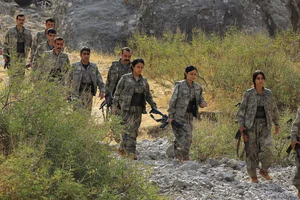
Iran’s Revolutionary Guards said on Thursday that they killed a five-member armed team in an ambush in the border heights of Piranshahr in northwestern Iran.
The IRGC said the team had entered Iran’s northwestern border areas a day earlier, adding that bodies, weapons and equipment were recovered after the clash.
Kurdish armed groups have long been active in parts of northwestern Iran, particularly in border areas of West Azarbaijan and Kordestan provinces, where IRGC forces regularly report clashes.
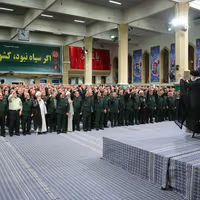
IRGC commanders meeting Iran's late Supreme Leader ali Khamenei in September 2007
A state-TV commentator’s claim that factions want to dissolve the IRGC has revived debate over Iran’s dual military structure, the Guards’ expanding political and economic role, and whether the army-IRGC system remains an asset after a war that exposed its reach and costs.
Kharratian has often argued that Iran must preserve what he sees as its strategic leverage in any confrontation or negotiation with Washington, including its military and nuclear capabilities, control over pressure points such as the Strait of Hormuz, the impact of oil prices and political divisions inside the United States.
His latest remarks have triggered debate across Iranian media and social networks.
Some experts interviewed by Iran International said any restructuring of the IRGC would likely amount to little more than a rebranding exercise, preserving the Guards’ power while trying to shed some of their political and economic baggage.
Others see the debate as a sign that Iran’s leadership understands the country cannot emerge from the recent war unchanged.
Proposal predates the war
The discussion is not entirely new. Shortly before the outbreak of the recent war, the moderate daily Jomhouri-e Eslami proposed merging the IRGC into the regular army, arguing that Iran’s security and economic conditions required a review of the country’s military structure.
The newspaper said such a move could create a more coherent defense system. But its argument went beyond military organization.
The article also criticized the IRGC’s growing reach outside the battlefield, including its role in the economy, politics, media and parts of diplomacy.
It said that expansion had not produced greater national power or strategic cohesion, but had instead given the IRGC the image of a controversial, factional and multifaceted institution.
Domestically, the newspaper argued, the Guards had become a source of political dispute.
Abroad, it said, their expanded role had given Iran’s adversaries a pretext for pressure, sanctions and costly decisions against Iran’s national interests.
Hardline backlash
Jomhouri-e Eslami’s proposal drew an immediate backlash from conservative media.
The hardline newspaper Kayhan described the idea as “a project to eliminate the IRGC,” comparing it to what it called US and Israeli efforts to dismantle Iraq’s Popular Mobilization Forces.
It dismissed the proposal as “not an expert discussion,” but rather a continuation of foreign projects aimed at weakening what it called the Islamic Republic’s defensive arm.
Abdollah Ganji, the former managing director of the IRGC-affiliated newspaper Javan, also denounced Jomhouri-e Eslami on X, calling it “a polluted mouthpiece.”
He wrote that raising such an idea while the country faced the threat of war was, “even if it is not evidence of enemy infiltration, evidence of catastrophically flawed understanding.”
Arguments for restructuring
Not all commentary rejected the idea. The website Eghtesad 24 argued that, given the IRGC’s designation as a terrorist organization by the United States and the European Union, some analysts viewed a merger with the regular army as a possible way to reduce legal and diplomatic pressure on Iran.
The outlet wrote that “merging the army and the IRGC could, from the perspective of reducing legal and international pressure, be worthy of consideration,” adding that such a move could reduce some of the diplomatic costs created by those designations.
It also referred to an earlier claim by IRGC commander Hassan Kazemi that the United States had demanded the dissolution of the IRGC and its integration into the regular army.
Social media reflects sharp divisions
The issue has circulated on Iranian social media for months, where hardline users have recently accused senior officials involved in negotiations, including Parliament Speaker Mohammad Bagher Ghalibaf and members of President Masoud Pezeshkian’s administration, of trying to sideline revolutionary forces and even plotting a coup.
One X user wrote: “The final stage of the coup is dissolving the IRGC and merging the armed forces.”
Another said: “You’ll take the dream of dissolving the IRGC to your grave.”
A third argued that Kharratian’s remark alone was enough to show that “the coup plotters signed Iran’s destruction and partition long ago,” adding that dissolving the IRGC would mean disarming the Islamic Revolution and stripping it of legitimacy.
Others voiced a different concern. They argued that if a merger ever took place, it would not produce a more conventional national army, but would instead amount to the regular army being absorbed into the IRGC, turning the unified force into an ideological military organization.
A recurring debate
The idea of dissolving the IRGC or merging it with the regular army dates back to the early years of the Islamic Republic under Ruhollah Khomeini.
No merger took place. But in 1989, Iran merged the Ministry of Defense and the Ministry of the IRGC as part of an administrative, budgetary and logistical restructuring, while leaving the two forces institutionally separate.
The General Staff of the Armed Forces was also established to coordinate strategy, assign responsibilities and oversee the military.
Later that year, Iran’s new supreme leader, Ali Khamenei, emphasized that both the IRGC and the regular army should be preserved, and that neither should be sacrificed for the other.
Months later, he sought to settle the debate by defining the IRGC’s primary mission as defending the Islamic Revolution and the Islamic Republic, while assigning the regular army responsibility for defending Iran’s borders.
Iranian President Masoud Pezeshkian said on Thursday that the death of late Supreme Leader Ali Khamenei marked the beginning of a new chapter of national unity.
In a message ahead of Khamenei’s funeral, Pezeshkian said his death in US-Israeli airstrikes on February 28 was “not the end of the road, but the beginning of a new chapter of solidarity, resilience and growth.”
He said the ceremony would show the world that Iranians stood united in defense of the country, adding a large public turnout would be a firm response to “the logic of terror, violence and bullying.”