• العربية
  • فارسی
Brand
  • Iran Insight
  • Politics
  • Economy
  • Analysis
  • Special Report
  • Opinion
  • Podcast
  • Iran Insight
  • Politics
  • Economy
  • Analysis
  • Special Report
  • Opinion
  • Podcast
  • Theme
  • Language
    • العربية
    • فارسی
  • Iran Insight
  • Politics
  • Economy
  • Analysis
  • Special Report
  • Opinion
  • Podcast
All rights reserved for Volant Media UK Limited
volant media logo

IRGC says it killed five armed men near northwest border

Jul 2, 2026, 10:56 GMT+1Updated: 14:02 GMT+1

Iran’s Revolutionary Guards said on Thursday that they killed a five-member armed team in an ambush in the border heights of Piranshahr in northwestern Iran.

The IRGC said the team had entered Iran’s northwestern border areas a day earlier, adding that bodies, weapons and equipment were recovered after the clash.

Kurdish armed groups have long been active in parts of northwestern Iran, particularly in border areas of West Azarbaijan and Kordestan provinces, where IRGC forces regularly report clashes.

Most Viewed

Khamenei to end Eje'i’s judiciary tenure after one term
1
EXCLUSIVE

Khamenei to end Eje'i’s judiciary tenure after one term

2

How Trump decided to strike Iran, new book reveals final hours

3

IRGC moves to seize historic Protestant church in Tehran

4

Iranians barely visible in US-Iran deal, UN rapporteur says

5

Iran parliament cries censorship after Ghalibaf interview cut short

Banner
Banner
Banner

Spotlight

  • Talk of dissolving IRGC revives debate over Iran's dual military

    Talk of dissolving IRGC revives debate over Iran's dual military

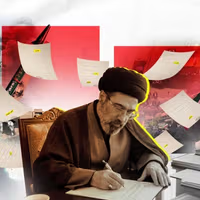
  • Mojtaba Khamenei’s key word for Iran’s future: a people given a mission
    ANALYSIS

    Mojtaba Khamenei’s key word for Iran’s future: a people given a mission

  • Iran parliament cries censorship after Ghalibaf interview cut short

    Iran parliament cries censorship after Ghalibaf interview cut short

  • How Trump decided to strike Iran, new book reveals final hours

    How Trump decided to strike Iran, new book reveals final hours

  • Khamenei to end Eje'i’s judiciary tenure after one term
    EXCLUSIVE

    Khamenei to end Eje'i’s judiciary tenure after one term

  • Iran among top foreign espionage threats to Germany, security report says

    Iran among top foreign espionage threats to Germany, security report says

  • Two-week banking disruption leaves Iranians struggling to access money
    VOICES FROM IRAN

    Two-week banking disruption leaves Iranians struggling to access money

•
•
•

More Stories

Talk of dissolving IRGC revives debate over Iran's dual military

Jul 2, 2026, 10:42 GMT+1
•
Maryam Sinaiee
Talk of dissolving IRGC revives debate over Iran's dual military
100%
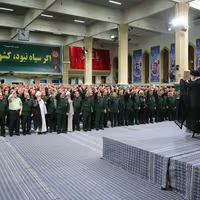
IRGC commanders meeting Iran's late Supreme Leader ali Khamenei in September 2007

A state-TV commentator’s claim that factions want to dissolve the IRGC has revived debate over Iran’s dual military structure, the Guards’ expanding political and economic role, and whether the army-IRGC system remains an asset after a war that exposed its reach and costs.

Kharratian has often argued that Iran must preserve what he sees as its strategic leverage in any confrontation or negotiation with Washington, including its military and nuclear capabilities, control over pressure points such as the Strait of Hormuz, the impact of oil prices and political divisions inside the United States.

His latest remarks have triggered debate across Iranian media and social networks.

  • Is Tehran preparing to reinvent the IRGC?

    Is Tehran preparing to reinvent the IRGC?

Some experts interviewed by Iran International said any restructuring of the IRGC would likely amount to little more than a rebranding exercise, preserving the Guards’ power while trying to shed some of their political and economic baggage.

Others see the debate as a sign that Iran’s leadership understands the country cannot emerge from the recent war unchanged.

Proposal predates the war

The discussion is not entirely new. Shortly before the outbreak of the recent war, the moderate daily Jomhouri-e Eslami proposed merging the IRGC into the regular army, arguing that Iran’s security and economic conditions required a review of the country’s military structure.

The newspaper said such a move could create a more coherent defense system. But its argument went beyond military organization.

The article also criticized the IRGC’s growing reach outside the battlefield, including its role in the economy, politics, media and parts of diplomacy.

It said that expansion had not produced greater national power or strategic cohesion, but had instead given the IRGC the image of a controversial, factional and multifaceted institution.

Domestically, the newspaper argued, the Guards had become a source of political dispute.

Abroad, it said, their expanded role had given Iran’s adversaries a pretext for pressure, sanctions and costly decisions against Iran’s national interests.

Hardline backlash

Jomhouri-e Eslami’s proposal drew an immediate backlash from conservative media.

The hardline newspaper Kayhan described the idea as “a project to eliminate the IRGC,” comparing it to what it called US and Israeli efforts to dismantle Iraq’s Popular Mobilization Forces.

It dismissed the proposal as “not an expert discussion,” but rather a continuation of foreign projects aimed at weakening what it called the Islamic Republic’s defensive arm.

  • Iran ultra-hardliners accuse Ghalibaf, Pezeshkian of ‘coup’ over US deal

    Iran ultra-hardliners accuse Ghalibaf, Pezeshkian of ‘coup’ over US deal

Abdollah Ganji, the former managing director of the IRGC-affiliated newspaper Javan, also denounced Jomhouri-e Eslami on X, calling it “a polluted mouthpiece.”

He wrote that raising such an idea while the country faced the threat of war was, “even if it is not evidence of enemy infiltration, evidence of catastrophically flawed understanding.”

Arguments for restructuring

Not all commentary rejected the idea. The website Eghtesad 24 argued that, given the IRGC’s designation as a terrorist organization by the United States and the European Union, some analysts viewed a merger with the regular army as a possible way to reduce legal and diplomatic pressure on Iran.

The outlet wrote that “merging the army and the IRGC could, from the perspective of reducing legal and international pressure, be worthy of consideration,” adding that such a move could reduce some of the diplomatic costs created by those designations.

It also referred to an earlier claim by IRGC commander Hassan Kazemi that the United States had demanded the dissolution of the IRGC and its integration into the regular army.

Social media reflects sharp divisions

The issue has circulated on Iranian social media for months, where hardline users have recently accused senior officials involved in negotiations, including Parliament Speaker Mohammad Bagher Ghalibaf and members of President Masoud Pezeshkian’s administration, of trying to sideline revolutionary forces and even plotting a coup.

One X user wrote: “The final stage of the coup is dissolving the IRGC and merging the armed forces.”

Another said: “You’ll take the dream of dissolving the IRGC to your grave.”

A third argued that Kharratian’s remark alone was enough to show that “the coup plotters signed Iran’s destruction and partition long ago,” adding that dissolving the IRGC would mean disarming the Islamic Revolution and stripping it of legitimacy.

Others voiced a different concern. They argued that if a merger ever took place, it would not produce a more conventional national army, but would instead amount to the regular army being absorbed into the IRGC, turning the unified force into an ideological military organization.

A recurring debate

The idea of dissolving the IRGC or merging it with the regular army dates back to the early years of the Islamic Republic under Ruhollah Khomeini.

No merger took place. But in 1989, Iran merged the Ministry of Defense and the Ministry of the IRGC as part of an administrative, budgetary and logistical restructuring, while leaving the two forces institutionally separate.

The General Staff of the Armed Forces was also established to coordinate strategy, assign responsibilities and oversee the military.

Later that year, Iran’s new supreme leader, Ali Khamenei, emphasized that both the IRGC and the regular army should be preserved, and that neither should be sacrificed for the other.

Months later, he sought to settle the debate by defining the IRGC’s primary mission as defending the Islamic Revolution and the Islamic Republic, while assigning the regular army responsibility for defending Iran’s borders.


Pezeshkian says Khamenei death opens new chapter of unity

Jul 2, 2026, 10:10 GMT+1

Iranian President Masoud Pezeshkian said on Thursday that the death of late Supreme Leader Ali Khamenei marked the beginning of a new chapter of national unity.

In a message ahead of Khamenei’s funeral, Pezeshkian said his death in US-Israeli airstrikes on February 28 was “not the end of the road, but the beginning of a new chapter of solidarity, resilience and growth.”

He said the ceremony would show the world that Iranians stood united in defense of the country, adding a large public turnout would be a firm response to “the logic of terror, violence and bullying.”

Iran warns US over Strait of Hormuz

Jul 2, 2026, 09:28 GMT+1

Iran's Khatam al-Anbiya Central Headquarters said on Thursday that any US "intervention" in the Strait of Hormuz would draw a "swift and decisive" response from Iran's armed forces.

The headquarters said the Strait of Hormuz was "not a playground for the aggressive United States" but "territory under the sovereign authority of the Islamic Republic of Iran."

It said all oil tankers and commercial vessels must use routes designated by Iran when transiting the strait, warning that any vessel that failed to follow Iran's navigation protocols would face an "immediate and powerful" response.

The headquarters also said continued flights by US manned and unmanned aircraft over the Strait of Hormuz threatened security in the waterway and the wider region.

Iran ultra-hardliners accuse Ghalibaf, Pezeshkian of ‘coup’ over US deal

Jul 2, 2026, 09:25 GMT+1

Iran’s ultra-hardliners have escalated their campaign against the US-Iran memorandum, accusing Parliament Speaker Mohammad Bagher Ghalibaf and President Masoud Pezeshkian of forcing through a deal they say amounts to a “coup” against the line of the slain Supreme Leader.

The accusations come from the most hardline wing of Iran’s conservative camp, including the Paydari Party and supporters of Saeed Jalili, and mark the latest escalation in a long-running power struggle inside the establishment.

The US-Iran memorandum has deepened that rift, exposing a widening divide between pragmatic conservatives aligned with Ghalibaf and factions that reject any compromise with Washington.

With more conservatives moving closer to Pezeshkian’s administration, Jalili’s camp appears increasingly worried that it is being pushed to the margins.

Continue reading

Iran ultra-hardliners accuse Ghalibaf, Pezeshkian of ‘coup’ over US deal

Jul 2, 2026, 08:55 GMT+1
•
Maryam Sinaiee
Iran ultra-hardliners accuse Ghalibaf, Pezeshkian of ‘coup’ over US deal
100%
A group of female ultra-hardliners staging a sit-in near the place Supreme Leader Ali Khamenei was killed on February 28 in protest to MoU signed with the United States

Iran’s ultra-hardliners have escalated their campaign against the US-Iran memorandum, accusing Parliament Speaker Mohammad Bagher Ghalibaf and President Masoud Pezeshkian of forcing through a deal they say amounts to a “coup” against the position of the slain Supreme Leader.

The accusations come from the most hardline wing of Iran’s conservative camp, including the Paydari Party and supporters of Saeed Jalili, and mark the latest escalation in a long-running power struggle inside the establishment.

The US-Iran memorandum has deepened that rift, exposing a widening divide between pragmatic conservatives aligned with Ghalibaf and factions that reject any compromise with Washington.

With more conservatives moving closer to Pezeshkian’s administration, Jalili’s camp appears increasingly worried that it is being pushed to the margins.

Old rivalries flaring up

The latest controversy began Tuesday when hardline lawmaker Mahmoud Nabavian posted a blunt warning on X: “People of Iran, is a coup underway?”

Nabavian argued the Supreme Leader’s 10 conditions for negotiations had been ignored and that the memorandum with the United States had been forced through despite his objections.

A day earlier, he wrote that what officials described as the country’s interest, despite the Leader’s opposition, was “not expediency but the very essence of corruption.”

The remarks triggered a fierce conservative backlash.

Mojtaba Zarei, a Tehran lawmaker considered close to Ghalibaf, dismissed the accusation as the fantasy of the super-revolutionary camp and an election slogan aimed at rivals.

Citing reports that around 60 Paydari-affiliated lawmakers planned to stage a sit-in outside parliament, Zarei said parliament’s leadership, the Supreme National Security Council and other lawmakers had thwarted what he called an election-driven attempt by a “super-revolutionary” party to seize parliament in the style of Eastern Europe’s color revolutions.

Parliament dispute fuels tensions

Paydari lawmakers have denounced the suspension of parliamentary sessions for more than 120 days since the war began, saying the closure has stripped parliament of its oversight role at a critical moment.

Unverified social media reports suggested that security agencies pressured some legislators to drop plans for a sit-in, while separate reports claimed hardline lawmaker Hamid Rasaei was briefly detained for several hours.

Still, around a dozen lawmakers gathered outside parliament on Tuesday in protest, according to social media reports.

Rouydad24 reported that one of the group’s main aims in forcing parliament back into session is to pass legislation asserting full Iranian control over the Strait of Hormuz, a step that could create new obstacles for implementing the US-Iran memorandum.

'Coup' accusations dominate social media

The coup narrative has spread quickly among ultra-hardline activists on social media, where Ghalibaf and Pezeshkian are being portrayed as defying the Supreme Leader’s wishes.

One user said Ghalibaf had known the Supreme Leader’s position but “not only voted against it himself, but persuaded other commanders to do the same.”

Another described a coordinated coup project aimed at weakening revolutionary forces, promoting “begging diplomacy,” ignoring the killing of Shiites in Lebanon and turning Iran into a passive country.

The post concluded that confronting this “silent coup” required exposing those behind it, resisting surrender and returning to the path of resistance.

Security concerns ahead of Khamenei funeral

Some social media posts by supporters of the ultra-hardline faction have raised concerns that they may use the funeral of Supreme Leader Ali Khamenei, scheduled for July 9, to protest against the memorandum.

One ultra-hardliner activist claimed on X that "the coup is advancing; they are only waiting to assassinate the Leader," before adding: "I see no solution other than removing this government and Ghalibaf. Going to Tehran [for the funeral] is the best opportunity."

  • Khamenei mourning site shut as shroud-wearing hardliners expose loyalist rift

    Khamenei mourning site shut as shroud-wearing hardliners expose loyalist rift

The rhetoric echoes a confrontation during this year’s Muharram ceremonies, when security forces dismantled a mourning site near the place where Ali Khamenei was killed.

The site had been occupied for three days by mostly female ultra-hardliners wearing white burial shrouds to signal readiness for death or revenge. The protesters chanted harsh slogans against officials who backed negotiations.

One participant later posted a video accusing “coup agents” of assaulting protesters and seizing their sound equipment.

The footage showed shroud-clad women chanting “Allahu Akbar” as security personnel moved to disperse them.