CENTCOM chief praises US troops who downed Iranian drones
US Central Command Commander Adm. Brad Cooper on Thursday praised American soldiers and sailors assigned to a counter-drone unit in Bahrain for shooting down 14 Iranian one-way attack drones over the past several weeks.
“Today, I was proud to recognize American Soldiers and Sailors assigned to a Joint Counter-Unmanned Aerial System (C-UAS) unit in Bahrain for their exceptional performance,” Cooper said according to a statement CENTCOM posted on X. “The incredible professionalism, skill, and dedication they displayed saved lives.”
A framed portrait of Iran's slain Supreme Leader Ali Khamenei is displayed beside lit candles during a mourning ceremony.
Dozens of messages sent to Iran International say Iranian authorities and state-linked institutions are pressuring workers, businesses and charities to take part in funeral ceremonies for slain Supreme Leader Ali Khamenei.
The accounts describe a broad campaign of workplace directives, business closures and logistical mobilization in the days leading up to Khamenei’s funeral and burial.
The Islamic Republic's second Supreme Leader was killed on the morning of February 28, in the opening hours of the war with Israel and the United States.
More than four months after Khamenei's death, authorities say he will be buried on July 9 following five days of ceremonies across Iran and Iraq. Officials have attributed the unusually long delay to wartime conditions and security concerns, a sign of the political sensitivity and logistical difficulty surrounding the former leader’s burial.
Several messages said that businesses had been warned to close during the ceremonies or face penalties if they remained open.
A portrait of Iran's Supreme Leader Ali Khamenei is displayed on a black-draped ceremonial stand adorned with a mourning banner.
"We received a text message from the real estate union saying we are not allowed to open our office during the funeral days and must attend the ceremonies," one Tehran resident wrote.
Another message from Tehran said members of the Basij visited shops and warned owners that businesses opening during the mourning period would be sealed.
"My parents are shopkeepers. Basij members told our shop and others nearby that if we open during the funeral days, the shop will be sealed," the citizen said.
Others described wider economic disruption linked to the ceremonies.
One Tehran gym owner wrote that officials had instructed fitness centers to close from Saturday through Wednesday.
Another message said Tehran's Grand Bazaar had been ordered shut until Thursday, adding that the prolonged closure would place further pressure on already struggling businesses.
Workers describe mandatory attendance
Several messages added that public-sector employees were ordered to attend official ceremonies.
One Tehran municipality employee said all leave had been canceled and staff across municipal bodies had been ordered to attend the ceremonies.
Another message referred to an audio recording attributed to the human resources director of Tehran Municipality's District 10, which instructed all employees, including parents with young children and workers with serious medical conditions, to attend.
The Hamshahri newspaper group, another citizen said, had instructed management to provide 200 employees for the ceremonies.
Workers at automaker Saipa also described disruptions, with one employee saying overtime had been canceled as company facilities were prepared to accommodate around 2,000 visitors from Iraq attending the funeral.
Charities, restaurants and residents pressured
Messages also pointed to pressure beyond government workplaces.
One message from Nahavand in Hamedan province said local officials summoned charities on Wednesday and demanded they contribute to the funeral, warning that their work could be disrupted if they refused.
Another said that police and Basij members visited restaurants in an industrial town near Tehran and warned owners they must prepare thousands of free meals for mourners or risk closure.
A Tehran resident also reported that text messages encouraged households to host visitors traveling to the capital for the ceremonies.
Extensive state mobilization
Official announcements indicate the authorities are preparing a large logistical operation for the funeral.
The Basij Organization for Guilds said 50 million loaves of bread were being prepared nationwide with the participation of bakers' unions, while 16 mobile bakeries would be deployed across Tehran and surrounding areas to prevent shortages.
Workers arrange decorations during funeral preparations for Iran's former Supreme Leader Ali Khamenei.
Several messages criticized the scale of those preparations, contrasting them with economic hardship and reductions in public support.
"Free trains and hotels are available for their leader's burial, but student food subsidies have been cut," one student wrote.
Another message said bread was being transported from Kerman for the ceremonies, adding that transport resources would face additional pressure.
Iran has announced that funeral processions will begin in Tehran on July 4 before continuing through Qom, Najaf and Karbala ahead of Khamenei's burial in Mashhad on July 9. Authorities have also announced heightened security measures, including temporary airspace restrictions over Tehran and Mashhad during the ceremonies.
The absence of top leaders from major powers at the funeral of Iran's former Supreme Leader Ali Khamenei reflects the country's international isolation, counterterrorism expert Mohammed Omar told Fox News.
"No major power is sending its top leader," Omar, of the George Washington Program on Extremism, told Fox News.
"For a regime that claims to lead a front stretching from Beirut to Sanaa, a regional turnout at its founder-successor's funeral is the isolation showing through the pageantry," he said.
India, despite an invitation from Iranian President Masoud Pezeshkian to Prime Minister Narendra Modi, is sending a delegation led by a deputy foreign minister and a state governor. China and Pakistan have also announced lower-level delegations.
Iranian security forces arrested environmental activists Houman Jokar and Sepideh Kashani at their home on Wednesday and seized their electronic devices, their lawyer said.
Lawyer Hojjat Kermani said Kashani's sister, Sima Kashani, was also arrested. He said it was not immediately clear which security agency had detained the three, according to the Emtedad news website.
Kermani said the arrests, ahead of a long public holiday and the closure of judicial offices, had increased concern among their families.
Iranian security forces arrested environmental activists Houman Jokar and Sepideh Kashani at their home on Wednesday and seized their electronic devices, their lawyer said.
Lawyer Hojjat Kermani said Kashani's sister, Sima Kashani, was also arrested. He said it was not immediately clear which security agency had detained the three, according to the Emtedad news website.
Kermani said the arrests, ahead of a long public holiday and the closure of judicial offices, had increased concern among their families.
Jokar and Kashani were among a group of environmental activists arrested in 2018 by the Revolutionary Guards' intelligence organization. They were later convicted on espionage charges after a case that drew criticism from human rights groups and UN experts over the arrests, interrogations and trial.
Jokar was sentenced to eight years in prison and Kashani to six years. The other defendants were released from Tehran's Evin prison at different times, with the last of them freed in April 2024.
One of the defendants, Iranian-Canadian conservationist Kavous Seyed-Emami, died in custody about a month after his arrest in 2018. Iranian judicial officials said he had killed himself, a conclusion rejected by his family.
The latest arrests come amid reports by rights groups of a new wave of detentions of civil, political and labor activists across Iran following recent unrest and the war with Israel and the United States.
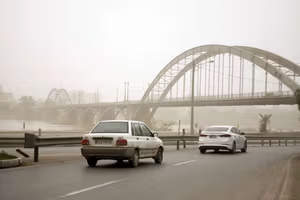
A dust storm has affected large parts of central and eastern Iran this week, with air quality reaching hazardous levels in some areas, visibility falling and authorities closing roads in parts of the country on Thursday.
Air quality monitors showed hazardous pollution levels in parts of Kerman, Yazd, Isfahan, Markazi, Chaharmahal-Bakhtiari, and Sistan-Baluchestan provinces, according to Iranian media.
The sustainable development news site Payam-e Ma reported that air quality index readings reached 500, the highest level on the scale, at several monitoring stations in Kerman province on Thursday morning.
The site said the extent of the dust storm showed it was a regional weather event rather than pollution from local urban or industrial sources.
Experts told the outlet that simultaneous increases in airborne particles across several provinces on Iran's central plateau pointed to weather systems carrying dust across the region.
Repeated droughts, shrinking vegetation cover, dry wetlands and expanding dust sources had increased the frequency and severity of such events, they said.
"From this afternoon, the concentration of dust will gradually decrease," she told state media, adding that skies over the province would remain dusty on Friday, although conditions would improve.
Authorities issue health warnings
Authorities across affected provinces urged residents to stay indoors where possible, wear masks and avoid unnecessary outdoor activity, particularly children, older people and those with heart or lung conditions.
In Isfahan province, crisis management chief Mansour Shishehforoush said a dust mass with domestic origins had entered from Semnan province and northern parts of Isfahan.
"This condition will continue until the end of Thursday," he told IRNA.
He said authorities had ordered temporary restrictions on polluting industrial units and other measures to reduce health risks.
In Yazd province, weather official Ghasem Raji said the dust had spread across most parts of the province from Wednesday afternoon into Thursday morning.
"Horizontal visibility in Yazd city reached the critical level of 500 meters at times today," Raji told Mehr. He said relatively strong winds had carried dust into the province from neighboring areas and warned the conditions would continue through Thursday, disrupting travel.
Police in Kerman province said heavy dust and sharply reduced visibility had forced the closure of roads in both directions in Rigan, Fahraj and Narmashir counties until further notice. Authorities urged motorists to avoid the affected routes, slow down elsewhere in the province and postpone unnecessary travel.
Maryam Salajegheh, a Kerman weather official, said conditions would remain severe until Thursday afternoon.
"From this afternoon, the concentration of dust will gradually decrease," she told state media, adding that skies over the province would remain dusty on Friday, although conditions would improve.
In Chaharmahal and Bakhtiari province, a weather official said dust had moved in from central and neighboring provinces and would persist until early next week.
"With the increase in wind speed in the coming days, dust will intensify," the official, identified by state media as Qatreh, said.