• العربية
  • فارسی
Brand
  • Iran Insight
  • Politics
  • Economy
  • Analysis
  • Special Report
  • Opinion
  • Podcast
  • Iran Insight
  • Politics
  • Economy
  • Analysis
  • Special Report
  • Opinion
  • Podcast
  • Theme
  • Language
    • العربية
    • فارسی
  • Iran Insight
  • Politics
  • Economy
  • Analysis
  • Special Report
  • Opinion
  • Podcast
All rights reserved for Volant Media UK Limited
volant media logo
INSIGHT

Khamenei mourning site shut amid hardliners' rift

Jun 28, 2026, 23:39 GMT+1

A mourning site set up near the place where Ali Khamenei was killed has been shut down after shroud-wearing ultra-hardliners turned it into a three-day sit-in, exposing a widening rift inside Iran’s loyalist camp over how to use the slain leader’s memory.

The site, known as Ravagh Keshvardoust, had been turned into a shrine-like space in central Tehran for prayer, mourning and ritual gatherings after Khamenei’s killing.

In Iranian religious architecture, a ravagh usually refers to a covered hall or portico attached to a shrine. In this case, the term was being used for a temporary devotional space around the site of Khamenei’s death.

According to Jamaran, a news outlet close to the family of the Islamic Republic’s founder Ruhollah Khomeini, organizers closed the site after a group of kafan-poushan, or shroud-wearers, arrived from Mashhad on Ashura (June 25) and occupied the space under the banner of “avenging the blood of the slain leader.”

Read the full article here.
Most Viewed

Iran held by Egypt, waits on results in bid for first World Cup knockout place
1

Iran held by Egypt, waits on results in bid for first World Cup knockout place

2
EXCLUSIVE

Iraq arrests officials tied to Iran-aligned parties in Baghdad raids, sources say

3
INSIGHT

Khamenei mourning site shut as shroud-wearing hardliners expose loyalist rift

4

Iran’s banks keep failing, but no one explains why – Iranian daily

5
ANALYSIS

How a US-Iran deal can reshape the Middle East

Banner
Banner
Banner

Spotlight

  • Return of Iran-US thaw advocate ignites hardline debate
    INSIGHT

    Return of Iran-US thaw advocate ignites hardline debate

  • How a US-Iran deal can reshape the Middle East
    ANALYSIS

    How a US-Iran deal can reshape the Middle East

  • Iranians recast Ashura mourning to remember January protest victims
    VOICES FROM IRAN

    Iranians recast Ashura mourning to remember January protest victims

  • Investigation traces January protest deaths to Gharazi Hospital in Isfahan
    SPECIAL REPORT

    Investigation traces January protest deaths to Gharazi Hospital in Isfahan

  • US-Iran MoU pauses conflict but leaves nuclear dispute unresolved

    US-Iran MoU pauses conflict but leaves nuclear dispute unresolved

•
•
•

More Stories

Khamenei mourning site shut as shroud-wearing hardliners expose loyalist rift

Jun 28, 2026, 11:24 GMT+1
•
Arash Sohrabi
Khamenei mourning site shut as shroud-wearing hardliners expose loyalist rift
100%
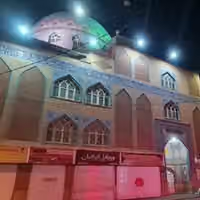
Mourners attend ceremonies at Ravagh Keshvardoust, a shrine-like mourning site set up near the place where Ali Khamenei was killed on Tehran’s Jomhouri Street. (June 2026)

A mourning site set up near the place where Ali Khamenei was killed has been shut down after shroud-wearing ultra-hardliners turned it into a three-day sit-in, exposing a widening rift inside Iran’s loyalist camp over how to use the slain leader’s memory.

The site, known as Ravagh Keshvardoust, had been turned into a shrine-like space in central Tehran for prayer, mourning and ritual gatherings after Khamenei’s killing. In Iranian religious architecture, a ravagh usually refers to a covered hall or portico attached to a shrine. In this case, the term was being used for a temporary devotional space around the site of Khamenei’s death.

According to Jamaran, a news outlet close to the family of the Islamic Republic’s founder Ruhollah Khomeini, organizers closed the site after a group of kafan-poushan, or shroud-wearers, arrived from Mashhad on Ashura (June 25) and occupied the space under the banner of “avenging the blood of the slain leader.”

  • US talks trigger unprecedented rift in Iran’s hardline camp

    US talks trigger unprecedented rift in Iran’s hardline camp

The term kafan-poushan refers to activists who wear white burial shrouds in political or religious demonstrations, presenting themselves as ready for death or martyrdom. The symbolism has long been used by hardline factions in the Islamic Republic, especially when they want to frame a political demand as a sacred duty.

Organizers said the group’s three-day sit-in changed the function of the site. What had been a place for prayer, mourning, daily ceremonies and congregational prayers became, in their words, a place for overnight stays, food distribution and protest equipment. They said repeated requests and mediation failed to persuade the protesters to leave.

The decision to close the site was presented as an effort to protect the sanctity of a site named after the slain leader. But politically, it showed something more sensitive: even parts of the pro-Khamenei establishment now appear to see some of the most radical mourners as disruptive, not useful.

The conflict is not between supporters and opponents of the Islamic Republic. It is between two loyalist currents.

  • Iran hardliners seek to stir unrest in parliament after US MoU, activist says

    Iran hardliners seek to stir unrest in parliament after US MoU, activist says

One side wants Khamenei’s death to be used as a managed symbol of unity, grief and continuity under the new leadership. The other wants to turn that grief into a permanent pressure campaign against officials accused of compromise, especially over talks with the United States and the interim memorandum meant to end the war.

That split has been visible for weeks.

Ultra-hardline figures linked to the Paydari Front have attacked the negotiating team led by Parliament Speaker Mohammad Bagher Ghalibaf and Foreign Minister Abbas Araghchi, accusing them of crossing the late leader’s red lines. Some protesters at hardline rallies have chanted against Ghalibaf and Araghchi, asking what happened to “the blood” of their leader. Some went further, calling for their death or execution.

  • Iran hardliners rage over US deal, but experts say regime is closing ranks

    Iran hardliners rage over US deal, but experts say regime is closing ranks

Iran International previously reported that supporters of the Paydari Front were removed from nightly state-organized rallies in Tehran after requests by President Masoud Pezeshkian and Ghalibaf, in an apparent attempt to contain pressure from the ultra-hardline street while talks with Washington continued.

The same divide has appeared in parliament and in the media. Lawmakers close to the ultra-hardline camp have accused Ghalibaf of keeping parliament closed to shield negotiations from criticism. Conservative activist Mohammad Mohajeri accused hardline lawmakers of trying to use parliament’s podium for factional purposes after the US-Iran memorandum.

Earlier, Iran International reported that the dispute had spilled into a public clash between Raja News, close to Saeed Jalili’s ultraconservative camp, and the IRGC-linked Tasnim News Agency. The argument centered on how far Iran should go in negotiations and whether maximalist demands, including sweeping sanctions relief and regional ceasefires, were realistic.

  • Iran sidelines ultra-hardliners from pro-government nightly rallies

    Iran sidelines ultra-hardliners from pro-government nightly rallies

The closure of the site brings that fight into the religious arena.

State-linked outlets had spent weeks giving the site a sacred vocabulary. Some described it as a place where mourners could approach the “killing site” of the slain leader. Others compared it to Tel Zaynabiyya, a deeply emotional reference in Shiite memory. In Karbala, Tel Zaynabiyya is associated with the place from which Zaynab, the sister of Imam Hussein, is believed to have witnessed the battlefield after Hussein’s killing in 680. Using that phrase for Khamenei’s death places the site inside the language of Ashura, martyrdom and sacred grief.

Ashura is not just a mourning ritual in the Islamic Republic’s political culture. It is also a vocabulary of legitimacy, sacrifice and confrontation. Since 1979, the state has repeatedly used the story of Imam Hussein’s stand at Karbala to frame political loyalty as moral resistance and compromise as betrayal.

But the Keshvardoust dispute shows the risk of that language for the state itself. Once Khamenei’s death is framed as a sacred wound demanding revenge, the most radical loyalists can use the same symbolism against the government, parliament speaker, foreign minister or any official seen as too “pragmatic.”

That is why the incident is politically revealing. The establishment wants mourning that strengthens the system. The ultra-hardliners want mourning that disciplines the system.

Iran economists warn recovery needs reform not just relief

Jun 26, 2026, 06:57 GMT+1
•
Behrouz Turani
Iran economists warn recovery needs reform not just relief
100%
A woman and child look at clothes displayed outside a shop in Tehran, June 11, 2026

Economists and business analysts in Iran say the country's biggest challenges may come after any agreement with the United States, arguing that structural reforms will be as crucial as sanctions relief to achieving a durable economic recovery.

They say Tehran must use the post-war period to impose budgetary discipline, avoid past currency-stabilization mistakes and overhaul its bureaucracy to attract foreign investment, rather than treating the current pause as a short-lived tactical opportunity.

Business strategy consultant Ali Nazemzadeh argued that historical experience—from post-World War II Germany and Japan to Iran's reconstruction after the Iran-Iraq War and the 2008 global financial crisis—suggests economies rarely collapse permanently after major shocks.

Instead, they undergo periods of restructuring and renewal.

Writing in Jahan-e Sanat earlier this week, Nazemzadeh urged business leaders to abandon a passive "waiting mode" and prepare for a post-crisis economy that could unleash pent-up demand and redistribute market share toward the most resilient firms.

Although the 12-day and 40-day wars constrained business decision-making through currency volatility, internet disruptions, the triggering of the UN snapback mechanism, domestic unrest and military tensions, he argued that economic recovery remains historically inevitable.

With its natural resources, strategic location and population of 90 million, "Iran cannot fail to develop after a wartime era," he wrote, describing crises as an "economic sieve" that allows businesses with liquidity, disciplined management and clear strategy to emerge stronger.

Economist Pouya Jabal Ameli echoed that view, arguing that while the interim agreement may not permanently end the cycle of war and ceasefire, it creates a crucial window ahead of the 60-day deadline for negotiating a comprehensive settlement.

He urged policymakers to treat the period not as a tactical pause but as a launchpad for deep structural reforms.

By taking advantage of falling inflation expectations, enforcing budgetary discipline, avoiding historical currency-stabilization traps such as Dutch disease, and preparing a bureaucratic overhaul capable of attracting foreign investment, Iran could shift its global image from conflict toward economic renewal.

Jabal Ameli concluded that Iranian officials should view the memorandum—and any subsequent agreement with the United States—as an opportunity for structural reform rather than a short-term tactical maneuver.

Offering a more optimistic political assessment, pro-reform daily Sharq described the memorandum as "the first direct official agreement between the presidents of Iran and the U.S. in over four decades."

Columnist Abdolrahman Fathollahi argued the agreement could pave the way for a durable ceasefire, economic recovery and the gradual lifting of sanctions while noting that Supreme Leader Mojtaba Khamenei had approved the talks only conditionally and continued to stress distrust of Washington.

He also pointed to repeated warnings from the IRGC and the Supreme National Security Council that Iran had prepared retaliatory measures should the United States fail to honour its commitments.

Despite criticism from a handful of hardline lawmakers, Parliament Speaker Mohammad Bagher Ghalibaf, who also serves as Iran's chief negotiator, declared parliament's backing for the process.

"With the finalization of the memorandum, the difficult path of fulfilling commitments and reclaiming the rights of the Iranian nation has only just begun," he said.

Fathollahi cautioned against excessive optimism, arguing that the agreement's ultimate success "will be determined not in its text, but in the degree of adherence to commitments, the management of regional crises, and the tests ahead."

Rival visions of Iran take to the streets during Ashura

Jun 26, 2026, 01:49 GMT+1
Rival visions of Iran take to the streets during Ashura
100%

Iran's Ashura commemorations have again become a stage for competing political narratives, with government supporters and opponents alike using Shi'ite mourning rituals to advance sharply different messages.

Every year during the Islamic month of Muharram, millions of Shi'ite Muslims across Iran commemorate the martyrdom of Imam Hussein, the grandson of the Prophet Muhammad who was killed in 680 AD.

Hardliners often invoke his example to argue Iran should continue confronting the United States, while government critics use the same symbolism to condemn injustice at home.

Political messaging also comes through speeches by eulogists (maddahs), who preside over ceremonies recounting Hussein's sacrifice and heroism.

Read the full article here.

Rival visions of Iran take to the streets during Ashura

Jun 25, 2026, 23:52 GMT+1
•
Maryam Sinaiee
Rival visions of Iran take to the streets during Ashura
100%
Mourners at an Ashura procession in Tehran. June 24, 2026.

Iran's Ashura commemorations have again become a stage for competing political narratives, with government supporters and opponents alike using Shi'ite mourning rituals to advance sharply different messages.

Every year during the Islamic month of Muharram, millions of Shi'ite Muslims across Iran commemorate the martyrdom of Imam Hussein, the grandson of the Prophet Muhammad who was killed in 680 AD.

Hardliners often invoke his example to argue Iran should continue confronting the United States, while government critics use the same symbolism to condemn injustice at home.

Political messaging also comes through speeches by eulogists (maddahs), who preside over ceremonies recounting Hussein's sacrifice and heroism.

At one ceremony, well-known maddah Reza Narimani criticized President Masoud Pezeshkian for disclosing in a recent speech that funds equivalent to the value of 20 million barrels of oil had been allocated to the Revolutionary Guards' Aerospace Force during the war.

Narimani also claimed Supreme Leader Mojtaba Khamenei opposed negotiations and an agreement with Washington and had merely observed the government's recent diplomatic efforts.

Another eulogist, Mohammad Reza Bazri, criticized officials he accused of ignoring "the ten conditions of the Imam"—a reference to slain leader Ali Khamenei—while pursuing an agreement with Washington and failing to respond to what he described as US violations of the ceasefire.

"The Iranian people would never consent to an agreement with the United States," he claimed.

Opposition mourning

Government critics have likewise used Ashura ceremonies to express dissent, often through traditional mourning chants or carefully worded speeches condemning injustice without directly naming officials.

Religious gatherings in Yazd and Bushehr have become known for incorporating such politically charged poetry.

One widely performed lament, heard again this year, calls on people to rise up and "bring down the idols and palaces of tyrannical rulers."

Another popular mourning chant, which has gained prominence among religious opponents of the government in recent years, criticizes what it portrays as state-sponsored religion.

"In your religion, there is God's name, but God is absent," the lyrics say.

The poem's author, Shahabeddin Mousavi, was detained for a period after it became widely known.

Remembering those killed

While many ceremonies are organized or supported by the state, independent local communities also hold mourning processions that sometimes become venues for political expression.

According to social media posts, some Ashura gatherings this year included performances of the patriotic song Az Khoon-e Javanan-e Vatan ("From the Blood of the Nation's Youth") in memory of thousands of young people killed during the January unrest.

Originally composed during Iran's Constitutional Revolution more than a century ago, the song likens the blood of fallen youth to red tulips blooming from the earth.

At some ceremonies, eulogists reportedly read aloud the names of those killed.

In the central city of Arak, the mother of Mohammad Radmannia, a 29-year-old who was fatally shot in the back of the head with live ammunition in Tehran, urged mourners to continue her son's path.

In a village in the northern province of Gilan, mourners attached a photograph of Mani Safarpour, an 18-year-old from Lahijan who was also killed in Tehran, to a ceremonial drum and cymbals before gathering at his grave to perform chest-beating rituals.

Some opposition activists criticized fellow government opponents for attending Ashura ceremonies, arguing that the events are widely viewed because of state promotion as expressions of support for the Islamic Republic.

"The massacre of protesters in January was carried out on the direct orders of the leader of Shi'ites (Ali Khamenei), while other senior clerics remained silent," one user wrote on X. "A couple of Yazdi or Bushehri mourning chants cannot erase that crime from our society's memory."

Another user wrote: "The blood that was unjustly spilled will never be washed away. No lament or elegy can diminish the scale of this tragedy in our collective memory."

Others defended participation in the ceremonies.

"These mourning chants serve to remind people of those tragedies," one user argued.

Another wrote that participating in Ashura ceremonies was "part of the struggle to reclaim religious symbols" from the government.

A further comment added: "When will people understand that many ordinary religious Iranians have nothing to do with the government or its hardline supporters?"

Unveiled in wartime, targeted in peacetime?

Jun 25, 2026, 10:23 GMT+1

Many Iranians fear that a diplomatic opening with the United States could come at the cost of renewed social restrictions at home, as reports of stricter hijab enforcement begin circulating following the recent war.

Over recent days, social media users have voiced concern that a period of relative tolerance toward personal freedoms may be coming to an end.

With the immediate external crisis easing and further negotiations with Washington expected, many fear authorities could once again shift their focus to domestic social controls.

There has been no official announcement confirming the return of the morality police. But reports circulating online suggest increased scrutiny of hijab compliance in several cities, particularly the religious centers of Qom and Mashhad, although many of the incidents remain difficult to independently verify.

Continue reading