• العربية
  • فارسی
Brand
  • Iran Insight
  • Politics
  • Economy
  • Analysis
  • Special Report
  • Opinion
  • Podcast
  • Iran Insight
  • Politics
  • Economy
  • Analysis
  • Special Report
  • Opinion
  • Podcast
  • Theme
  • Language
    • العربية
    • فارسی
  • Iran Insight
  • Politics
  • Economy
  • Analysis
  • Special Report
  • Opinion
  • Podcast
All rights reserved for Volant Media UK Limited
volant media logo
INSIGHT

Unveiled in wartime, targeted in peacetime?

Jun 25, 2026, 10:23 GMT+1

Many Iranians fear that a diplomatic opening with the United States could come at the cost of renewed social restrictions at home, as reports of stricter hijab enforcement begin circulating following the recent war.

Over recent days, social media users have voiced concern that a period of relative tolerance toward personal freedoms may be coming to an end.

With the immediate external crisis easing and further negotiations with Washington expected, many fear authorities could once again shift their focus to domestic social controls.

There has been no official announcement confirming the return of the morality police. But reports circulating online suggest increased scrutiny of hijab compliance in several cities, particularly the religious centers of Qom and Mashhad, although many of the incidents remain difficult to independently verify.

Continue reading

Most Viewed

Don’t feed us, free us: Iranians hit back at Vance over 'hunger' remarks
1
VOICES FROM IRAN

Don’t feed us, free us: Iranians hit back at Vance over 'hunger' remarks

2
EXCLUSIVE

IRGC personnel sheltered in Shiraz lodging complex were target of deadly strike

3
INSIGHT

President's economic reality check fuels Iran's US deal debate

4

IAEA chief says inspectors will visit Iran enrichment sites under US-Iran MoU

5
EXCLUSIVE

Opium for survival: Inside a shift in Iran’s Zagros villages

Banner
Banner
Banner

Spotlight

  • Sources detail Ali Khamenei bunker with blast-resistant room
    EXCLUSIVE

    Sources detail Ali Khamenei bunker with blast-resistant room

  • Unveiled in wartime, targeted in peacetime?
    INSIGHT

    Unveiled in wartime, targeted in peacetime?

  • US sanctions waiver could bring Iran's oil trade out of the shadows
    ANALYSIS

    US sanctions waiver could bring Iran's oil trade out of the shadows

  • Hardline revolt targets Ghalibaf over US agreement
    INSIGHT

    Hardline revolt targets Ghalibaf over US agreement

  • IRGC personnel sheltered in Shiraz lodging complex were target of deadly strike
    EXCLUSIVE

    IRGC personnel sheltered in Shiraz lodging complex were target of deadly strike

  • Don’t feed us, free us: Iranians hit back at Vance over 'hunger' remarks
    VOICES FROM IRAN

    Don’t feed us, free us: Iranians hit back at Vance over 'hunger' remarks

  • Opium for survival: Inside a shift in Iran’s Zagros villages
    EXCLUSIVE

    Opium for survival: Inside a shift in Iran’s Zagros villages

•
•
•

More Stories

Unveiled in wartime, targeted in peacetime?

Jun 25, 2026, 09:53 GMT+1
•
Maryam Sinaiee
Unveiled in wartime, targeted in peacetime?
100%
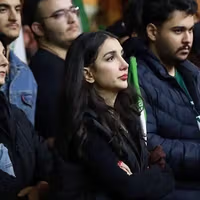
Unveiled woman at a pro-government wartime rally, March 2026

Many Iranians fear that a diplomatic opening with the United States could come at the cost of renewed social restrictions at home, as reports of stricter hijab enforcement begin circulating following the recent war.

Over recent days, social media users have voiced concern that a period of relative tolerance toward personal freedoms may be coming to an end.

With the immediate external crisis easing and further negotiations with Washington expected, many fear authorities could once again shift their focus to domestic social controls.

There has been no official announcement confirming the return of the morality police. But reports circulating online suggest increased scrutiny of hijab compliance in several cities, particularly the religious centers of Qom and Mashhad, although many of the incidents remain difficult to independently verify.

One widely shared video, which users say was filmed in the holy city of Qom, appears to show male and female officers attempting to persuade a young woman to enter a white van resembling those previously used by the so-called morality police.

In a separate video reportedly filmed in Mashhad, a police officer is seen confronting a young woman riding as a passenger on a motorcycle, telling her to buy a headscarf from a nearby shop before continuing her journey.

Another video from Tehran shows an argument between a young woman and several men. One tells her she has no right to appear without a head covering because it is against the law, while others threaten to call the police.

Optional, or is it?

Social media users have also reported visits by the Public Venues Supervision Office, the police body responsible for monitoring businesses, to inspect compliance with hijab regulations in companies, cafés and restaurants.

"They say hijab has become optional," one user wrote. "It's true that the way we dress has completely changed, both in the street and at work. But during these days of negotiations officials came to inspect our workplace over hijab.

"Imagine the anxiety in a company where most employees are women without hijab, fearing the business could be sealed because of them."

The legal rights group Dadban said reports from different parts of Iran suggested security, law enforcement and judicial institutions had once again increased their focus on domestic social control.

"Measures taken in recent weeks, from intensified street enforcement to growing pressure on citizens, point to the return of this approach," the group said.

"It appears that, following the reduction of external tensions, the responsible institutions have once again prioritized internal control and restricting individual and social freedoms."

Wartime tolerance, post-war uncertainty

During the war, state media and some officials openly welcomed the participation of unveiled women in pro-government gatherings. Images of women without head coverings were broadcast on state television, breaking with longstanding editorial practice.

At one gathering, organizers even projected a performance by a Lebanese female singer onto a large screen, challenging the state's longstanding ban on solo female singing.

Those departures from established norms unsettled many hardline supporters of the Islamic Republic. Now, with a memorandum signed with the United States and the prospect of further negotiations ahead, some Iranians fear authorities could seek to reassure conservative constituencies by tightening social controls once again.

Others worry that radical groups could feel emboldened to intervene directly under the principle of "enjoining good and forbidding wrong," a religious doctrine frequently invoked to justify policing perceived moral violations.

"After an agreement, what can their street forces do?" one social media user wrote. "Will they once again be unleashed on the public over hijab and other issues? A confrontation between society and the state lies ahead."

Another predicted authorities would intensify hijab enforcement and close cafés to appease conservatives opposed to rapprochement with Washington.

Political scientist Morteza Nemati urged caution over reports of the morality police's return but highlighted what he saw as an irony.

"I don't know how accurate the reports about relaunching the morality police are," he wrote on X. "But if you do bring them back, please be careful not to accidentally arrest the same unveiled women whose images you were showing at the nighttime rallies."

Hardline revolt targets Ghalibaf over US agreement

Jun 25, 2026, 02:46 GMT+1
•
Behrouz Turani
Hardline revolt targets Ghalibaf over US agreement
100%
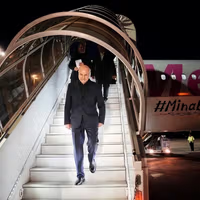
Iran's parliament speaker and lead negotiator Mohamed Bagher Ghalibaf arrives in Zurich, Switzerland for talks with the United State, June 20, 2026

Resistance to Mohammad Bagher Ghalibaf's leadership, both as parliament speaker and chief negotiator, appears to be growing, though it remains confined to a small but vocal group of ultraconservative lawmakers.

Over recent days, at least four MPs—Hamid Rasai, Amir Hossein Sabeti, Abolfazl Aboutorabi and Kamran Ghazanfari—have publicly challenged Ghalibaf, accusing him of violating Supreme Leader Mojtaba Khamenei's red lines and keeping parliament closed to shield the government and negotiators from criticism.

Despite the attacks, Ghalibaf's position appears secure. A recent internal vote showed his supporters retain a comfortable majority, with fewer than 30 of the Majles' 290 members opposing his speakership.

All four leading critics belong to the ultraconservative Paydari (Steadfastness) Party, which has consistently opposed negotiations with the United States.

Even so, Ghazanfari has threatened that if parliament does not reopen before June 28, he and like-minded MPs will stage a sit-in outside the Majles. He argues the closure was never authorized by the Supreme National Security Council (SNSC), as Ghalibaf has maintained, and claims one man has effectively been making decisions on behalf of all 290 lawmakers.

Parliament was originally closed after the outbreak of the 40-day war with Israel and the United States because of security concerns.

Ghazanfari's assertion that "all MPs" want parliament reopened is not borne out by events. Over the past four months, only Rasai has publicly demanded its reopening. Ghazanfari nevertheless accuses Ghalibaf of unlawfully keeping the Majles shut because he fears lawmakers would oppose negotiations with Washington.

Ghalibaf has rejected the allegation, saying parliament remains operational and that sessions are being held online because of continuing security risks. He has also called on the Judiciary to investigate the claims against him.

According to ILNA, Ghazanfari has further accused Ghalibaf of violating the constitution and falsely claiming the SNSC ordered parliament's closure.

He also alleges Ghalibaf refused to show MPs the purported SNSC authorization and ignored what he described as a request from Mojtaba Khamenei to reopen parliament.

Hardline MP Abolfazl Aboutorabi told the Didban Iran website that Ghalibaf was preventing parliament from legislating on Iran's sovereignty over the Strait of Hormuz. He accused the speaker of "playing with words" by presenting the accord with the United States as an MoU rather than a binding agreement.

Aboutorabi said several MPs were preparing a legal complaint against Ghalibaf, arguing that any memorandum or agreement should require parliamentary approval.

Asked whether MPs planned to impeach President Masoud Pezeshkian over the MoU, he replied that impeachment was not currently under consideration, adding: "Maybe God helps and makes him a martyr."

The remark is among the most serious death-tinged comments directed at the president since a prominent eulogist earlier suggested Pezeshkian could be beheaded before later insisting the remark had been intended as an "internal discussion."

Aboutorabi also accused Ghalibaf of violating Khamenei's red lines on the Strait of Hormuz and nuclear negotiations.

Similar allegations have been made by other Paydari figures, including Mahmoud Nabavian and Amir Hossein Sabeti, who argue the agreement with Washington is being pursued against the Supreme Leader's wishes.

For now, however, there is little indication the campaign is gaining traction beyond a small faction. Ghalibaf's support within parliament remains strong, while his longstanding ties to the Revolutionary Guards and Khamenei's inner circle leave him well placed to withstand attacks from rivals with far less institutional backing.

President's economic reality check fuels Iran's US deal debate

Jun 25, 2026, 00:47 GMT+1
•
Maryam Sinaiee
President's economic reality check fuels Iran's US deal debate
100%
President Masoud Pezeshkian showing his copy of the MoU signed remotely with President Donald Trump. June 17, 2026

President Masoud Pezeshkian's unusually blunt remarks about Iran's economic crisis have intensified infighting over Supreme Leader Mojtaba Khamenei's position on the US-Iran agreement.

The dispute centers on a written message attributed to Khamenei outlining his position on the Memorandum of Understanding.

In the message, Khamenei wrote: "In principle, I had a different view, but because of the commitment that the President, as head of the Supreme National Security Council, gave on behalf of himself and the council members regarding safeguarding the rights of the Iranian nation and the Resistance Front, and because they explicitly accepted responsibility for it, I authorized it."

Hardliners, including parliamentarian Hamid Rasaei and former MP Kamran Ghazanfari, accused Pezeshkian, parliament speaker Mohammad Bagher Ghalibaf and their allies of effectively staging a "coup" against the Supreme Leader.

'A devastated economy'

The dispute spilled into public view when attendees at an official event shouted that Pezeshkian's government should adhere to the "principles" referenced by Khamenei.

"The principle is justice. The principle is serving the people. The principle is honesty," Pezeshkian responded.

"For 40 to 50 days, we could not export a single barrel of oil from the Persian Gulf," he said. "They have devastated our economy, and many young people have become unemployed. Our young people have no hope for the future. We have to pay benefits to the unemployed and we cannot collect taxes. You tell me, where is the money supposed to come from?"

Pezeshkian also revealed that the government had diverted $20 million in oil-export revenues that would normally have gone into the state budget to the IRGC Aerospace Force to procure military equipment.

"If we had not supported the IRGC, our armed forces would not have been able to fight."

He added that he was withholding further details in the interest of national unity, saying he had much more to say but preferred not to disclose it.

Institutional backing

Pezeshkian's remarks also suggested growing confidence that key power centers continue to back the agreement despite mounting criticism from hardliners.

According to the president, the memorandum was approved by the Supreme National Security Council (SNSC) with the backing of the country's most senior commanders from both the regular army and the Revolutionary Guards.

Further evidence emerged on Tuesday when Sobh-e Sadegh, the weekly publication of the IRGC's political office, reported that Saeed Jalili—an SNSC member and a longstanding opponent of talks with Washington—had sought to clarify the leader's position.

According to the report, Jalili said Khamenei's statement was not opposition to negotiations but to Tehran's negotiating approach and certain provisions of the memorandum. He reportedly also said those who voted for the agreement in the council could not be accused of acting against the leadership.

His remarks echoed those of IRGC political chief Yadollah Javani, who said on Monday that the negotiations had been conducted with Khamenei's permission and according to the conditions he had set.

"The interpretation by some that the phrase 'in principle' signifies opposition to negotiations with the United States is incorrect," Javani said.

Competing readings

Iranian newspapers have offered sharply different interpretations of the controversy.

The government newspaper Iran argued that the Supreme Leader's message emphasized "responsibility, commitment, effort, and concern" on the part of government officials.

"The Leader's message was about the government's responsibility," it wrote, "but in part of the political sphere it became a tool for intensifying attacks on the government."

The conservative Khorasan newspaper argued that the message sought to balance three principles: maintaining the Islamic Republic's stance toward US hostility, conditionally accepting the outcome of the official decision-making process and demanding accountability from those implementing the memorandum.

It added that, in political and jurisprudential reasoning, the phrase "in principle" refers to a general rule that can admit exceptions under special circumstances.

Not all conservative voices defended the government. In an editorial titled Mr. President, the Enemy Can Hear You Too, the conservative website Alef criticized Pezeshkian for repeatedly discussing Iran's economic difficulties in public.

One reader commented: "Saying that not even a single barrel of oil was exported because of the US blockade, or that all military officials supported the memorandum, does not send a good message to the enemy."

Debate spills onto social media

Social media reflected the same divide. Supporters praised Pezeshkian's candor, while critics renewed accusations that he was attempting to pressure the Supreme Leader into accepting the agreement.

One supporter wrote: "Pezeshkian is completely right. You cannot run a country without money. We have to face reality."

A critic responded on X: "Standing against the Leader and then blaming everything on the Leader and the system is not called courage."

The dispute increasingly appears to be less about the memorandum itself than about who gets to define Khamenei's position. As negotiations with Washington move forward, competing factions are seeking to claim the leader's authority either to legitimize the agreement or to constrain those implementing it.

Iran and US trade rival readings of MoU before 60-day talks mature

Jun 23, 2026, 13:48 GMT+1
•
Arash Sohrabi
Iran and US trade rival readings of MoU before 60-day talks mature
100%

The US-Iran memorandum is being implemented before Washington and Tehran have agreed what it means, turning the fragile deal into a battle over interpretation across the Strait of Hormuz, frozen funds, nuclear inspections, oil sanctions and Lebanon.

Less than a week after the two sides signed the MoU to end more than three months of war, its contradictions are already shaping the next phase of diplomacy: Hormuz is open, but ships may still need Iranian permission; funds are “available,” but Washington says they may be channeled toward wheat, corn and other approved purchases; inspectors are “back,” according to US officials, but Iran says there is no plan for UN inspectors to visit bombed nuclear sites; oil sales have been authorized, but Vice President JD Vance says Tehran will not benefit unless it changes behavior; Lebanon is written into the deal, but Israel is not a party to it.

For Iran, ambiguity has become leverage. Officials in Tehran are insisting that implementation of the MoU’s early provisions is a precondition for talks on more sensitive issues, while rejecting US descriptions of what the next stage should include.

Nuclear sites and missiles

Iranian Foreign Ministry spokesman Esmaeil Baghaei said on Tuesday that Tehran had not met International Atomic Energy Agency chief Rafael Grossi in Switzerland and had no plan for UN nuclear inspectors to visit facilities damaged in US and Israeli strikes.

“We have not had a meeting with the director general of the International Atomic Energy Agency, nor do we have any plans for an agency inspection of Iran’s nuclear facilities that were damaged as a result of the military attack by the United States and the Zionist regime,” Baghaei said. “Basically, there is no procedure at all in this regard.”

  • Iran says no plan for UN nuclear inspections at bombed sites

    Iran says no plan for UN nuclear inspections at bombed sites

That directly undercut Vance’s statement that talks on inspectors’ return could begin this week and President Donald Trump’s claim that Iran would agree to “major weapons inspections.”

Baghaei also ruled out talks on Iran’s missile program.

“Iran’s defensive and missile capabilities have never been part of our talks, nor will they ever be subject to negotiation with any party,” he said.

Money, oil and the first rewards

The dispute over money is just as sharp. Baghaei rejected the idea that Iran had agreed to spend released assets on US agricultural goods, after Vance said Washington wanted a mechanism to steer funds toward purchases such as soy, corn and wheat.

Baghaei said Iran would use its assets based on national needs, including price and quality.

“What is important for us is access to assets that have been unjustly blocked,” he said.

At the same time, the US Treasury has issued a 60-day license allowing Iran to produce, sell and deliver crude oil, petroleum products and petrochemicals, with related banking, insurance and transport services.

That gives both sides a political line. Washington says deeper benefits remain conditional. Tehran can point to immediate oil authorization and access to blocked assets as proof that pressure has begun to give way.

The same ambiguity surrounds the proposed $300 billion reconstruction framework. It exists in the text, but US officials have denied direct US or Qatari payments, leaving unclear whether it means grants, investment, credit facilities or future regional funding.

Hormuz is open, but under whose rules?

The Strait of Hormuz is the clearest practical test.

Ali Bahreini, Iran’s ambassador to the UN office in Geneva, said Tuesday that Hormuz was “completely open” to commercial vessels and that no charges would be collected during the 60-day period.

“Yes, the Strait of Hormuz is completely open, of course, for commercial vessels, according to the memorandum of understanding,” Bahreini said. “And it is without receiving any charges. After 60 days, it depends on the negotiations.”

  • Ships face conflicting Iran, US instructions in Strait of Hormuz - FT

    Ships face conflicting Iran, US instructions in Strait of Hormuz - FT

But the Financial Times reported that shipowners are in “deep confusion” over conflicting guidance. Iran has told vessels to seek permission from Tehran and use a route near the Iranian coast, while the US and some Western insurers advise ships to use a route on the Omani side under US air cover.

That leaves shipowners weighing the risk of Iranian interference against possible sanctions, insurance or compliance concerns.

The contradiction captures the MoU’s central problem: the US says Hormuz has reopened; Iran says reopening proves ships must deal with Tehran’s authority.

Lebanon still as the next flashpoint

Lebanon may be the deal’s most dangerous test.

Bahreini said Iran told the Switzerland talks that Lebanon is an “unquestionable part” of the MoU and that ending military operations must include respect for Lebanon’s territorial integrity, a halt to attacks and Israeli withdrawal.

“Iran’s red line is any attack against Lebanon, any more attack against Lebanon,” he said.

He warned that Iran would respond to any violation, including attacks on Lebanon or Hezbollah.

“If they are going to violate the MOU in any format, including by attacking Lebanon and Hezbollah in Lebanon, then Iran will respond,” he said.

Earlier on Tuesday, Reuters reported that Israeli gunfire killed two people in southern Lebanon, the first reported fatalities from Israeli fire there in three days. The Israeli military said it struck armed militants who posed an immediate threat.

A joint statement after US-Iran talks mediated by Pakistan and Qatar said the parties had agreed to create a deconfliction cell to monitor the termination of hostilities in Lebanon. But Israel is not a party to the US-Iran MoU, and Prime Minister Benjamin Netanyahu said this week that Israeli troops retain freedom of action against Hezbollah threats and will remain in Lebanon as long as necessary.

That leaves Washington responsible for restraining an ally outside the deal, while Tehran treats Lebanon as a condition for keeping talks alive.

A deal already under strain

Baghaei said talks on sanctions and nuclear issues depend on implementation of specific MoU provisions.

“The start of negotiations on these two issues is contingent on the implementation of specific provisions of the memorandum of understanding,” he said. “Part of it has been achieved, and part of it is being implemented.”

That is the emerging shape of the deal: each side is implementing the clauses it can sell, disputing the clauses it dislikes, and using unresolved language as leverage before the final agreement.

For now, the MoU has stopped a wider war and reopened commercial movement through Hormuz. But it has also created a new diplomatic battlefield in which every clause is being tested, stretched and weaponized before the 60-day clock has even fully begun.


Relief or resistance? Tehran dailies offer diverging readings of talks

Jun 23, 2026, 04:08 GMT+1
•
Behrouz Turani
Relief or resistance? Tehran dailies offer diverging readings of talks
100%
A paddleboarder moves through the waters of the Strait of Hormuz as a tanker sails in the distance, June 21, 2026

While much of Iran's political press focused on the diplomatic drama surrounding the latest round of US-Iran talks in Switzerland, several economic newspapers used Monday's coverage to highlight the country's deeper economic challenges and post-war uncertainties.

The talks ended with a joint statement from mediators Qatar and Pakistan announcing a roadmap toward a final agreement within 60 days, alongside plans for further technical negotiations.

Iranian officials have also highlighted progress on the release of frozen assets and the possibility of expanded trade.

On Monday, Iran's central bank chief Abdolnasser Hemmati said funds released under the emerging agreement would not necessarily be limited to essential goods and could be used to purchase other non-sanctioned products.

Iranian newspapers largely divided along familiar lines, with hardline outlets portraying the talks as a test of national resolve and moderate publications emphasizing the potential economic benefits of diplomacy.

Economic outlets, by contrast, focused on questions of market stability, sanctions relief and the country's long-term structural problems.

The prominent economic daily Donyaye Eghtesad argued that "a 60-day diplomatic stopgap cannot solve deep-seated, post-war structural challenges."

Its editorial noted that "the diplomacy of the mattress in Switzerland cannot mask the reality that a 60-day roadmap is a temporary truce, not a permanent architecture."

It warned that markets had reacted with immediate volatility to the diplomatic developments, underscoring the risks of managing the economy through short-term political decisions.

Oil-export waivers may provide temporary liquidity, the paper argued, but cannot by themselves resolve deeper structural problems or restore long-term confidence.

Resistance versus relief

The dominant hardline narrative remained one of resistance rather than compromise.

Kayhan argued that Iran's temporary reinstatement of restrictions on traffic through the Strait of Hormuz over the weekend had forced the United States "back to reality."

The newspaper wrote that the brief disruption "proved once again that the only language the Western front understands is the language of definitive leverage," adding that Parliament Speaker Mohammad Bagher Ghalibaf's reported walkout from negotiations demonstrated that Iran "does not negotiate under the shadow of social media threats."

Javan urged negotiators to remain cautious, describing the 60-day roadmap as "a tactical pause forced upon the Americans by the operational readiness of our armed forces."

But moderate voices offered a markedly different assessment.

Shargh described the outcome of the talks as "a fragile but essential window of relief," noting that concrete oil and petrochemical waivers had, for the first time, been linked to a diplomatic timetable.

At the same time, it cautioned that "the shadow of Donald Trump's erratic, transactional approach to international relations looms large," urging negotiators to secure technical and economic guarantees before the current opportunity closes.

Etemad focused on the domestic economy, arguing that Iran "desperately requires the structural stability these sanctions waivers promise" and portraying the developments in Switzerland as evidence that a pragmatic diplomatic framework remains viable.