They say Tehran must use the post-war period to impose budgetary discipline, avoid past currency-stabilization mistakes and overhaul its bureaucracy to attract foreign investment, rather than treating the current pause as a short-lived tactical opportunity.
Business strategy consultant Ali Nazemzadeh argued that historical experience—from post-World War II Germany and Japan to Iran's reconstruction after the Iran-Iraq War and the 2008 global financial crisis—suggests economies rarely collapse permanently after major shocks.
Instead, they undergo periods of restructuring and renewal.
Writing in Jahan-e Sanat earlier this week, Nazemzadeh urged business leaders to abandon a passive "waiting mode" and prepare for a post-crisis economy that could unleash pent-up demand and redistribute market share toward the most resilient firms.
Although the 12-day and 40-day wars constrained business decision-making through currency volatility, internet disruptions, the triggering of the UN snapback mechanism, domestic unrest and military tensions, he argued that economic recovery remains historically inevitable.
With its natural resources, strategic location and population of 90 million, "Iran cannot fail to develop after a wartime era," he wrote, describing crises as an "economic sieve" that allows businesses with liquidity, disciplined management and clear strategy to emerge stronger.
Economist Pouya Jabal Ameli echoed that view, arguing that while the interim agreement may not permanently end the cycle of war and ceasefire, it creates a crucial window ahead of the 60-day deadline for negotiating a comprehensive settlement.
He urged policymakers to treat the period not as a tactical pause but as a launchpad for deep structural reforms.
By taking advantage of falling inflation expectations, enforcing budgetary discipline, avoiding historical currency-stabilization traps such as Dutch disease, and preparing a bureaucratic overhaul capable of attracting foreign investment, Iran could shift its global image from conflict toward economic renewal.
Jabal Ameli concluded that Iranian officials should view the memorandum—and any subsequent agreement with the United States—as an opportunity for structural reform rather than a short-term tactical maneuver.
Offering a more optimistic political assessment, pro-reform daily Sharq described the memorandum as "the first direct official agreement between the presidents of Iran and the U.S. in over four decades."
Columnist Abdolrahman Fathollahi argued the agreement could pave the way for a durable ceasefire, economic recovery and the gradual lifting of sanctions while noting that Supreme Leader Mojtaba Khamenei had approved the talks only conditionally and continued to stress distrust of Washington.
He also pointed to repeated warnings from the IRGC and the Supreme National Security Council that Iran had prepared retaliatory measures should the United States fail to honour its commitments.
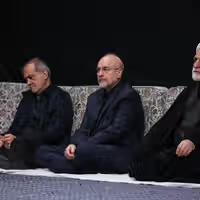
Despite criticism from a handful of hardline lawmakers, Parliament Speaker Mohammad Bagher Ghalibaf, who also serves as Iran's chief negotiator, declared parliament's backing for the process.
"With the finalization of the memorandum, the difficult path of fulfilling commitments and reclaiming the rights of the Iranian nation has only just begun," he said.
Fathollahi cautioned against excessive optimism, arguing that the agreement's ultimate success "will be determined not in its text, but in the degree of adherence to commitments, the management of regional crises, and the tests ahead."