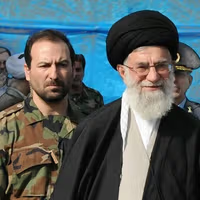
The dispute centers on a written message attributed to Khamenei outlining his position on the Memorandum of Understanding.
In the message, Khamenei wrote: "In principle, I had a different view, but because of the commitment that the President, as head of the Supreme National Security Council, gave on behalf of himself and the council members regarding safeguarding the rights of the Iranian nation and the Resistance Front, and because they explicitly accepted responsibility for it, I authorized it."
Hardliners, including parliamentarian Hamid Rasaei and former MP Kamran Ghazanfari, accused Pezeshkian, parliament speaker Mohammad Bagher Ghalibaf and their allies of effectively staging a "coup" against the Supreme Leader.
'A devastated economy'
The dispute spilled into public view when attendees at an official event shouted that Pezeshkian's government should adhere to the "principles" referenced by Khamenei.
"The principle is justice. The principle is serving the people. The principle is honesty," Pezeshkian responded.
"For 40 to 50 days, we could not export a single barrel of oil from the Persian Gulf," he said. "They have devastated our economy, and many young people have become unemployed. Our young people have no hope for the future. We have to pay benefits to the unemployed and we cannot collect taxes. You tell me, where is the money supposed to come from?"
Pezeshkian also revealed that the government had diverted $20 million in oil-export revenues that would normally have gone into the state budget to the IRGC Aerospace Force to procure military equipment.
"If we had not supported the IRGC, our armed forces would not have been able to fight."
He added that he was withholding further details in the interest of national unity, saying he had much more to say but preferred not to disclose it.
Institutional backing
Pezeshkian's remarks also suggested growing confidence that key power centers continue to back the agreement despite mounting criticism from hardliners.
According to the president, the memorandum was approved by the Supreme National Security Council (SNSC) with the backing of the country's most senior commanders from both the regular army and the Revolutionary Guards.
Further evidence emerged on Tuesday when Sobh-e Sadegh, the weekly publication of the IRGC's political office, reported that Saeed Jalili—an SNSC member and a longstanding opponent of talks with Washington—had sought to clarify the leader's position.
According to the report, Jalili said Khamenei's statement was not opposition to negotiations but to Tehran's negotiating approach and certain provisions of the memorandum. He reportedly also said those who voted for the agreement in the council could not be accused of acting against the leadership.
His remarks echoed those of IRGC political chief Yadollah Javani, who said on Monday that the negotiations had been conducted with Khamenei's permission and according to the conditions he had set.
"The interpretation by some that the phrase 'in principle' signifies opposition to negotiations with the United States is incorrect," Javani said.
Competing readings
Iranian newspapers have offered sharply different interpretations of the controversy.
The government newspaper Iran argued that the Supreme Leader's message emphasized "responsibility, commitment, effort, and concern" on the part of government officials.
"The Leader's message was about the government's responsibility," it wrote, "but in part of the political sphere it became a tool for intensifying attacks on the government."
The conservative Khorasan newspaper argued that the message sought to balance three principles: maintaining the Islamic Republic's stance toward US hostility, conditionally accepting the outcome of the official decision-making process and demanding accountability from those implementing the memorandum.
It added that, in political and jurisprudential reasoning, the phrase "in principle" refers to a general rule that can admit exceptions under special circumstances.
Not all conservative voices defended the government. In an editorial titled Mr. President, the Enemy Can Hear You Too, the conservative website Alef criticized Pezeshkian for repeatedly discussing Iran's economic difficulties in public.
One reader commented: "Saying that not even a single barrel of oil was exported because of the US blockade, or that all military officials supported the memorandum, does not send a good message to the enemy."
Debate spills onto social media
Social media reflected the same divide. Supporters praised Pezeshkian's candor, while critics renewed accusations that he was attempting to pressure the Supreme Leader into accepting the agreement.
One supporter wrote: "Pezeshkian is completely right. You cannot run a country without money. We have to face reality."
A critic responded on X: "Standing against the Leader and then blaming everything on the Leader and the system is not called courage."
The dispute increasingly appears to be less about the memorandum itself than about who gets to define Khamenei's position. As negotiations with Washington move forward, competing factions are seeking to claim the leader's authority either to legitimize the agreement or to constrain those implementing it.