FDD urges Melania Trump to spotlight Iran women’s rights
A letter published on Wednesday by the Foundation for Defense of Democracies (FDD) urged First Lady Melania Trump to draw attention to human rights abuses in Iran, particularly against women, alongside ongoing US focus on nuclear talks and energy policy.
"Iran’s current Islamic revolutionaries are not less radicalized than their predecessors. They are not interested in turning over a new leaf, nor are they looking to help their country," FDD founder Clifford May wrote in letter.
"They are Khomeinists, which means they are eager to kill - and die - to reestablish Islamic supremacy far and wide," he added. "All I am asking is that you bring your clear-eyed and worldly perspective to the people around you — as loudly as possible."
Senator Lindsey Graham said on Wednesday that the Senate should, “to the extent possible,” re-vote a War Powers resolution related to Iran and defeat it, arguing the earlier vote could embolden Iran during ongoing negotiations.
"I believe it is imperative that to the extent possible the Senate re-vote the Iran War Powers resolution – and defeat it. The president’s concern about Iran being emboldened by this vote in the middle of negotiations to end this war is not unwarranted. Frankly, it’s just common sense. What’s ironic is that votes like this have the unintended consequence of extending the conflict," Graham posted on X. "If possible, we should re-vote."
Former Iranian vice president Mohammad Ali Abtahi said on Wednesday oil is expected to be sold at full price under the recent memorandum of understanding and that revenues would go directly to the public without intermediaries.
Abtahi said opposition to the agreement may be linked to the loss of income for those involved in oil-trading networks under sanctions.
"We had nearly ten years of oil sanctions. Oil network intermediaries took heavy losses to bypass the sanctions in order to bring only a small amount of oil revenue into the treasury. Countries that did not comply with the sanctions drove our oil prices down and bought it cheaply," Abtahi posted on X.
"Now, for the first time after the recent agreement, oil is expected to be sold at market price, with the money going directly into people’s pockets without intermediaries. Could this unprecedented attack on the agreement possibly be related to the cutting off of this source of income?" he added.
US President Donald Trump criticized several NATO members on Wednesday for what he described as a lack of support during the conflict with Iran, singling out the United Kingdom, Germany, France and Spain.
Trump said Washington had been "disappointed" by the positions taken by some allies, adding that Spain was "terrible."
Prime Minister Benjamin Netanyahu said he did not ask President Donald Trump for permission before Israel’s June 2025 campaign against Iran, saying he only informed the US president of Israel’s plan.
“I did not ask for permission. I simply informed him of our plan,” Netanyahu said at the Muni Expo conference in Tel Aviv, adding that he was pleased Trump “ultimately joined in toward the end of this very important action.”
Netanyahu defended Israel’s preemptive security doctrine, saying Israel had to “initiate” and “attack” rather than wait for enemies to act, and said one of its most important achievements in recent conflicts was to “break the barrier of fear.”
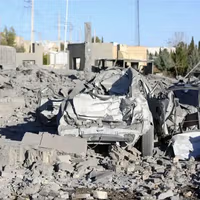
Aftermath of the March 2026 strike on the Zibashahr complex in Shiraz
IRGC personnel sheltering in a civilian lodging complex in Shiraz were the likely target of a strike that also killed nine civilians at a neighboring emergency center in the early days of the 2026 war, an Iran International investigation found.
The March 5 strike hit several buildings inside the Zibashahr emergency lodging complex, where members of the Islamic Revolutionary Guard Corps and affiliated forces had taken shelter during the war, according to images from the site, open-source data, Iranian media reports, witness accounts and an expert assessment reviewed by Iran International.
The evidence suggests the strike was not a simple miss aimed at a nearby IRGC facility, but an attack on the lodging complex itself.
The site sat inside a civilian area, beside a local ambulance station that is part of Iran’s 115 emergency medical service, as well as service buildings and residential homes.
No party has claimed responsibility for the strike.
Fars provincial authorities later said 20 people had been killed and 30 wounded. At an official memorial ceremony in Zibashahr, however, only 16 names and photographs were released: seven IRGC and Basij members and nine civilians.
The civilians included two emergency technicians, a health worker, municipal employees and contractors, and a local shopkeeper.
The strike destroyed the ambulance station, a neighboring building and a larger structure to the east that formed part of the municipal emergency lodging complex. Nearby residential buildings were also damaged.
Aftermath of the March 2026 strike on the Zibashahr complex in Shiraz
Why the lodging complex was hit
The large destroyed building inside the Zibashahr complex was not an empty passenger facility or an unidentified structure.
The Student News Agency, linked to the Student Basij, published a video report from the site after the attack and said missiles had hit “dormitory and administrative buildings” in the complex. It also reported that military personnel had been killed and wounded.
The agency said the personnel were there for “training courses for border protection.”
But public mapping services, including Google Maps and the Iranian app Neshan, identify the site as an emergency lodging complex, not a military training facility.
The entrance of the Zibashahr complex
Verified images and videos from the area also show the lodging complex sign at the entrance. Iran International found no publicly available evidence that the site had previously functioned as a military training center.
Less than 200 meters away, across the highway, sits a large IRGC Ground Forces training and military complex. Open-source mapping also links the area to the IRGC’s 19th Fajr Division and an IRGC Aerospace Force unit in Shiraz. One officer killed in the Zibashahr strike was linked to the 19th Fajr Division.
Yet post-strike imagery showed no sign that the nearby IRGC complex itself had been destroyed.
That pattern is central to the investigation. If the intended target had been the formal IRGC facility, a miss of about 200 meters across the highway would have to explain several impacts on separate buildings inside the civilian lodging complex.
Wes Bryant, a former head of a US Air Force special targeting team and former Pentagon civilian-casualty assessment official, reviewed visual evidence from the site.
He assessed that the strike involved about 1,350 kilograms of munitions, including a weapon comparable to a 900-kilogram bomb against the larger eastern building and smaller munitions, comparable to 220-kilogram bombs, against two western structures, including the ambulance station.
With modern precision-guided munitions, Bryant said, a 200-meter error across a highway would be highly unlikely, particularly in several separate impacts.
His assessment supports the conclusion drawn from the other evidence: the lodging complex itself, or specific buildings inside it, was the likely target.
Aftermath of the March 2026 strike on the Zibashahr complex in Shiraz
A target among civilians
The evidence reviewed by Iran International points to a strike on a civilian lodging complex after IRGC personnel moved into it during the war.
That may explain why the Zibashahr complex, rather than the nearby formal IRGC facility, was hit. But the same evidence also shows that the targeted buildings stood inside a civilian setting, beside an ambulance station and near residential homes.
That leaves responsibility on the Iranian side.
By moving or allowing military personnel to shelter in a civilian lodging complex, next to an emergency medical site and homes, Iranian authorities placed civilians and medical workers in the path of a foreseeable strike.
It is not necessary to prove that civilians were intentionally used as shields to establish the consequence: the risk of war was shifted from a military facility into a place used by civilians.
That responsibility does not remove the attacker’s obligations.
Even if the presence of IRGC personnel made part of the lodging complex a military target, it did not automatically strip the neighboring ambulance station, surrounding buildings or nearby homes of protection.
A medical site loses its special protection only if it is itself used for acts harmful to the enemy; Iran International found no evidence in the material reviewed that the ambulance station was used in that way.
The strike therefore leaves two central facts in tension.
IRGC personnel appear to have taken shelter among civilians, turning part of the complex into a target. But the attack also destroyed an ambulance station and killed civilians in an area whose medical and residential character was visible in public maps and imagery.
In Zibashahr, the war moved from a military complex into a lodging site, an ambulance station and people’s homes.