The MoU is expected to be formally signed on Friday and followed by 60 days of talks aimed at reaching a final deal, leaving many Iranians torn between relief over the end of fighting, hope for sanctions relief, anger over years of delay, and distrust of both Tehran and Washington.
Regime supporters say Iran forced concessions
Some government supporters argued that Iran emerged from the conflict without losing territory and succeeded in compelling its adversaries to accept its demands through resistance.
A review of public comments posted in response to a Khabar Online survey on reactions to the end of the war showed both pride and anger among users.
One user wrote that they were “very happy” about the end of the war while also feeling “a sense of pride.”
That view was quickly challenged by others. Responding to the comment, another user wrote: “Exactly what is there to be proud of? The destruction of military and technical infrastructure? Crushing inflation that is breaking people's backs? Or the fact that countries in the region are no longer willing to maintain relations with Iran? What pride are you talking about?”
Another user was even more critical, writing: “They struck our leader and senior officials. Several layers of leadership were hit from top to bottom. Our skies had become a thoroughfare for Israel and the United States. I am not proud of this situation.”
Relief mixed with anxiety
Many users said they welcomed the end of the fighting but remained pessimistic about the future or fearful that war could erupt again.
Responding to Khabar Online, one user wrote: “I am happy the war is over, but I do not have an encouraging outlook for the future.”
The user added that prospects would remain bleak as long as some groups could freely gather in the streets under the protection of security forces and express their views, while criticism of government policies by others was treated as opposition to the entire political system and met with “insults, reprimands, prison, and torture.”
Another user described their feelings as “a measure of calm accompanied by anxiety about another war in the future.”
Some users expressed hopes that a final agreement and the lifting of sanctions could improve living conditions.
Dorna Afshinfar wrote on X: “If a final agreement is reached and sanctions are lifted, what changes do you expect to see? I expect dramatic falls in the prices of essential goods such as rice, meat, chicken, dairy products, and fruit; sharp declines in housing, dollar, and gold prices; medicines and healthcare becoming much cheaper; the arrival of new airplanes, buses, and ships; and lower ticket prices for all of them.”
Critics say the deal came too late
A recurring theme among users was criticism of the government for resisting negotiations with Washington for years before eventually returning to the negotiating table after a costly conflict.
One user named Mojtaba wrote on X: “After all this war and misery, we are back to nuclear negotiations again. My God, what sin did we commit that negotiations never leave us Iranians alone?”
He added: “If you were going to make all these concessions, you should have accepted them from the beginning and not let people be crushed under the burden of inflation.”
The same user accused officials of ruining lives through years of insistence on the nuclear issue, writing: “You destroyed people's lives through all these years of absurd insistence on nuclear energy. Now you have accepted it. You should have made a rational decision from the start. I feel bitter that my past, present, and lost youth have been wasted.”
Another user wrote: “What do we feel? We feel inflation, helplessness, and a lost future. Why did you choose this path from the beginning, create all this damage, and then return to where you started? Why all these costs and wasted opportunities?”
Opposition lashes out at Trump
Many opponents of the Islamic Republic reacted angrily to Washington's decision to reach an agreement with Tehran, saying they felt abandoned by President Donald Trump and his administration.
One user wrote on X: “Shame on Trump for making a deal with the killers of 50,000 martyrs.”
Another user, referring to reports that Trump prevented Israel from targeting Ali Khamenei during the 12-day war in 2025, said: “This agreement is a betrayal of the Iranian people. They told us not to come out into the streets until the right time arrived, but it never came. Why did they not allow Khamenei to be targeted during the 12-day war? There are many other questions that I know will never be answered. They played with our blood.”
Yet another user wrote: “Forty thousand martyrs are the light that guides us, and avenging them remains our goal. Whether America wants it or not, whether it makes a deal or not, what matters is what the people of Iran want.”
Others insisted that the opposition movement would continue regardless of diplomatic developments.
“One way or another, they will reach an agreement and remain in power, but we will still be here. We will confront them in the streets. We swear by the blood of the slain that we will not go back,” one user wrote on X.
Another added: “Despite this agreement, I have never been more certain that this regime will fall. We have a king, and we will stand by our king and our flag until the end. We will reclaim Iran ourselves.”
Hardliners reject negotiations
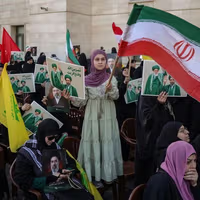
Hardline government supporters who oppose any negotiations with the United States and believe the conflict should continue until the defeat of the United States and Israel also expressed anger at the agreement.
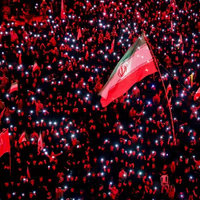
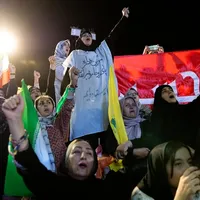
In recent days, hardline demonstrators have chanted slogans such as “Death to the compromisers,” “What happened to the blood of the martyred Leader?” and “We do not accept the agreement.” They have also launched a campaign under the slogan “We Do Not Accept” in an effort to halt the deal.
Videos and posts circulating on social media appeared to show security forces trying to prevent some of these gatherings and, in some cases, using force against demonstrators in Tehran and Mashhad. Iran International could not independently verify the footage or the circumstances.
Among the posts shared on X was one by Mohammad-Taher Rahimi, who wrote: “May the hand be cut off of anyone who shakes hands with the killers of the martyred Imam and poses for a commemorative photograph with them.”
A hardline user named Mehrdad wrote: “After the enemy gains access to uranium, we will enter a difficult existential war. Do not forget that Ghalibaf and Pezeshkian paved the way for this conflict.”
Another user, Hessam Mahmoudi, argued that Iran's uranium stockpile was a key deterrent. “The enemy needed to destroy missile cities with tactical nuclear bombs to force Iran's surrender. The only thing stopping them was uranium. If we give up our uranium stockpile or destroy it, next time they will do something unprecedented to us.”
A user posting under the name Bi Behnam on X wrote: “Let me be very clear. Trump's primary and ultimate goal in accepting this agreement is to remove Iran's uranium reserves. After that, the rest of the path will not be difficult for him. The moment the reserves are handed over or diluted, they will come down on Iran in a way that will become a lesson for history.”