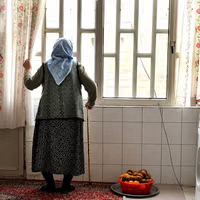
A woman wearing a shroud-like garment attends a rally of hardline Islamic Republic loyalists in Tehran on June 8, 2026, urging Iran’s negotiating team to adhere to Mojtaba Khamenei’s conditions.
Iranian newspapers and digital outlets split sharply over the emerging US-Iran memorandum, with hardliners denouncing it as retreat and pro-diplomacy outlets framing it as a system-backed path to end the war and ease economic pressure.
The Tehran-Washington Memorandum of Understanding, digitally signed on Sunday and expected to be formally signed in Geneva on Friday, has exposed deep divisions across Iran’s media landscape.
Editorials and opinion columns published after the announcement ranged from warnings of capitulation to claims that diplomacy had been made possible by Iran’s military deterrence and could offer the country a path out of war and economic pressure.
Hardliners warn of retreat
Kayhan, the hardline conservative daily, adopted a tone of open opposition, portraying the agreement as diplomatic capitulation under Western pressure and breaking with the official state narrative of victory.
“Surrendering to the Great Satan under the guise of an ‘antidote’ or regional de-escalation is a betrayal of our long-standing resistance,” Kayhan wrote.
“The historical track record shows that retreating before American demands never guarantees peace; it only invites further exploitation. This administration is repeating past blunders, turning a blind eye to our ultimate red lines.”
Khorasan, a conservative daily close to chief negotiator and parliamentary speaker Mohammad Bagher Ghalibaf, framed the MoU not as a peace settlement but as a tactical pause.
“The emerging agreement only aims to end the current war and does not resolve the underlying issues between Iran and the United States,” it wrote.
“This text merely delays the ‘final battle,’ giving both sides time to rebuild offensive and defensive military capabilities and prepare for a larger, full-scale war.”
Hamshahri, the conservative daily affiliated with Tehran Municipality, adopted a more cautious and technocratic tone. It neither endorsed nor rejected the agreement outright, but argued that any concessions from Washington were the result of Iran’s military deterrence rather than US goodwill.
“Let no one mistake this memorandum for a change of heart in Washington,” Hamshahri wrote.
“It is the undeniable triumph of the ‘Field’ and our defensive missile deterrence that dragged Trump’s negotiators to the table. Our economic relief is a direct dividend of our strategic strength, not a product of blind trust in foreign promises.”
Conservatives split over diplomacy
Not all conservative outlets rejected the agreement. Jomhouri Eslami, a traditional conservative newspaper, took the opposite line, criticizing hardline factions that it accused of trying to sabotage diplomacy.
“Anyone who possesses true national pride and genuine patriotism does not beat the drums of endless war,” the paper wrote.
“The remnants of past failed administrations are deliberately trying to stoke public unrest and invite economic ruin just to force their way back into power. True resilience is knowing when to secure the nation’s interests through calculated diplomacy.”
The split among conservative outlets reflected a broader divide inside the Iranian establishment: whether the MoU should be presented as a forced retreat, a tactical military pause, or a pragmatic decision backed by the state.
Reformists defend the agreement
Reformist newspaper Shargh focused on the structural pressures facing Iran, arguing that diplomacy carried costs but that continued economic siege left the country with few viable alternatives.
“We have reached a critical junction where the heavy toll of economic warfare and international naval blockades has worn down our baseline financial structures,” Sharq wrote.
“Confronted with a choice between managed tactical retreats or total systemic rupture, holding a unified defense line via calculated engagement remains our only viable shield against unchecked American geopolitical overreach.”
Etemad, a reformist daily closely aligned with President Masoud Pezeshkian’s administration, emphasized institutional cohesion and warned against internal fractures during the high-stakes implementation phase.
“The finalization of this text is not the decision of a single rogue faction or isolated ministry,” Etemad wrote.
“It is the calculated strategy of the entire sovereign system. The judiciary must act firmly against coordinated internal actors who use falsehoods, defamation, and targeted threats to undermine national unity at the very hour the country needs internal stability most.”
Arman-e Melli, a reform-leaning centrist publication, focused on the economic implications of the agreement, especially the need to ensure that sanctions relief and the lifting of shipping restrictions produce tangible results.
“While the baseline text provides a necessary safety valve for the national currency and immediate relief for global maritime commerce, the true test lies in the verification phase,” the paper wrote.
“The Foreign Ministry must ensure that the lifting of shipping blockades and primary oil sanctions occurs concurrently with our own adjustments, preventing any unilateral bad-faith maneuvers from Washington.”
Digital outlets highlight political fallout
Moderate news website Khabar Online celebrated the breakthrough while highlighting the anxiety it has created among hardliners and regional rivals.
“This historic text marks the definitive victory of collective wisdom over blind extremism,” it wrote.
“While radical elements inside the country scream betrayal, this agreement dismantles the multi-decade campaign to isolate Iran, offering a path where our core nuclear infrastructure remains intact while the economic siege is shattered.”
Fararu, a reform-leaning website, focused on the widening split within the conservative camp, saying mainstream conservative figures were increasingly distancing themselves from the hard right.
“The political landscape has completely shifted overnight,” Fararu wrote.
“Mainstream conservative pillars and major establishment figures are openly breaking away from the ultra-radical factions who are screaming ‘treason’ on the streets.”
Rouydad24 took a sharper institutional angle, arguing that opposition to the deal could isolate hardliners from the state’s decision-making structure.
“By standing against a deal approved at the highest levels of the National Security Council, the extreme right is effectively alienating themselves from the core governance architecture of the Islamic Republic,” it wrote.
Nour News, linked to the Supreme National Security Council, stayed close to the official line, presenting the agreement as a victory for Iran’s combined strategy of deterrence and diplomacy.
“Through a grueling, multi-month diplomatic campaign backed by unbreakable defense capabilities, the Islamic Republic has successfully achieved its primary strategic objectives,” Nour News wrote.
“The immediate and permanent termination of hostile operations across all fronts, coupled with the absolute lifting of the naval embargo, stands as an unvarnished testament to the efficacy of our dual strategy of active deterrence and robust negotiation.”
A deal, and a domestic battle
Taken together, the reactions show that the MoU has not only opened a new diplomatic phase between Tehran and Washington, but also triggered a domestic battle over how the agreement should be understood.
For hardliners, it risks being framed as a retreat from Iran’s red lines. For pro-diplomacy outlets, it is a state-backed attempt to end the war, ease economic pressure and prevent further escalation.
The sharpness of the debate suggests that the next stage of the MoU may be fought not only at the negotiating table, but also inside Iran’s political and media establishment.
An illustration showing an ancient Iranian soldier and a Revolutionary Guard member holding a weapon together, displayed during a November 7 ceremony in Tehran where a statue of pre-Islamic Persian King Shapur I was unveiled.
Tehran’s unveiling of a towering statue depicting the Roman Emperor Valerian kneeling before pre-Islamic Persian King Shapur I has renewed criticism of the Islamic Republic’s appeal to nationalist sentiment following the June war with Israel.
For over forty years, the theocracy purged ancient Persian history from schoolbooks, replacing it with post-Islamic narratives. But after the 12-day conflict with Israel, officials have turned to the distant pre-Islamic past to rally a divided society.
From murals of ancient kings and soldiers to patriotic songs added to Shi’ite mourning ceremonies performed before Supreme Leader Ali Khamenei, Tehran now embraces imagery once deemed heretical by its own revolutionary ethos.
The statue unveiled in Tehran's Revolution Square
'Kneel before Iran' campaign
Tehran’s Revolution (Enghelab) Square was the scene of an unusual spectacle on Friday as officials unveiled a massive bronze statue depicting Roman Emperor Valerian kneeling in submission before Sassanid King Shapur I, commemorating Iran’s victory at the Battle of Edessa (260 AD).
The event was held under the slogan “Kneel before Iran,” part of what authorities describe as a campaign to project “national unity and historical pride” following the June war with Israel.
Tehran Mayor Alireza Zakani, a staunch ultraconservative, said on X: “Enmity with Great Iran can only end in kneeling before this historic nation.”
Municipal official Davood Goodarzi said the installation would be accompanied by visual displays depicting “other victories of Iranians over foreign aggressors,” including the defeat of British forces by local commander Rais-Ali Delvari, Mirza Kuchak Khan’s resistance against Russian troops, and Surena’s triumph over Rome at the Battle of Carrhae in 53 BCE.
The goal, Goodarzi said, is “strengthening concepts such as national dignity, social unity, and Iranian identity.”
The statue, he said, would remain temporarily at Revolution Square before being moved to a city gateway “where it will stand as the first emblem of Iran before diplomats and foreign visitors.”
Unveiled women were allowed to attend the unveiling ceremony—an uncommon scene at events organized by Tehran’s ultra-hardline municipality.
The turn to the pre-Islamic past
The sharp reversal also recalls remarks once made by Khamenei. In a 2011 speech, he asserted that “all the great military victories of this nation came after Islam,” dismissing pre-Islamic accounts as “things that are not documented.”
In 1987, he had said that prophets triumphed over kings such as Cyrus and that “nothing remains of these monarchs in history but names remembered with derision.”
Nevertheless, pro-government social media accounts have now gone so far as to circulate posters equating Khamenei himself with Shapur, showing him standing with a staff as Benjamin Netanyahu and Donald Trump kneel before him. The caption reads: “You will kneel before Iran.”
Image circulating by hardliners on social media
'Hypocrisy'
Pro-government figures have hailed the move as a patriotic success. Conservative political reporter Hossein Saremi posted: “Today’s grand Iranian gathering showed that people and the state share one essence: Iran itself. Nothing can take our homeland away.”
Others, however, called the spectacle “hypocrisy.” Journalist Gholamhossein Pashaei wrote on X: “Every year you close Pasargadae to stop people from celebrating Cyrus Day, yet you unveil Shapur’s statue in Enghelab Square with drums and fireworks during Fatimiyya (mourning period)!”
Dissident commentator Hamid Asafi called the ceremony “a perfect snapshot of the Islamic Republic’s contradictions.”
On Telegram he wrote: “A week ago they closed Cyrus’s tomb out of fear of the crowds, and now they glorify Shapur in the same breath. The Islamic Republic fears living history but poses for selfies with its corpse.”
He added: “They know people no longer respond to rosaries and sermons. That’s why they’ve brought history back to the stage—in a controlled costume. If they can’t erase the past, they’ll try to own it.”
The irony deepened as UNESCO formally recognized Cyrus’s Charter as one of the earliest human-rights documents.
President Masoud Pezeshkian wrote on X: “Iran, the cradle of dialogue, justice, and coexistence, can still inspire peace today.”
Users swiftly replied, questioning how such pride could coexist with a government that blocks access to Cyrus’s tomb each year to those wishing to visit it on his birthday.