• العربية
  • فارسی
Brand
  • Iran Insight
  • Politics
  • Economy
  • Analysis
  • Special Report
  • Opinion
  • Podcast
  • Iran Insight
  • Politics
  • Economy
  • Analysis
  • Special Report
  • Opinion
  • Podcast
  • Theme
  • Language
    • العربية
    • فارسی
  • Iran Insight
  • Politics
  • Economy
  • Analysis
  • Special Report
  • Opinion
  • Podcast
All rights reserved for Volant Media UK Limited
volant media logo
PODCAST

Lebanon may become first test of emerging Iran-US deal, experts say

Negar Mojtahedi
Negar Mojtahedi

Iran International

Jun 13, 2026, 21:42 GMT+1
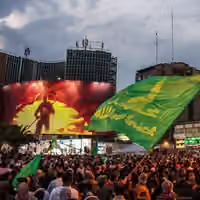
The image shows a gathering in Beirut, Lebanon, on April 22, 2026, where supporters paid tribute to Iran's late Supreme Leader Ali Khamenei and expressed support for his successor, Mojtaba Khamenei.

As Washington and Islamabad push for a preliminary agreement with Iran, experts say the unresolved fight over Lebanon could determine what the region looks like after the war and how much influence Iran retains.

The US and Pakistani officials say a Memorandum of Understanding with Iran will be signed on Sunday, describing it as a step toward ending the wider conflict, but Tehran has cast doubt on the timing.

That uncertainty has kept attention on the issues still capable of derailing or reshaping any deal.

One of them is Lebanon.

Iranian officials and media reports have suggested that any broader understanding with the United States would have to include an end to fighting involving Hezbollah. Israel has rejected any arrangement that would limit its freedom of action, with Defense Minister Israel Katz saying Friday that Israel would continue operating in Lebanon regardless of any agreement with Tehran.

The dispute reflects a larger reality taking shape across the Middle East: even if a preliminary Iran-US agreement moves forward, the struggle over Lebanon may decide what kind of post-war order follows it.

For veteran Middle East negotiator Aaron David Miller, Tehran’s focus on Lebanon is no accident.

“I think they are using Lebanon now to try to push Trump to push Netanyahu and to establish a new equation,” Miller, a senior fellow at the Carnegie Endowment for International Peace, told Eye for Iran.

For decades, Hezbollah served as Iran’s primary deterrent against direct attacks on Iranian territory. Now, Miller argues, Tehran is attempting to reverse that logic by making Hezbollah itself the red line.

Lebanon, he said, has become even more important to Iran after setbacks elsewhere in its regional network. The result is a new dynamic in which military action in Lebanon risks triggering a wider confrontation involving Iran directly.

“The concern about Lebanon and the Persian Gulf is that they provide ample opportunities for miscalculation or kinetic interaction,” Miller said.

The repercussions are already being felt beyond Lebanon.

Mohamed Fahmy, an Egyptian-Canadian journalist and Middle East political analyst who recently returned from reporting in Kuwait, Saudi Arabia and the United Arab Emirates, said the war has altered how Iran is viewed across parts of the Arab world.

“There is a scar that has changed the psyche of people there towards how Iran is viewed,” Fahmy said.

Fahmy said governments across the region are now grappling with questions about deterrence, security and their future relationship with Tehran as missile and drone attacks continue despite diplomatic efforts.

The shifting landscape is also reshaping traditional assumptions about power in the Middle East.

“If you ask me who are the three most powerful players in the region, they’re the three non-Arabs: Israel, Turkey and Iran,” Miller said.

“The three states that dominated Middle Eastern politics for decades, Egypt, Iraq and Syria, are all offline.”

That makes Lebanon more than a side issue in the diplomacy around Iran. It is one of the places where the limits of any agreement may be tested first: whether Iran can preserve the deterrent value of Hezbollah, whether Israel can keep striking without triggering a wider war, and whether Washington can turn a preliminary understanding with Tehran into a more durable regional arrangement.

'The only real end is Iran regime change'

For former US special representative for Iran Elliott Abrams, the debate over Lebanon points to a larger question about the future of the Islamic Republic itself.

“The only real end of this is the end of the regime, which is to say, let the Iranian people govern themselves,” Abrams told Eye for Iran.

Looking beyond the immediate fighting, Abrams argued that the significance of the war may not ultimately be measured by what happens in Lebanon, but by what happens inside Iran.

“If the regime falls in a few years, we’ll all look back on early 2026 and say that’s when it started.”

For now, Lebanon remains one of the clearest tests of the emerging Iran-US track. A preliminary agreement may slow the war, but experts say the unresolved fight over Hezbollah and Israel’s freedom of action could still shape what comes after it.

Most Viewed

Iran officials threaten Hormuz escalation as Trump says deal is near
1

Iran officials threaten Hormuz escalation as Trump says deal is near

2

Iran says US MoU may be signed in days as hardliners warn of retreat

3

US, Pakistan say Iran deal set for Sunday as Tehran split clouds signing

4
ANALYSIS

The uneasy mix of diplomacy and pressure in Canada’s Iran policy

Banner
Banner

Spotlight

  • The uneasy mix of diplomacy and pressure in Canada’s Iran policy
    ANALYSIS

    The uneasy mix of diplomacy and pressure in Canada’s Iran policy

  • How Nourabad Mamasani became an early flashpoint of Iran’s January bloodshed

    How Nourabad Mamasani became an early flashpoint of Iran’s January bloodshed

  • As prices soar, Iranian diets shrink to survival level
    VOICES FROM IRAN

    As prices soar, Iranian diets shrink to survival level

  • Iranian teens say rising costs turn simple wishes into distant dreams
    VOICES FROM IRAN

    Iranian teens say rising costs turn simple wishes into distant dreams

•
•
•

More Stories

US, Pakistan say Iran deal set for Sunday as Tehran split clouds signing

Jun 13, 2026, 12:49 GMT+1
US, Pakistan say Iran deal set for Sunday as Tehran split clouds signing
100%
File photo shows US President Donald Trump (left) and Pakistani Prime Minister Shehbaz Sharif

US President Donald Trump and Pakistani officials said an Iran-US memorandum of understanding is set for electronic signing Sunday, but Tehran’s path to signing is being clouded by hardline backlash, disputes over nuclear terms and the fate of frozen funds.

Trump, in a Truth Social post, said the Deal is scheduled to get signed on Sunday, and "immediately after it is signed, the Hormuz Strait is open to all."

He also said no money would change hands under the agreement, a claim that contrasts with Iranian statements that the release of blocked funds would be an integral part of any deal.

Trump said that “at the appropriate time,” once conditions are calm, the United States would retrieve what he called “the Nuclear Dust” buried deep underground and downblend and destroy it, either in Iran or the United States.

He also warned that if the process fails, Washington has “the ultimate alternative.”

Pakistan’s Foreign Ministry said Saturday that an electronic signing ceremony for the Iran-US memorandum of understanding is scheduled for Sunday.

A senior US administration official told Reuters that Washington believes it has reached a “strong” deal with Iran.

Yet Iran’s security and military establishment has not yet signed off on the agreement, in what The Wall Street Journal described as a potentially significant stumbling block.

Mediators told the Journal on Friday that circles centered on the Islamic Revolutionary Guard Corps had yet to approve the preliminary deal to wind down the war.

Iran remains cautious

That uncertainty cuts against the public confidence coming from Washington and Islamabad, and helps explain why Tehran’s public messaging has remained more cautious.

Iranian Foreign Minister Abbas Araghchi has said a memorandum of understanding with the United States could be signed remotely if final negotiations are completed, while insisting the text has not yet been finalized and could still change.

Al-Arabiya reported that Araghchi will travel to Pakistan on Sunday with a delegation for technical discussions related to the emerging agreement.

However, Iran's foreign ministry spokesman had earlier said no delegation would visit Pakistan and no deal is expected to be signed on Sunday.

Differing versions

The two sides are describing the possible agreement in sharply different ways.

Washington has framed it as a performance-based deal that would require Iran to dismantle its nuclear program, destroy or remove highly enriched uranium and accept inspections before receiving economic relief.

A US official told the Wall Street Journal that under the deal, Iran could receive broad sanctions relief if it decommissions nuclear sites, ends its enrichment program and stops funding proxy militia groups, including Hezbollah in Lebanon.

The signing of an initial agreement would open a 60-day period during which Iran would reopen the Strait of Hormuz and the United States would wind back its blockade of Iranian ports and commerce, the Journal reported.

During that period, negotiations would continue on a final nuclear deal and the sanctions relief Tehran would receive under it.

The US official said Iran would receive no money upfront under the deal, despite Tehran’s demand for $24 billion in assets frozen under US sanctions during the 60-day period, along with some upfront economic relief.

Tehran has presented the memorandum as a political and security framework rather than a final agreement. Foreign Ministry spokesman Esmail Baghaei said the release of Iran’s blocked funds would be an “integral” part of any agreement, while arguing that Tehran should receive payment for services it provides in the Strait of Hormuz. He said foreign military bases and forces in the region must come to an end.

Baghaei also said the nuclear issue and related matters would not be addressed at this stage, with the focus instead on ending the war and issues related to Lebanon.

A deal still contested in Tehran

That gap has given hardliners inside Iran an opening to attack the draft before it is signed.

A video released by IRGC-affiliated media appears to show a gathering outside the Foreign Ministry’s representative office in Mashhad on Saturday evening where protesters chant, “Death to Araghchi, the dishonorable compromiser and infiltrator.”

The hardliners have been criticizing the foreign ministry and the negotiating team in recent days, accusing them of giving too many concessions to the United States in the emerging deal.

Kayhan, a hardline daily close to Iran’s most uncompromising faction, warned that the Strait of Hormuz must not be reopened through diplomacy with Washington. It said Hormuz had been closed “with power” and should not be opened until US forces leave the region and Washington accepts the supreme leader’s red lines.

Khorasan daily went further, arguing that any deal would only delay what it described as a final confrontation between Iran and the United States, giving both sides time to rebuild offensive and defensive strength before a wider war.

The backlash has also moved through parliament. Ebrahim Rezaei, spokesman for parliament’s National Security Committee, said “excessive generosity” at the negotiating table had changed “the enemy’s calculations” and made Washington think Iran was weak.

Mahmoud Nabavian, another hardline member of the committee, criticized the emerging MoU as open-ended, saying it does not set a timeline for a final agreement and allows for its extension. He said sanctions relief, the withdrawal of US forces and the lifting of the blockade had all been deferred to a final agreement.

Nabavian also said enrichment would remain at its current level, which he described as “zero,” while Tehran would be committed to preparing the ground for reopening the Strait of Hormuz and allowing all commercial vessels to pass without restrictions.

But the hardline front is not entirely unified. The conservative daily Javan criticized those rejecting any negotiation with Washington, arguing that diplomacy can be part of confrontation rather than surrender.

Tehran also appears to be keeping its strategic partners informed. Iranian Deputy Foreign Minister Kazem Gharibabadi said he discussed the latest developments on the draft Islamabad memorandum with the Russian and Chinese ambassadors in Tehran.

Hormuz remains the test

Hormuz remains the clearest test of whether diplomacy is lowering the temperature or merely reorganizing the pressure.

Araghchi has said Iran’s pressure over the strait would remain in place and that Iranian forces would intervene whenever necessary. He said tolls could not be imposed under international law, but described “service fees” as part of the negotiations.

Baghaei echoed that argument, saying Tehran’s measures to manage safe traffic through the Strait of Hormuz were both a step to protect national security and an effort serving the broader interests of the international community.

At the same time, the blockade is already affecting trade. Abbas Soufi, deputy chairman of parliament’s Construction Committee, said imports through Iran’s southern ports have faced challenges because of maritime restrictions.

A senior US administration official said Washington would be involved in de-mining the Strait of Hormuz as it reopens, with G7 countries possibly joining the effort. The official also said Trump will meet leaders from the UAE, Qatar and other Middle Eastern countries at the G7 summit.

The uneasy mix of diplomacy and pressure in Canada’s Iran policy

Jun 13, 2026, 02:21 GMT+1
•
Mahsa Mortazavi
The uneasy mix of diplomacy and pressure in Canada’s Iran policy
100%

Canada’s response to the latest Iran crisis reflects the contradiction at the heart of Western policy toward Tehran: a continued call for diplomacy with a government it simultaneously treats as a source of terrorism, repression and regional instability.

In a written response to Iran International, the Canadian government said all parties involved in the latest exchanges between Iran, Israel and the United States must comply with international humanitarian law, including the protection of civilians and civilian infrastructure.

Ottawa also stressed the need for diplomacy and dialogue to resolve the crisis. But in Canada’s case, that language does not signal a softer approach toward Tehran. It sits alongside one of the most restrictive Iran policies among Western governments, built around sanctions, terrorist designations and a long-standing diplomatic rupture.

That tension is especially visible in Canada’s concern over the Strait of Hormuz.

Global Affairs Canada said Ottawa remains worried about disruptions in the strategic waterway and emphasized that respect for international navigation rights under international law is essential. It said the free flow of maritime traffic through the corridor is critical to global energy stability and supply chains.

For Canada, the crisis is therefore not only about preventing a wider war or limiting civilian harm. It is also about protecting the rules and routes that underpin global trade, energy flows and maritime security.

That is where Ottawa’s call for diplomacy begins to narrow. Canada supports de-escalation, but not in a way that separates the current crisis from Tehran’s broader conduct in the region.

Global Affairs Canada said Ottawa will continue working with allies and partners, both bilaterally and multilaterally, to support a diplomatic solution while countering what it describes as destabilizing activities by the Islamic Republic.

Those activities include Iran’s support for terrorist organizations, its ballistic missile program, nuclear activities and systematic human rights violations.

In other words, Canada’s message is not simply that the fighting should stop. It is that any diplomatic path must exist alongside continued pressure on the structures Ottawa believes drive Iran’s regional behavior.

That pressure is not only rhetorical.

Canada lists Hamas, Hezbollah and Yemen’s Houthi movement, also known as Ansarallah, as terrorist organizations. Ottawa has accused Iran of providing political, financial or military support to such groups.

In June 2024, Canada also listed the Islamic Revolutionary Guard Corps as a terrorist organization, following years of pressure from victims’ families of Flight PS752, human rights advocates and the Iranian-Canadian community.

Since 2012, Canada has designated Iran as a foreign state supporter of terrorism under the State Immunity Act, a legal framework that allows victims of terrorism to pursue civil action against the Iranian state in Canadian courts.

Together, those measures make Canada’s diplomatic language more constrained than it may first appear. Ottawa can call for dialogue, but it is doing so with a state it has legally and politically framed as a sponsor of terrorism and a source of transnational threats.

The sanctions record points in the same direction.

In March 2026, Canada sanctioned five individuals and four entities involved in procurement networks supplying technology used in IRGC weapons production, including drone-related systems. Canada said some Iranian arms, drones and technology have been transferred to Russia for use in the war against Ukraine.

A month earlier, Ottawa sanctioned seven individuals linked to Iranian state bodies responsible for intimidation, violence and transnational repression targeting dissidents and human rights defenders.

These measures show why Canada’s Iran policy cannot be read only through its latest call for restraint. The government is trying to prevent escalation in the short term while preserving the tools it has built over years to isolate and pressure Tehran.

The relationship has been moving in that direction for more than a decade.

Canada severed diplomatic relations with Iran in September 2012, closed its embassy in Tehran and declared Iranian diplomats in Canada persona non grata. Relations have not been restored since.

The gap widened further after the downing of Flight PS752, crackdowns on protests in Iran, allegations of transnational repression, Tehran’s regional activities, and concerns over its missile and nuclear programs.

Against that backdrop, Canada’s latest response is less a change in policy than a reminder of its limits. Ottawa wants diplomacy to contain the crisis, but it has little trust in the government with which diplomacy would have to be conducted.

That is the uneasy mix shaping Canada’s approach: avoid direct military involvement, keep channels for de-escalation open, and continue working with allies to restrict Iran’s room for maneuver.

The unresolved question is whether diplomacy can contain the crisis if Tehran is unwilling to make lasting changes, or whether negotiations will again become a way to delay pressure while preserving the policies that brought the region to this point.

Tit-for-tat under ceasefire: Experts warn of new normal in Mideast conflict

Jun 11, 2026, 19:46 GMT+1
Tit-for-tat under ceasefire: Experts warn of new normal in Mideast conflict
100%
From right to left: Negar Mojtahedi, Alex Vatanka, Robert Satloff, and Ambassador David Hale attend Iran International's townhall in Washington DC on June 10, 2026.

The Middle East may be entering a period in which ceasefires no longer end wars but manage them, as the warring sides trade limited strikes below the threshold of an all-out war, experts told Iran International’s townhall held in Washington DC.

The discussion, hosted by Iran International’s Negar Mojtahedi, centered on whether the latest ceasefire in Lebanon marks the end of a war or the beginning of a more dangerous phase: a regional conflict in which Iran increasingly treats attacks on its proxies as attacks on itself.

A ceasefire that does not end the war

Alex Vatanka, a senior fellow at the Middle East Institute, said Iran’s latest posture toward Lebanon should be viewed against the long arc of the Islamic Republic’s presence there.

He noted that it has been more than four decades since the first official officers of the Islamic Revolutionary Guard Corps arrived in Lebanon, making the country a central pillar of Tehran’s regional project.

Alex Vatanka
100%
Alex Vatanka

For years, Vatanka said, Iran used Lebanon and Hezbollah to project power, particularly against Israel. But recent events suggest Tehran may now be entering “a new chapter,” one in which the distinction between Iran and its proxy network becomes more blurred.

“An attack on Hezbollah, an attack on the Houthis, an attack on the Hashd al-Shaabi is going to, from now onward, be considered an attack on Iran,” Vatanka said, describing what Iranian officials have presented as a new defense doctrine.

He cautioned that if taken literally, such a doctrine could mean an open-ended regional confrontation. Any strike on Hezbollah in Lebanon, the Houthis in Yemen, or Iran-backed militias in Iraq could invite a direct Iranian response, turning local battlefields into triggers for wider escalation.

Vatanka said Tehran appears to be defending its proxy strategy at a moment when many analysts had expected the opposite. After October 7 and the heavy blows inflicted on Iran-backed groups, some believed the Islamic Republic might conclude that its “forward defense” strategy had failed. Instead, he said, influential voices in Tehran appear to be arguing that this is precisely the moment to double down.

Iran’s umbrella over Lebanon

Robert Satloff, executive director of the Washington Institute, said Lebanon is now caught between two competing visions of its future.

“There are two competing realities in Lebanon,” Satloff said. “One reality is Iran asserting its umbrella to control Lebanon... The other reality is Lebanon and Israel negotiating a security agreement, potentially a peace agreement.”

That contrast may define the next phase of the conflict. In one scenario, Iran tries to reassert control through Hezbollah and make clear that Lebanon remains part of its regional security architecture. In the other, Lebanon’s government attempts to reclaim sovereignty and pursue security arrangements with Israel, with US backing.

Robert Satloff
100%
Robert Satloff

Satloff said Iran’s attempt to claim Lebanon under its umbrella has not succeeded, but neither has the effort to fully disarm Hezbollah. He described the challenge as a contest between Iran’s regional power projection and a fragile Lebanese state trying to implement commitments it has made before but repeatedly failed to fulfill.

He also argued that Iran’s latest direct attack on Israel showed weakness rather than strength. Compared with previous barrages involving hundreds of missiles, he said, the latest attack was limited and intercepted, exposing the degradation of Iran’s capabilities rather than demonstrating strategic confidence.

Hezbollah down, but not out

Ambassador David Hale, a distinguished diplomatic fellow at the Middle East Institute and former US ambassador to Lebanon, Jordan and Pakistan, said one of the most striking changes is Hezbollah’s current vulnerability.

“Hezbollah is so degraded, it's down but not out, but it's so degraded that it can't defend itself,” Hale said. “Iran is coming in to defend its proxy. It's always the other way around.”

For Hale, that reversal is significant. Hezbollah was long understood as one of Iran’s most powerful deterrent tools, a force capable of threatening Israel and shaping Lebanese politics on Tehran’s behalf. Now, he said, Iran’s direct intervention suggests Hezbollah can no longer perform its traditional role with the same effectiveness.

Ambassador David Hale
100%
Ambassador David Hale

Still, Hale warned against assuming that Lebanon can resolve the Hezbollah question through military action alone. He said sovereignty is not “a light switch,” and disarming Hezbollah will require a political process as well as military pressure.

Lebanon’s state institutions, he said, remain weak by design, reflecting the country’s sectarian balance. Although President Joseph Aoun and Prime Minister Nawaf Salam have shown willingness to engage in a new direction, Hale said the Lebanese Armed Forces are unlikely to simply move into Hezbollah-controlled areas “guns blazing.” A durable solution would require humanitarian support, political alternatives for Lebanon’s Shiite community, and a credible state presence in the south.

The US as the decisive variable

The panelists agreed that whether this becomes the region’s new normal depends heavily on Washington.

Satloff said Iran’s attacks across the region, including against Kuwait, Bahrain and a US base in Jordan, should remind Arab states “who the real aggressor is” and create an opportunity for President Donald Trump to rally regional partners against Tehran. But he warned that the moment could be lost if Washington quickly returns to seeking any deal it can get.

Hale said the United States should rely less on public rhetoric and more on sustained pressure. He argued that Tehran understands violence and intimidation, and that Washington must be prepared to respond with persistent military, economic and political pressure.

100%

But the panel also raised doubts about the coherence of US strategy. Vatanka said he was struck by how much planning appeared to have gone into the military side of the confrontation, and how little into the political endgame. The stated US goal, he noted, has shifted from encouraging Iranians to challenge the regime to narrower objectives such as the nuclear file, trade and the Strait of Hormuz.

That uncertainty may be what makes the current moment so dangerous. A ceasefire may reduce the intensity of the fighting, but if Iran continues to defend its proxies as extensions of itself, Israel continues to strike perceived threats, Arab states are drawn into the line of fire, and Washington alternates between pressure and dealmaking, the region could remain trapped in a cycle of calibrated escalation.

Audience questions turn to Washington’s endgame

The audience Q&A shifted the discussion from battlefield dynamics to whether Washington has a political strategy to match its military pressure on Tehran.

Asked about regime change, Hale warned against raising expectations among Iranians without being prepared to follow through.

Satloff said Washington should instead invest in tools that prepare the ground for change, including stronger broadcasting to Iranians, internet access, and visa or asylum pathways for dissidents.

Vatanka said the deeper problem remains the lack of a coherent US strategy toward Iran.

100%

The exchange underscored a central point of the townhall: without a political endgame, military pressure alone may leave the region trapped in a cycle of ceasefires, strikes and retaliation.

For now, the experts suggested, the Middle East is not clearly moving from war to peace. It may instead be settling into a volatile gray zone: a ceasefire era in which the guns never fully fall silent.

US probes NIAC founder Trita Parsi for possible deportation - Free Press

Jun 11, 2026, 07:24 GMT+1
US probes NIAC founder Trita Parsi for possible deportation - Free Press
100%

The US State Department is investigating NIAC founder Trita Parsi and weighing whether to revoke his green card, The Free Press reported, in a case that revives long-running questions over Tehran’s influence in Washington.

The report, by Jay Solomon, said US officials and documents reviewed by The Free Press show Parsi has become a target of the State Department investigation as Secretary of State Marco Rubio seeks to counter Iranian influence inside the United States.

Parsi, 51, was born in Iran, raised in Sweden and has lived in the United States for more than 25 years. He is a green-card holder and co-founder of the Quincy Institute for Responsible Statecraft, a Washington think tank that argues for diplomacy, military restraint and a smaller US military role overseas.

The State Department declined to discuss Parsi’s immigration status, The Free Press said. Parsi and Quincy did not respond to the outlet’s requests for comment.

  • Inside Tehran’s Soft War: How Iran Gained Influence In US Policy Centers

    Inside Tehran’s Soft War: How Iran Gained Influence In US Policy Centers

The investigation places one of the most prominent critics of the US-Israel war against Iran at the center of a broader fight over who shapes Washington’s Iran debate.

Since the war began, Parsi has appeared across left-wing, mainstream and even pro-MAGA platforms arguing that Trump faces a quagmire and that Washington should seek a deal with Tehran.

  • US arrests Iranian national over alleged Basij-linked visa fraud

    US arrests Iranian national over alleged Basij-linked visa fraud

His critics say that position fits a much longer pattern: opposing sanctions and military pressure, amplifying Tehran’s warnings, and presenting policies favorable to the Islamic Republic as anti-war realism. Parsi has denied wrongdoing and has said such criticism is an effort to silence opponents of Trump’s Iran policy.

The Free Press cited a Trump administration official saying the State Department is reviewing people whose work is seen as helping US adversaries. “Anyone who seeks to undermine the US, we’re taking a hard look at,” the official said.

  • US terminates green cards of 3 Iranians tied to Islamic Republic

    US terminates green cards of 3 Iranians tied to Islamic Republic

Parsi has long been a divisive figure among Iranian Americans. In 2002, he founded the National Iranian American Council, or NIAC, which described itself as a voice for Iranian Americans and later became one of the most visible organizations advocating engagement with Tehran.

In 2020, Republican senators Tom Cotton, Mike Braun and Ted Cruz asked the Justice Department to examine whether NIAC should register as a foreign agent, accusing it of amplifying Iranian government propaganda. No investigation or enforcement action was publicly announced.

  • Under fire at home, Pezeshkian misses own VIP dinner send-off at UN

    Under fire at home, Pezeshkian misses own VIP dinner send-off at UN

The Free Press also revisited Parsi’s defamation lawsuit against Iranian American journalist Hassan Daioleslam, who had accused Parsi and NIAC of advancing Tehran’s interests. The lawsuit was dismissed. Emails disclosed in the case showed Parsi had corresponded with Iran’s then-UN ambassador, who later became foreign minister, about meetings with US lawmakers and policy conferences.

The latest report also points to Parsi’s family and professional ecosystem. His brother, Rouzbeh Parsi, helped create the Iran Experts Initiative, a network of Iranian scholars and analysts formed in 2014 as nuclear talks with world powers intensified.

  • Exclusive: Covert Ties Between Iran And The International Crisis Group

    Exclusive: Covert Ties Between Iran And The International Crisis Group

The initiative was first exposed in 2023 by Iran International and Semafor, based on thousands of Iranian Foreign Ministry emails. The documents showed Iranian officials sought to cultivate overseas analysts and academics who could promote Tehran’s positions on the nuclear talks in Western media and policy circles.

The Free Press said Trita Parsi’s name did not appear in the Foreign Ministry emails as a member of the initiative. But it quoted critics who argued that the work of the two brothers should be viewed as part of a broader effort to weaken pressure on Tehran and normalize engagement with the Islamic Republic.

  • Leaked documents tie Iranian-Swedish scholar to Tehran’s influence network

    Leaked documents tie Iranian-Swedish scholar to Tehran’s influence network

Rouzbeh Parsi has denied cooperating with Tehran. A later investigation by the Swedish Institute of International Affairs, his former employer, found no evidence that he was paid by Iran or controlled by it. But it concluded that he had been a principal creator of the initiative and had failed to disclose its work to the institute, Sweden’s foreign ministry or Lund University. The institute ended his employment in May 2025.

The Iran Experts Initiative revelations also drew attention in Washington because one of its founding members, Ariane Tabatabai, later held a senior Defense Department role under the Biden administration.

  • Republican senator seeks FBI, Pentagon probe into Iranian influence

    Republican senator seeks FBI, Pentagon probe into Iranian influence

Republican lawmakers pressed the Pentagon and FBI to ensure members of the initiative were not in positions to influence US policy or access sensitive intelligence. Tabatabai’s current employer has defended her record and said she had passed security reviews under multiple administrations.

The controversy around Parsi has not been limited to Washington. In February, the German Institute for Global and Area Studies canceled a Berlin event featuring him after public backlash from Iranian activists and opponents of the Islamic Republic.

  • Biden White House regularly hosted Pentagon official with ties to Iran

    Biden White House regularly hosted Pentagon official with ties to Iran

The institute cited security concerns, while critics said Western institutions should not offer unchallenged platforms to figures they accuse of echoing Tehran’s policy line.

The Free Press report said Quincy had prepared for a possible legal fight. In an April memo reviewed by the outlet, Quincy CEO Lora Lumpe said the think tank’s chairman had agreed to cover legal costs to prepare for, and if necessary fight, what she called a “deportation attack on Trita.”

The memo said Quincy was retaining an immigration lawyer and preparing a habeas corpus petition in case Parsi was suddenly detained by immigration authorities.

The report also said Parsi’s recent criticism of the Iran war has been noticed in Tehran. Photos circulated last month by Iranian activists showed banners bearing his face on a Tehran overpass and lamppost, alongside a quote attributed to him saying Trump’s “failed war” had destroyed Washington’s ability to make military threats.

  • Iran Influence Network Parallels Soviet Era 'Active Measures'

    Iran Influence Network Parallels Soviet Era 'Active Measures'

For critics, those images captured the central question around Parsi’s career: why a Washington analyst’s arguments are repeatedly useful to Tehran at moments when US pressure on the Islamic Republic is at stake.

For his defenders, the case raises a different concern: whether the Trump administration is using immigration powers to punish lawful political speech and dissent over war policy.

That tension makes the Parsi investigation more than a dispute over one analyst’s status. It is now part of a wider battle over Iranian influence, free speech, immigration power and the long-running struggle to define US policy toward Tehran.

Iran defrocks cleric after challenge to state-backed Shiite narratives

Jun 10, 2026, 14:16 GMT+1
Iran defrocks cleric after challenge to state-backed Shiite narratives
100%
Cleric Abdolrahim Soleimani Ardestani (right) during a youtube debate show with cleric Hamed Kashani (center)

Iran’s Special Clerical Court has sentenced dissident cleric Abdolrahim Soleimani Ardestani to six years in prison, a fine and removal from the clergy, months after his public challenge to state-backed Shiite narratives drew threats and political pressure.

Soleimani Ardestani, a religious scholar, former Mofid University professor and member of a reformist association of Qom seminary teachers and researchers, is being held in Qom’s prison.

According to Mojtaba Lotfi, an official from the office of the late dissident cleric Hossein Ali Montazeri, the court convicted him on all eight charges brought against him.

Lotfi said Soleimani Ardestani does not plan to appeal unless the court agrees to hold a public hearing.

In a letter from prison, Soleimani Ardestani said the charges against him included disturbing public opinion, insulting sacred values, insulting the leadership in relation to Ali Khamenei and his son Mojtaba, taking part in a gathering over the house arrest of Mir-Hossein Mousavi, and assembly and collusion against domestic security.

Mousavi, a former prime minister, has been under house arrest since 2011 after rejecting the official result of Iran’s disputed 2009 presidential election and becoming one of the symbols of the Green Movement protests.

Soleimani Ardestani also listed accusations such as propaganda against the system, spreading falsehoods online, insulting senior religious authorities, damaging the dignity of the clergy and “mind control and psychological suggestion” – a striking charge even by the standards of Iran’s broad political indictments.

He has called the indictment weak and baseless, criticized his arrest and solitary confinement, and said he wrote his defense not to seek acquittal but to leave a record for history.

The case began with remarks in a debate with pro-government cleric Hamed Kashani. Soleimani Ardestani questioned long-promoted Shiite accounts about the death of Fatemeh Zahra, the daughter of the Prophet Muhammed and wife of Ali, the first Shiite Imam.

In Iran, the story of Fatemeh’s martyrdom is not only a religious narrative but part of a vast state-backed culture of mourning, ritual and political identity.

Soleimani Ardestani argued that if Ali had merely watched his wife being attacked and had not intervened, then the traditional account would raise questions about his justice. He later said he had not insulted Fatemeh and was challenging what he called the “stories told by religious singers or eulogists (maddahs).”

  • Q&A: Who are Iran's ‘eulogists’ and what is their role in the Islamic Republic?

    Q&A: Who are Iran's ‘eulogists’ and what is their role in the Islamic Republic?

He also questioned mourning ceremonies for Muhammad Taqi, the ninth Shiite Imam, saying his death was linked to jealousy by his wife after he remarried and that mourning the event 1,300 years later was meaningless.

The backlash was immediate. Pro-government eulogists, who play an influential role in mobilizing religious crowds, attacked him with vulgar and sexist language. Reports also emerged of a group attack on his home.

  • Eulogists Are Khamenei's Favorite Politicians, Mob Influencers

    Eulogists Are Khamenei's Favorite Politicians, Mob Influencers

Hardline figures called for prosecution and defrocking, while some religious voices went further, suggesting that denial of Fatemeh’s martyrdom could amount to leaving Shiite doctrine.

The controversy also split parts of the political middle ground. Reformist figures criticized Soleimani Ardestani’s tone and timing, while others warned that violent threats, home attacks and denunciations violated freedom of belief.

The sentence is significant because it shows how quickly the Islamic Republic can convert a dispute over religious history into a security case.

Soleimani Ardestani was not an outside critic of clerical rule. He was a cleric from inside the seminary world, which makes his challenge more sensitive.

By sentencing him to prison and stripping him of clerical status, the system is not only punishing one man. It is policing the boundaries of who is allowed to interpret religion, how far internal debate can go, and what happens when religious scholarship collides with the political theology of the state.