Bessent says damage to US allies will be paid from Iranian accounts
US Treasury Secretary Scott Bessent said damage to US allies in the Persian Gulf would be paid for with funds extracted from Iranian accounts, warning that every attack launched by Iran would deepen the economic and financial consequences it faces.
“The Iranian regime will lose the zero-sum game it is playing,” Bessent said on X.
“Any damage it inflicts on our allies in the Gulf will be paid for with funds extracted from Iranian Accounts. Any tolls paid to the Persian Gulf Strait Authority will be offset by funds extracted from their accounts,” he added.
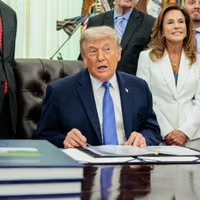
President Donald Trump said in a Fox News interview on Thursday that the United States was still talking to Iran but that his preference would be to take Kharg Island, the country’s oil infrastructure hub.
“We are talking to them and all, but you know, look, my preference has always been - take Kharg Island ... my preference would be that. I don't know that America has the stomach for it,” Trump said.
Trump said the United States would attack Iran again with intensified strikes on Thursday night, but added that he would rather not hit bridges and power plants.
“There will be more bombing tonight. It will be bigger - bigger, more powerful,” he said.
Despite plans for more strikes, Trump said the United States was still talking with Iran to reach a deal.
Trump argued Iran was already feeling the effects of the strikes.
“They have no defense. They can't do anything about it... We dropped $250 million worth of bombs on them last night,” he said.
“They're in submission, they just don't know it yet,” he added.
The United States will hit Iran "very hard tonight" and will soon take control of the country's oil and gas infrastructure and markets, US President Donald Trump said in a social media post on Thursday.
Trump specifically threatened to take Kharg Island and other energy infrastructure sites after asserting that Iran's military capabilities had been largely eliminated.
A general view of The Houses of Parliament in London
A UK minister said new state-threat legislation could give the Home Secretary power to act against hostile state-backed threats, as lawmakers pressed the government over the IRGC, Iran-linked proxy groups and threats to UK-based journalists and Jewish communities.
Home Office minister David Hanson, said the government wanted the bill passed so the Home Secretary could make judgments on state threats and take action that, if approved by both Houses of Parliament, could lead to sentences of up to 14 years for those convicted.
“We are trying to put in place a framework for legislation where we can act on any potential state threat,” Hanson told the House of Lords.
He added: “The Government condemns antisemitism and is very much aware of the Iranian state threat.”
Lord Henry Bellingham welcomed the legislation and said “the use of these proxies, behind which obviously countries like Iran are hiding, are doing untold harm.”
He said the issue was “not just the IRGC,” pointing also to the Iran-linked Harakat Ashab al-Yamin al-Islamiya, which he said had claimed responsibility for recent antisemitic attacks.
Hanson said any future designation would be for the Home Secretary to assess once the bill becomes law, adding: “We take the threats from Iran extremely seriously and we will continue to monitor that.”
Lord John Cryer said the bill was welcome but overdue, citing the case involving an attack on Iran International journalist Pouria Zeraati and saying IRGC proxies and agents had targeted British Jews and Jewish institutions.
Lord Stuart Polak urged ministers to look beyond the IRGC itself and examine “what’s going on in the charity world here,” saying money was being raised in Britain, including British taxpayers’ money, “towards helping the IRGC.”
Hanson said Britain had already sanctioned more than 550 Iranian individuals and organizations, including the IRGC in its entirety, and had placed Iran under the Foreign Influence Registration Scheme.
“What this power will do will give the Secretary of State, if passed by both Houses, an additional power to take action against any state threat the Secretary of State deems to be a threat to the United Kingdom,” he said.
US forces disabled a Guinea-Bissau-flagged oil tanker in the Sea of Oman on Wednesday after it violated a blockade against Iran by trying to transport Iranian oil, US Central Command said on Thursday.
CENTCOM said a US aircraft fired two Hellfire missiles into the engine room of the MT Jalveer after the crew repeatedly failed to comply with US directions.
It said the Jalveer was the third commercial vessel disabled by US forces this week, after the Palau-flagged MT Marivex and MT Settebello.
CENTCOM said US forces had disabled nine non-compliant vessels, redirected 135 ships that complied and allowed 42 vessels carrying humanitarian aid to pass since the blockade began on April 13.