Stolen Revolution: new book traces Iran’s path from revolution to mafia state
As Iran grapples with its most severe crisis since 1979, a new book by journalists Yeganeh Torbati and Bozorgmehr Sharafedin is revisiting how a revolution built on promises of justice and equality turned into what the authors describe as a mafia state.
Published this week, Stolen Revolution: Betrayal and Hope in Modern Iran has drawn attention at policy forums in Washington and New York, where its authors discussed Iran’s modern history, the resilience of the Islamic Republic and the country’s uncertain future after war, economic collapse and the succession of Mojtaba Khamenei.
The New York Times Book Review described Stolen Revolution as “one of the most perceptive books on modern Iran in years, capturing not only the machinery of repression but the fragile forms of hope that survive beneath it.”
The Center for Middle East Policy at Brookings hosted Torbati, the New York Times Iran correspondent, and Sharafedin, the Head of Digital at Iran International and a former Reuters Iran correspondent, on Wednesday.
The discussion was moderated by Suzanne Maloney, an Iran scholar and vice president and director of the Foreign Policy program at Brookings.
“One theme that runs throughout the book is the constant push and pull between the nation and the state,” Sharafedin said at the event.
“The Islamic Republic tries to project an image of continuity, to show it is business as usual and they are in full control. Much of the people’s struggle against the system has been an effort to break that continuity. Yet the system has proved quite resilient. Even foreign intervention was unable to create a rupture or break that continuity,” he said.
Sharafedin said the succession of Mojtaba Khamenei after his father was a sign of that continuity.
Authors Yeganeh Torbati and Bozorgmehr Sharafedin speak at the Brookings Institution in Washington, DC, on June 3, 2026, in a discussion moderated by Suzanne Maloney.
The assassination of Iran's Supreme Leader Ali Khamenei in late February plunged the country into its most perilous crisis since the 1979 revolution, leaving the Islamic Republic struggling with the aftermath of war, a collapsing economy and the military's expanding role in state affairs.
“I think what we've learned over the last 10 or 12 weeks—and what also became clearer to us while writing the book—is that individuals play a very important role in shaping the trajectory of events,” Torbati said.
“At the same time, the system is bigger than any one person—whether a supreme leader, a general, or a national security adviser. It is a system deeply committed to its own survival and self-preservation.”
Torbati said Iran is projected to face around 70 percent inflation this year. Food prices have soared, and layoffs have followed the war. Yet the system and its leadership appear willing to absorb those costs, and have ordinary Iranians bear much of the burden, in order to survive and avoid capitulating to the United States and Israel.
Yeganeh Torbati
“By contrast, American leaders must contend with public opinion. President Trump has to worry about public support, and his party has to worry about the midterm elections,” she said.
“As a result, the Iranian government can often tolerate far more pain and pursue tactics for much longer than its American counterparts. I think that helps explain its survival up to this point.”
At a separate discussion hosted by the 92nd Street Y in New York on Wednesday night, journalist Scott Anderson, the author of King of Kings, joined Torbati and Sharafedin to assess Iran's modern history and the fallout from the US-Israeli war.
“Iranians have expressed [they want democracy] many, many times, and they've been machine-gunned for it,” Anderson said, referring to the January massacre in Iran that killed tens of thousands.
“Iran is not a closed society like North Korea. Iranians have a very good concept of what's happening in the outside world. Yet it's just this massive monolithic structure that has the guns,” he said.
Bozorgmehr Sharafedin
The book traces how a revolution that promised to build an egalitarian society gradually transformed into what the authors describe as a mafia state. It tells that story through the lives of six Iranians whose experiences span the arc of modern Iranian history and who undergo profound transformations themselves.
One of them is Mehdi Karroubi, a devoted follower of Ayatollah Ruhollah Khomeini who rose to the highest ranks of power. Over time, however, he became a vocal critic of the Islamic Republic after seeing corruption, especially the growing role of the Revolutionary Guards in the economy. He paid a heavy price for his criticism and ultimately spent years under house arrest.
Another is Said Rahmani, who returned to Iran hoping to spark a startup boom in his country. Instead, he encountered a ruthless security state that seized much of his business empire and eventually forced him into exile.
“In my opinion, this is a book that will be of great interest both to those who have never read anything about Iran but are watching the news and want to better understand the country, and to those of us who already have large libraries of books on Iran,” Maloney said.
Former UK Foreign Secretary Jack Straw called the book “extraordinarily powerful,” while Jonathan Blitzer, an American journalist and writer, described it as “a masterwork of reporting.”
David Hoffman, author of The Billion Dollar Spy, called it “a brilliant investigative history of modern Iran,” and the BBC’s Lyse Doucet said it was “a rare and riveting chronicle of a major political story of our time.”
File photo of men resting in a dormitory at an addiction treatment camp in Iran.
Shortages and rising prices of addiction treatment medicines are disrupting care for many people with substance dependence in Iran, raising concerns that patients could relapse or turn to more dangerous drugs, a former addiction treatment official said on Thursday.
"The shortage of opium tincture has become one of the most serious challenges facing addiction treatment centers," Saeed Safatian, a former treatment director at Iran's Drug Control Headquarters, told ILNA.
Supplies of opium tincture, one of the three main medicines used in Iran's addiction treatment system alongside methadone and buprenorphine, have fallen sharply in recent months.
Safatian linked the shortages to reduced availability of raw opium following the Taliban's ban on poppy cultivation in Afghanistan and said authorities had failed to prepare adequately despite years of warnings about potential supply disruptions.
Proposals to cultivate opium domestically for pharmaceutical purposes and efforts to secure imports from countries including India and Turkey failed to materialize, leaving treatment providers with few options, according to Safatian.
File photo of residents sitting on bunk beds inside an addiction treatment and rehabilitation camp in Iran.
The shortages have fueled concerns among addiction specialists that patients unable to obtain prescribed medicines could return to the illicit drug market.
"Nearly one million patients depend on maintenance treatment with opium tincture across the country, but treatment centers in more than 15 provinces have faced shortages or suspension of their medicine allocations," Ali Ahmadi, deputy head of Tehran province's addiction treatment providers association, said earlier during a protest by treatment providers outside the Health Ministry.
A worker at an addiction treatment center told Iran International in January that he had received no support from the State Welfare Organization despite a decade of operating a treatment facility. The revocation of licenses for some centers had also pushed many patients toward methadone treatment, he said.
The effects of the shortages became apparent in 2023 and intensified in 2025, when some treatment centers were able to provide opium tincture to only a fraction of patients seeking it, Safatian said.
He warned that some users could shift to methamphetamine or combine multiple substances, making treatment more difficult and increasing health, social and economic harms.
Shortages of opium tincture, methadone and other addiction medicines, he said, could continue in the coming months if problems securing raw materials and foreign currency persist, adding to pressure on Iran's addiction treatment system.
A scene of nightly state-organized rallies in Tehran
Supporters of the ultra-hardline Paydari Front were removed earlier this week from nightly state-organized rallies backing the Islamic Republic, in an apparent effort to contain hardline pressure as talks with the United States continue, Iran International has learned.
According to the information obtained by Iran International, the order to keep Paydari supporters away from the gatherings was issued after requests by President Masoud Pezeshkian and Parliament Speaker Mohammad Bagher Ghalibaf, who also heads Tehran’s negotiating team.
Protesters carrying placards opposing concessions on the nuclear issue have also been removed from the state-backed rallies, according to the same information.
The move points to an effort by senior figures in the Islamic Republic to contain ultra-hardline pressure at a sensitive moment, as Tehran and Washington continue talks over a possible understanding involving the ceasefire, the Strait of Hormuz, frozen Iranian assets and nuclear-related terms.
The Paydari Front and its allies have been among the most vocal opponents of negotiations with the United States. In recent days, figures close to the camp have criticized Ghalibaf and the negotiating team, warning against concessions and arguing that talks with Washington amount to a mistake.
The reported removals came as the Islamic Republic held the first anniversary ceremony for Ruhollah Khomeini since the killing of Ali Khamenei, without the former supreme leader’s presence.
During the ceremony on Thursday, Mojtaba Khamenei issued a message warning against what he called doubt, despair, fear and suspicion.
The message, read by Mohammad-Javad Haj-Ali-Akbari, Tehran’s interim Friday prayer leader, said any action that causes public pessimism or disillusionment amounts to helping the enemy.
Children in military-style uniforms and riot gear stand at a checkpoint in Iran. Image quality has been enhanced using AI.
Iranian authorities are continuing to use children in security-related activities, including checkpoints and participating in military-themed programs, according to messages sent by citizens to Iran International.
Accounts from several provinces described children and teenagers taking part in checkpoint operations and handling weapons at state-sponsored gatherings, despite international conventions that call on governments to keep minors away from military and security activities.
“Recession, inflation, poverty and hardship are rampant, and this is a sign of economic collapse,” a resident of Fereydunkenar, north of Iran, said. “They have set up checkpoints with children aged 10 to 12 and gather people around city squares with food and payments to show strength.”
A resident of Tehran province described what he said was the growing presence of minors at checkpoints in Shahriar, near Tehran.
A child dressed in a military-style uniform attends a public gathering in Iran.
“Almost all the checkpoints in Shahriar are run by children under 16 holding flashlights. It is truly absurd,” the resident wrote.
Military training at public gatherings
Citizens also described state-organized events where children were given access to firearms and military training activities.
A resident of Tehran said children had been deployed at checkpoints during public events and that authorities had also set up stations distributing tea and refreshments.
Similar accounts emerged from other parts of the country.
“At the entrance to Bastak in Hormozgan province, they hand rifles to children every night,” one resident said.
Another citizen from Kelardasht in Mazandaran province reported seeing children being taught how to handle weapons.
Long history of youth mobilization
The use of minors in military and security-related activities has a long history in the Islamic Republic.
During the Iran-Iraq War, thousands of teenagers were sent to the front lines, and many were killed in military operations. In the decades that followed, military-oriented instruction continued through school programs such as “Defensive Readiness” classes and student Basij activities.
File photo showing a child at the front line during the Iran-Iraq War.
Student Basij organizations and university Basij branches have for years operated within educational institutions, recruiting young people into structures linked to the security establishment.
Human rights advocates argue that linking formal education with military and paramilitary activities risks normalizing violence and militarization among children and adolescents.
Iran is a party to the United Nations Convention on the Rights of the Child, which requires states to protect children from involvement in military activities and provide a safe environment for their development and education.
Expansion of military imagery
The reports coincide with a broader increase in the public display of military equipment across Iran.
In recent months, images have circulated showing missiles, military hardware, Revolutionary Guards speedboats and light and heavy weapons displayed in public spaces, schools, state-organized gatherings and media programs.
Child rights advocates view such measures as part of a wider effort to normalize the presence of weapons in children's daily lives and to militarize public space.
The growing involvement of children and teenagers in government-organized activities, checkpoints and military programs may also reflect efforts to cultivate future generations of ideologically aligned supporters and security personnel, according to critics of the policy.
Smoke billows from southern Lebanon, following Israeli strikes, as seen from Nabatieh, Lebanon, June 2, 2026.
Lebanon has emerged as a key obstacle to negotiations between Tehran and Washington, as Israel says it will continue striking Hezbollah and Iran insists that any ceasefire must apply across the region.
The dispute intensified after Tehran suspended talks with Washington on Monday, arguing that Israeli military operations in Lebanon violated the broader ceasefire framework established after the recent US-Iran conflict.
While US President Donald Trump described the interruption as a temporary “little glitch,” Iranian officials have since made clear that a halt to Israeli military operations in Lebanon remains a prerequisite for renewed diplomatic engagement.
On Tuesday, Fars News Agency, which is affiliated with the Revolutionary Guards (IRGC), cited an informed source as rejecting Trump's claims about ongoing, high-speed negotiations.
According to the source, exchanges of messages between Tehran and Washington had stopped “at least for a few days,” while Iran's latest communication to the United States was described as “a clear warning regarding Lebanon.”
Mohammad Bagher Ghalibaf, speaker of parliament and head of Iran's negotiating team, accused the United States of failing to uphold ceasefire commitments, saying on X that enforcement of a naval blockade and Israel's attacks on Lebanon were “clear evidence of US non-commitment to the ceasefire.”
“Every choice has a price, and the bill comes due,” he added.
Ghalibaf later said he had informed Lebanese Parliament Speaker Nabih Berri that Iran would not only suspend negotiations but would also be “in direct confrontation with the enemy” if Israeli attacks on Lebanon continued.
Foreign Minister Abbas Araghchi echoed that position, writing on X that a “ceasefire between Iran and the US is unequivocally a ceasefire on all fronts, including in Lebanon.” He added that any violation on one front “shall be considered a violation across all fronts.”
Tehran sees leverage in talks
With Tehran linking progress in negotiations to developments in Lebanon, the fate of any future agreement increasingly appears tied to the trajectory of the Israel-Hezbollah confrontation.
Some Iranian lawmakers believe Washington will ultimately seek to restrain Israel to prevent a broader crisis.
Ahmad Bakhshayesh, a member of parliament's National Security and Foreign Policy Committee, told Tabnak that the United States would likely increase pressure on Netanyahu's government to avoid further escalation.
Tabnak itself argued that Tehran could use the negotiations as leverage.
“Given that Hezbollah—Iran's most powerful regional ally—entered the conflict immediately following the attacks on Iran, Tehran could leverage the threat of walking away from ongoing negotiations to pressure the United States into restraining Israel,” the outlet wrote.
Growing doubts about a deal
Despite such expectations, several analysts expressed pessimism about the prospects for a final agreement between Tehran and Washington.
Hassan Hanizadeh, a senior analyst on Middle Eastern affairs, told Fararu that Israel's intensified military campaign in Lebanon was “directly designed to pressure Iran and can pose a major risk to the formation of any understanding between Tehran and Washington.”
He argued that Tehran views the attacks as part of broader Western pressure tactics and added: “Evidence shows that Trump has no desire for a comprehensive agreement in the current atmosphere.”
Amir-Ali Abolfath, an expert on US affairs, also questioned the likelihood of a breakthrough.
Speaking to Fararu, he said Israel's confrontation with both Iran and Hezbollah had made negotiations significantly more complicated than in previous rounds.
“The Americans are negotiating to not reach an agreement,” he said. “America proposes conditions that make it seem as though they are shouting: ‘We do not want to reach an agreement with the Islamic Republic,’ because their conditions are unfeasible.”
Other commentators voiced similar doubts. Reza Ghobeishawi, writing in Asr-e Iran, argued that Trump has concluded a deal with Tehran is unattainable and is instead using discussions over reopening the Strait of Hormuz to buy time.
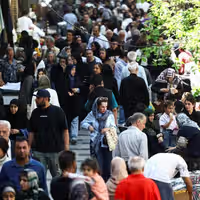
People cross a street in Tehran, with the Alborz mountains visible in the background.
Iranians in several cities described wages being consumed by rent, food and healthcare costs, according to messages received by Iran International on Wednesday.
A government employee in Dorud, in western Lorestan province, said a monthly salary of 20 million tomans, about $115 at the current rate, no longer covered basic needs.
“Half of this wage goes to rent, and the other half goes to medicine and doctors,” the message said. “Nothing is left for food and clothing.”
Another message said a salary below 50 million tomans, about $287, could no longer support a family of four, while one person said only three million tomans, about $17, remained from their monthly pay by the end of the month.
“With this situation, we have to fill ourselves with bread and water,” the message said.
Healthcare costs were also cited as a growing burden. A 51-year-old resident of Isfahan said an orthopedic visit cost one million tomans, about $6, and two prescribed scans would have cost four million tomans, about $23, each.
“I did not have the money, so I gave up,” the resident said.
Another message said medicine had become scarce and sharply more expensive, while insurance covered almost none of the costs of visits, treatment or tests. A monthly prescription that previously cost 200,000 tomans, about $1, had risen to 1.35 million tomans, about $8, the message said.
A separate message from Isfahan said most autism centers in the city had raised fees by 80%, leaving them far less crowded.
Others pointed to daily goods becoming unaffordable, citing a simple ice cream at 80,000 tomans, about 46 cents, and a 1.5-liter bottle of water at 35,000 tomans, about 20 cents.
“This is no longer inflation,” one message from Shahreza said. “It is swelling and bruising.”