• العربية
  • فارسی
Brand
  • Iran Insight
  • Politics
  • Economy
  • Analysis
  • Special Report
  • Opinion
  • Podcast
  • Iran Insight
  • Politics
  • Economy
  • Analysis
  • Special Report
  • Opinion
  • Podcast
  • Theme
  • Language
    • العربية
    • فارسی
  • Iran Insight
  • Politics
  • Economy
  • Analysis
  • Special Report
  • Opinion
  • Podcast
All rights reserved for Volant Media UK Limited
volant media logo

Rubio signals diplomacy as US-Iran war escalates

Jul 20, 2026, 04:02 GMT+1
U.S. President Donald Trump and Secretary of State Marco Rubio attend a meeting with oil industry executives, at the White House in Washington, D.C., U.S., January 9, 2026.

The United States intensified its military campaign against Iran after the first confirmed American combat deaths of the conflict, while Secretary of State Marco Rubio insisted Washington remained open to diplomacy with Tehran.

The renewed offensive, which entered its ninth consecutive night, came as Iranian media reported explosions across the country's southern coastline and, for the first time in the latest campaign, in the northwestern city of Tabriz, suggesting the geographic scope of the strikes may be expanding.

US president Donald Trump said the latest attacks honoured "probably three great patriots" killed in the conflict, describing them as soldiers who had fought to ensure "Iran cannot have a nuclear weapon."

"We hit them very hard again tonight," he told reporters after returning to Washington following the World Cup final.

US Central Command later said it had completed its ninth consecutive night of strikes, targeting Iranian military command centres, air defence and coastal surveillance sites, maritime capabilities, missile and drone launch sites, and communications networks to further degrade Tehran's ability to threaten shipping through the Strait of Hormuz.

Despite the escalation, Rubio reiterated that the United States remained open to a diplomatic solution, maintaining the administration's position that military pressure and negotiations can proceed in parallel.

The widening conflict also rippled through global energy markets. Brent crude rose more than 3% on Monday, climbing above $90 a barrel for the first time since June 11 as attacks on shipping and uncertainty over the Strait of Hormuz intensified.

Iran broadens its threats

Iran, meanwhile, adopted an increasingly confrontational tone in a series of statements issued by the Islamic Revolutionary Guard Corps.

State media reported fresh missile launches from Lorestan province toward what were described as "enemy targets", while the IRGC claimed it had carried out a surprise strike on the US base at al-Tanf in Syria in retaliation for American attacks that killed Iranian conscript soldiers near Iranshahr.

US Central Command previously denied an earlier Iranian claim that the base had been attacked.

In another statement, the IRGC claimed two oil tankers attempting to transit the Strait of Hormuz had exploded after trying to use what it described as an unsafe route under US pressure.

It warned that the waterway would remain unsafe "for even a single drop of oil and gas" as long as US military operations continued and threatened further "punitive" action against American forces.

The force also claimed Jordanians had provided intelligence that enabled attacks on US military facilities at al-Azraq and Aqaba. Those claims could not be independently verified.

Escalationm vs diplomacy

The widening military campaign has fuelled speculation in Washington that the strikes are intended to pave the way for a broader phase of the conflict if diplomacy ultimately fails.

Yet the political messaging from both capitals points to a more complicated picture.

Rubio's remarks echoed comments earlier this week by Vice President JD Vance, who argued that military pressure and diplomacy should proceed together. Iran's chief negotiator and parliament speaker, Mohammad-Bagher Ghalibaf, similarly described war and negotiations as complementary tools for defending national interests.

The parallel rhetoric suggests both governments may be seeking to strengthen their bargaining positions ahead of another round of talks rather than abandoning diplomacy altogether—even as the battlefield widens.

Whether that strategy succeeds may depend not only on developments on the ground but also on mounting economic pressure.

Most Viewed

Rubio signals diplomacy as US-Iran war escalates
1

Rubio signals diplomacy as US-Iran war escalates

Banner
Banner
Banner

Spotlight

  • Qatar, Pakistan push Iran-US diplomacy as war escalates
    INSIGHT

    Qatar, Pakistan push Iran-US diplomacy as war escalates

  • Family of executed protester says he was tortured into false confession

    Family of executed protester says he was tortured into false confession

  • Iran hardliners blamed as cost of US strikes mounts
    INSIGHT

    Iran hardliners blamed as cost of US strikes mounts

  • Leaked presidency report shows how Iran plans to manage record public anger
    INSIGHT

    Leaked presidency report shows how Iran plans to manage record public anger

•
•
•

More Stories

New US troop deaths, Iran’s MoU suspension push war into darker phase

Jul 18, 2026, 21:55 GMT+1
100%
File photo shows a US Marine Corps carry team transferring the remains of Marine Lance Cpl. Kevin Melendez of Fort Worth, Texas, March 4, 2026, who was killed in the Iran war.

The deaths of two US service members in Iranian attacks on Jordan, Tehran’s suspension of its commitments under the memorandum with Washington and a new threat from Iran’s Supreme Leader have raised fears that the war is entering a darker and more dangerous phase.

US Central Command said in a statement the two service members were killed in action on July 17 as US and partner forces defended against Iranian ballistic missile and drone attacks in Jordan. One American service member remained missing in action.

Four other US service members were medically evacuated to hospitals in Jordan and later discharged, CENTCOM said. Other personnel evaluated for minor injuries had returned to duty.

This brings the total number of American service members killed since the Iran war began in late February to 16, with more than 430 wounded, according to official figures.

“Godspeed, heroes. Their sacrifice only stiffens our resolve,” US Secretary of War Pete Hegseth said in a post on X.

The deaths came as Iran expanded missile and drone attacks against US-linked facilities across the region, targeting sites in Jordan, Kuwait and Bahrain. Jordan said it intercepted 10 missiles early Saturday, while Kuwait reported injuries and damage to a power and desalination plant.

The Gulf Cooperation Council condemned the attacks as a dangerous escalation and said infrastructure and civilian facilities had been hit. GCC Secretary General Jasem Mohamed Albudaiwi said the bloc stood with Bahrain, Kuwait and Jordan in measures taken to defend their security and sovereignty.

Tehran also intensified its warnings to Arab governments along the Persian Gulf. Seyed Majid Mousavi, commander of the IRGC Aerospace Force, advised the rulers of those states to take Iran’s “final warning” seriously.

Separately, an unnamed Iranian security official warned that Dubai and Abu Dhabi airports, along with the ports of Fujairah and Jebel Ali, should be evacuated immediately if the United States struck civilian infrastructure in Iran, the IRGC-affiliated Fars news agency reported.

Mojtaba Yousefi, a member of parliament’s Construction Committee, said Israel and Persian Gulf states were more vulnerable than Iran if infrastructure became a target. He said Tehran could strike Israeli railways and bridges.

Collapse of Iran-US MoU

The threats unfolded alongside the breakdown of the diplomatic understanding between Tehran and Washington. Iranian officials said the country had suspended its commitments under the Islamabad memorandum of understanding after accusing the United States of violating the agreement.

Deputy Foreign Minister Kazem Gharibabadi said Washington had “trampled all of its commitments” and that Iran was therefore no longer implementing its own obligations. He said there was no new information about possible talks with the United States, adding that Tehran was focused on defending the country.

Foreign Ministry spokesman Esmaeil Baghaei said Iran was still pursuing diplomacy while keeping its armed forces fully prepared. He said the MoU had operated on the basis of “commitment for commitment” and that Tehran no longer regarded itself as bound by it after what he called the US breach and the start of military attacks.

Iran’s announcement came as the United States continued striking infrastructure and military-linked sites inside Iran during a seventh consecutive night of operations.

US attacks hit bridges, a road tunnel, surveillance sites, underground weapons storage facilities and maritime infrastructure. A strike on the Mirzaei tunnel in Hormozgan province severely disrupted telecommunications, causing widespread phone and internet outages in northern Bandar Abbas, local authorities said.

Officials in Hormozgan urged residents to avoid unnecessary road travel because of the possibility of renewed US attacks.

Khamenei vows ‘unforgettable lessons’ for US

Iran’s Supreme Leader Mojtaba Khamenei, who has not appeared in public since being reportedly injured in the February 28 attack on his father’s office, issued his latest written message, saying: “The Great Satan’s repeated breaches of understandings prove just how worthless and invalid the US president’s signature is.”

He accused Washington of bullying, expansionism and brutality, said the United States had once again revealed its “true face” and warned that Iran had “unforgettable lessons” for Washington if the US continued its military escalation and accepted heavier costs.

Khamenei’s message reinforced Tehran’s argument that the diplomatic track had collapsed because Washington could not be trusted. It also tied the formal suspension of the MoU to a broader warning that the conflict would continue both inside Iran and across the region.

US strikes cut roads and bridges in southern Iran as ground assault talk grows

Jul 18, 2026, 12:30 GMT+1
100%
Images released by Iranian state media on Saturday show damage to the Bandar Abbas-Rudan bridge following US strikes earlier in the day. (July 18, 2026)

US strikes have destroyed bridges, tunnels and rail links across southern Iran in a seventh straight night of attacks, severing roads to the Strait of Hormuz coast and feeding talk in Washington and Tehran that a ground assault may follow.

On the ground in Hormozgan province, the damage has fallen heavily on the civilian road network, and the tally has grown by the day.

On Friday the provincial governor's office said six bridges had been struck in Khamir county alone, cutting the Bandar Abbas to Lar highway; its list ran from the Gariveh bridge to spans near the villages of Latidan and Maru, with residents told to keep off the routes and leave them clear for rescue teams.

Within a day, officials were adding to it. The Shahid Mirzaei road tunnel was reported damaged in both directions, the Roudkhaneh Shour bridge was hit on the Bandar Abbas to Sirjan route, and two more bridges were damaged on the road from the Minab junction toward Roudan. With attacks continuing nightly, no official list has stayed final for long.

  • Why US strikes are moving deeper into southern Iran

    Why US strikes are moving deeper into southern Iran

The attacks have also reached utilities. Iranian media reported missile strikes on power facilities and desalination pumps in the coastal city of Jask, leaving some 10,000 people in 20 villages without water, according to the Tasnim news agency. The maritime control tower at Chabahar, which the Tehran daily Etemad described as civilian infrastructure that guides shipping and coordinates sea rescues, was hit for the third time in a week.

A port city going quiet

The cumulative effect is visible in Bandar Abbas, the provincial capital and Iran's main commercial gateway on the strait. Iran International has learned that the city has gone semi-dormant under the naval blockade and the severing of its road links, with activity at Shahid Rajaee, the country's largest container port, reduced to a minimum.

  • Iran hardliners blamed as cost of US strikes mounts

    Iran hardliners blamed as cost of US strikes mounts

Half of the port's workforce has been laid off in recent weeks, according to the information received, and those still employed are working for minimum pay. More than 4,000 containers are stranded in the port's yards. The blockade closed the sea route weeks ago; the strikes on bridges are now closing the roads.

The Strait of Hormuz, which normally carries a fifth of the world's oil, has been shut to Iranian exports and contested for a week, with US Marines boarding a tanker, the Revolutionary Guards saying they stopped four vessels with missile and drone fire, and Washington enforcing what it calls a naval blockade. The Guards say that until US attacks end, not a drop of oil or gas will leave the region.

Talk of a ground campaign

Trump has made no secret of the targeting. He told Fox News this week that the United States would knock out Iran's power plants and bridges unless Tehran returned to negotiations, and said the strikes would continue "until I say it's enough."

Asked in the same interview about sending ground troops, the president declined to rule it out. "Sometimes you need a ground campaign," he said, adding, "we have other people who will do the ground campaign for us." He said American forces had already struck Kharg Island, the hub of Iran's oil exports, two or three times, with instructions to spare the oil terminals themselves.

  • Vance, Ghalibaf back diplomacy as US, Iran strikes continue

    Vance, Ghalibaf back diplomacy as US, Iran strikes continue

Vice President JD Vance has said the United States does not intend to send ground troops to Iran, leaving the administration's position less than settled. US officials, for their part, have said the attacks on southern Iran are designed in part to give Trump options.

In Tehran, some of the loudest voices in the Islamic Republic's establishment are reading the map the same way. Amir-Hossein Sabeti, a hardline lawmaker from Tehran, wrote on social media that the destruction of the south's transport links was most likely the prelude to a ground attack, arguing that damaged roads and bridges would hamper the movement of Iranian forces ahead of any attempt to seize islands or key points on the coast.

Sabeti reserved part of his message for his own government, demanding that President Masoud Pezeshkian and Parliament Speaker Mohammad Bagher Ghalibaf either deliver on their promise that the agreement with Washington would end the war or admit their judgment had failed.

The swipe pointed to a widening argument inside the establishment over who bears responsibility for the ceasefire's collapse.

Mohsen Rezaei, an adviser to Iran's supreme leader and a former Revolutionary Guards commander, warned that if US strikes continue for several more days, Iran will move into what he called full-scale offensive operations.

Analysts note that a week of air strikes has not reopened the strait, and that controlling it durably may ultimately require forces on the coast or islands that command it, a step no amount of bombing substitutes for.

The targeting of bridges, power stations and water plants, on both sides, has drawn warnings beyond the region.

UN Secretary-General Antonio Guterres said he was concerned by attacks on civilian infrastructure in Iran and across the Persian Gulf, where Kuwait's desalination plants have been hit twice in two days by Iranian strikes.

The 1949 Geneva Conventions prohibit attacks on sites essential to civilian survival, and American legal scholars warned earlier this year, after Trump first threatened Iran's infrastructure, that such strikes could amount to war crimes.

Oil prices climbed more than 4 percent on Friday to their highest level in over a month, a third straight weekly gain that adds pressure on Trump ahead of November's congressional elections.

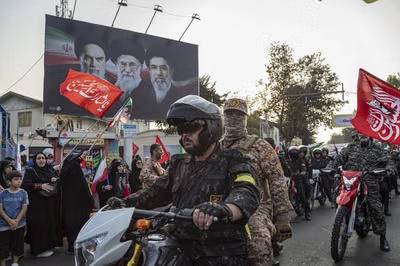
Why US strikes are moving deeper into southern Iran

Jul 18, 2026, 03:49 GMT+1
•
Negar Mojtahedi
100%
President Donald Trump observes a demonstration with U.S. Army 10th Mountain Division troops, an attack helicopter and artillery, as he visits Fort Drum, New York, in this 2018 file photo

The latest US strikes on southern Iran may offer the clearest indication yet of how Washington's campaign around the Strait of Hormuz is evolving from retaliation to the systematic degradation of Iran's military infrastructure.

American forces have been striking targets along Iran’s Persian Gulf coast for almost a week.

Iranian media reported that eight people were killed as bridges, communications infrastructure and a maritime surveillance tower were hit across Hormozgan and Sistan-Baluchistan provinces.

Rebeccah Heinrichs, a senior fellow at the Hudson Institute, says the concentration of attacks along Iran’s southern coastline—and increasingly farther inland—suggests the United States is moving beyond retaliation against individual strikes and targeting the infrastructure that allows Tehran to sustain and eventually rebuild the military capabilities underpinning its operations around the Strait of Hormuz.

“Up until very recently, the United States was primarily focused on doing retaliatory strikes exclusively along the coastline of Iran,” Heinrichs told Eye for Iran. . “

‘Protecting maritime traffic’

The attacks came after President Donald Trump warned that bridges and power infrastructure could become targets if Tehran refused to return to negotiations.

Iranian military officials, meanwhile, said the conflict would “spread to new areas” if US operations continued.

“I suspect that the United States has had these targets on their list,” she said. “President Trump has gone back to Admiral Cooper and said, ‘What else do we need to hit?’”

The likely focus, she added, was Iran’s ability to replenish the military capabilities it uses around the Strait of Hormuz.

Among the sites struck was a maritime surveillance tower in Chabahar. Iran described it as a facility monitoring commercial shipping, while US Central Command said it formed part of an IRGC network used to track vessels transiting the strait and coordinate attacks against them.

CENTCOM said destroying the tower would directly reduce the Revolutionary Guards’ ability to threaten maritime traffic.

The targeting of bridges in Hormozgan province also points to an expanding set of military objectives.

Heinrichs said Washington had sought to limit civilian harm, but argued that some dual-use infrastructure could become a legitimate military target if it substantially enabled IRGC operations.

“There are some targets that the United States could legitimately hit,” she said. “They may create some harm, of course, to the civilian population, but they also primarily enable and facilitate the IRGC to repress their people and to continue their war effort.”

A limited ground role?

The widening campaign has also fuelled speculation about whether Washington could eventually deploy ground forces inside Iran.

Heinrichs dismissed the prospect of a large-scale invasion, saying any deployment would more likely involve special operations forces tasked with securing or removing nuclear material rather than occupying territory.

“If President Trump were to go with any contingency that would entail some element of US ground forces, it would almost certainly be because the United States wants to remove any nuclear material that is still inside Iran,” she said.

For now, however, Heinrichs believes the campaign remains centred on the Strait of Hormuz.

The initial phase significantly weakened Iran’s military leadership and its capacity to project power beyond its borders, she said. Washington has now moved into what she described as “the battle over the Strait of Hormuz.”

Taken together, the latest strikes point to a campaign that is evolving beyond retaliation. Rather than simply responding to Iranian attacks, Washington appears increasingly focused on preventing Tehran from regenerating the military infrastructure underpinning its operations around the Strait of Hormuz.

US backs Iraq pipeline plans to bypass Hormuz

Jul 17, 2026, 19:24 GMT+1
100%
An Islamic Revolutionary Guard Corps speedboat patrols near a commercial tanker in the Strait of Hormuz in this file photo.

US-backed plans to revive an oil pipeline linking Iraq and Syria have gained new urgency as Iran's closure of the Strait of Hormuz and attacks on shipping disrupt regional exports and drive oil prices higher.

The US State Department on Wednesday welcomed Iraq's and Syria's decision to prioritize reconstruction of the Iraq-Syria crude oil pipeline, describing it as a strategically important regional infrastructure project and backing a US-led international consortium to carry out the technical and financial work.

The department said the rehabilitated pipeline would initially be capable of transporting 2 million barrels of crude per day from Iraq to Mediterranean export markets, calling the announcement "an important milestone" for the region and for relations between Baghdad and Damascus.

The renewed push comes during the US-Iran war, which has sharply reduced traffic through the Strait of Hormuz, a waterway that carried about one-fifth of global oil supplies before the conflict.

US ambassador to Turkey and special envoy for Syria and Iraq Tom Barrack said Iraqi Prime Minister Ali al-Zaidi's plans to develop alternative export corridors were aligned with broader regional efforts involving Syria, Jordan, Turkey, Lebanon and Egypt.

He said the projects could make Hormuz "an afterthought" for Iraq within two years.

Chevron is in advanced discussions with Los Angeles-based TI Capital and Qatar's UCC Holding to form a consortium for a pipeline network linking southern Iraqi oilfields to the Mediterranean through Syria, the Financial Times reported.

The proposed system would include one line running north from southern Iraq toward Kirkuk and another extending west to the Syrian port of Baniyas.

In parallel, Iraq's cabinet has approved preliminary studies of routes from Basra through Haditha to either Baniyas or Turkey's Mediterranean export terminal at Ceyhan. The approvals do not create binding financial or contractual obligations for Iraq's Oil Ministry.

US Representative Joe Wilson, a Republican from South Carolina, praised Barrack's efforts, saying pipelines through Syria and Turkey could help replace export capacity threatened by Iran's actions around Hormuz.

He estimated the broader network could eventually transport 2.5 million barrels per day to the Mediterranean or Turkey and reduce Baghdad's dependence on Tehran.

Oil prices have climbed during the renewed fighting, with Brent crude settling at $88 a barrel on Friday, its highest level in a month.

The proposed routes remain subject to feasibility studies and would face significant financing, construction and security challenges before becoming operational.

Iran hardliners blamed as cost of US strikes mounts

Jul 17, 2026, 16:04 GMT+1
•
Behrouz Turani
100%
An image released by Iranian media showing a bridge in the Persian Gulf port city of Bandar Khamir, destroyed by US strikes, July 17, 2026

Moderate voices in Iran are sharpening their criticism of hardline calls for continued confrontation with the United States, arguing that diplomacy has become a patriotic necessity as renewed war exacts mounting economic and human costs.

The debate has intensified since Iran targeted a vessel near the Strait of Hormuz last week, prompting a renewed US military campaign that has included days of strikes on ports, bridges, airports and military facilities across Iran’s southern provinces.

Even as US Vice President JD Vance and Iranian Parliament Speaker and chief negotiator Mohammad-Bagher Ghalibaf have continued to defend diplomacy backed by military preparedness, the fighting has persisted and the prospect of a wider conflict has grown.

The criticism has been directed in part at ultrahardline figures such as Qom Seminary Chancellor Alireza Arafi, who has called for further war against the United States and an end to negotiations.

Two recent commentaries—one by former lawmaker and former National Security Committee chairman Heshmatollah Falahatpisheh, the other by political analyst Abdolrahman Fathollahi—reflect the growing push to hold hardliners accountable for the costs of confrontation.

While one focuses on political responsibility for failed diplomacy, the other highlights the burden borne by communities on Iran’s southern frontier.

‘Defeating diplomacy’

Writing in the moderate daily Toseh Irani, Falahatpisheh accused hardline factions of using what he called a distorted interpretation of religion to obstruct diplomatic opportunities.

“I believe part of these two major wars against Iran was the result of this very definition of religious beliefs by extremists, who are now turning to distorting religion to defeat diplomacy,” he wrote.

He argued that the same factions had repeatedly promised better outcomes while blocking agreements that could have reduced tensions.

“They are the exact same people who blocked two good agreements during the major periods of 2021 and 2022, claiming they would forge a better deal,” he wrote. “But in practice, not only was no agreement achieved, but two major wars were imposed on Iran.”

Falahatpisheh called for the prosecution of those he said had turned diplomatic opportunities into military conflict.

‘Patriotism from a safe distance’

A second commentary, published Thursday in Shargh, shifted the focus from political responsibility to the human cost of confrontation.

Under the title The Country’s Future and the Triangle of Extremism, Costs, and Responsibility, Fathollahi warned about the toll of intensifying US airstrikes on Iran’s southern coastal provinces.

He pointed to public campaigns calling for outspoken opponents of negotiations to be sent to the front lines, accusing them of practising what he described as “patriotism from a safe distance.”

“One certainly cannot beat the drums of war from the safe margins of the capital behind podiums, while dumping the costs of those decisions onto the people living in the front lines,” Fathollahi wrote, highlighting the plight of communities bearing the brunt of the fighting over the Strait of Hormuz.

The comments come after a week of US strikes on infrastructure across Iran’s Persian Gulf provinces, where dozens have been killed or injured and many more affected by transport disruption, electricity blackouts and water shortages during the height of summer.

For Fathollahi, the question is no longer simply one of military strategy but whether Iran’s leaders are willing to change course before the costs grow even higher.

“Rethinking certain political approaches and utilizing all expert and diplomatic capacities is not a choice,” he concluded, “but a necessity to safeguard national interests and reduce the costs imposed on society.”