• العربية
  • فارسی
Brand
  • Iran Insight
  • Politics
  • Economy
  • Analysis
  • Special Report
  • Opinion
  • Podcast
  • Iran Insight
  • Politics
  • Economy
  • Analysis
  • Special Report
  • Opinion
  • Podcast
  • Theme
  • Language
    • العربية
    • فارسی
  • Iran Insight
  • Politics
  • Economy
  • Analysis
  • Special Report
  • Opinion
  • Podcast
All rights reserved for Volant Media UK Limited
volant media logo
INSIGHT

Iran hardliners blamed as cost of US strikes mounts

Behrouz Turani
Behrouz Turani

Iran International

Jul 17, 2026, 16:04 GMT+1
An image released by Iranian media showing a bridge in the Persian Gulf port city of Bandar Khamir, destroyed by US strikes, July 17, 2026

Moderate voices in Iran are sharpening their criticism of hardline calls for continued confrontation with the United States, arguing that diplomacy has become a patriotic necessity as renewed war exacts mounting economic and human costs.

The debate has intensified since Iran targeted a vessel near the Strait of Hormuz last week, prompting a renewed US military campaign that has included days of strikes on ports, bridges, airports and military facilities across Iran’s southern provinces.

Even as US Vice President JD Vance and Iranian Parliament Speaker and chief negotiator Mohammad-Bagher Ghalibaf have continued to defend diplomacy backed by military preparedness, the fighting has persisted and the prospect of a wider conflict has grown.

The criticism has been directed in part at ultrahardline figures such as Qom Seminary Chancellor Alireza Arafi, who has called for further war against the United States and an end to negotiations.

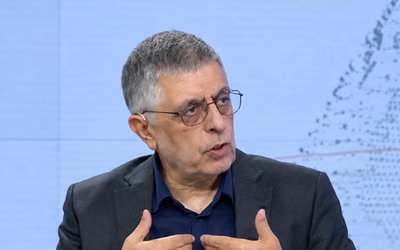
Two recent commentaries—one by former lawmaker and former National Security Committee chairman Heshmatollah Falahatpisheh, the other by political analyst Abdolrahman Fathollahi—reflect the growing push to hold hardliners accountable for the costs of confrontation.

While one focuses on political responsibility for failed diplomacy, the other highlights the burden borne by communities on Iran’s southern frontier.

‘Defeating diplomacy’

Writing in the moderate daily Toseh Irani, Falahatpisheh accused hardline factions of using what he called a distorted interpretation of religion to obstruct diplomatic opportunities.

“I believe part of these two major wars against Iran was the result of this very definition of religious beliefs by extremists, who are now turning to distorting religion to defeat diplomacy,” he wrote.

He argued that the same factions had repeatedly promised better outcomes while blocking agreements that could have reduced tensions.

“They are the exact same people who blocked two good agreements during the major periods of 2021 and 2022, claiming they would forge a better deal,” he wrote. “But in practice, not only was no agreement achieved, but two major wars were imposed on Iran.”

Falahatpisheh called for the prosecution of those he said had turned diplomatic opportunities into military conflict.

‘Patriotism from a safe distance’

A second commentary, published Thursday in Shargh, shifted the focus from political responsibility to the human cost of confrontation.

Under the title The Country’s Future and the Triangle of Extremism, Costs, and Responsibility, Fathollahi warned about the toll of intensifying US airstrikes on Iran’s southern coastal provinces.

He pointed to public campaigns calling for outspoken opponents of negotiations to be sent to the front lines, accusing them of practising what he described as “patriotism from a safe distance.”

“One certainly cannot beat the drums of war from the safe margins of the capital behind podiums, while dumping the costs of those decisions onto the people living in the front lines,” Fathollahi wrote, highlighting the plight of communities bearing the brunt of the fighting over the Strait of Hormuz.

The comments come after a week of US strikes on infrastructure across Iran’s Persian Gulf provinces, where dozens have been killed or injured and many more affected by transport disruption, electricity blackouts and water shortages during the height of summer.

For Fathollahi, the question is no longer simply one of military strategy but whether Iran’s leaders are willing to change course before the costs grow even higher.

“Rethinking certain political approaches and utilizing all expert and diplomatic capacities is not a choice,” he concluded, “but a necessity to safeguard national interests and reduce the costs imposed on society.”

Most Viewed

Iran hardliners cry foul as Ghalibaf camp gains ground
1
INSIGHT

Iran hardliners cry foul as Ghalibaf camp gains ground

2
INSIGHT

As Tehran debates, Iran's south lives the war

3

Petition tells Iran hardliners: Fight the US war yourselves

4
INSIGHT

Leaked presidency report shows how Iran plans to manage record public anger

5
VOICES FROM IRAN

Inflation leaves Iranian pensioners unable to cover basic costs

Banner
Banner

Spotlight

  • Iran hardliners blamed as cost of US strikes mounts
    INSIGHT

    Iran hardliners blamed as cost of US strikes mounts

  • Vance, Ghalibaf back diplomacy as US, Iran strikes continue
    INSIGHT

    Vance, Ghalibaf back diplomacy as US, Iran strikes continue

  • Leaked presidency report shows how Iran plans to manage record public anger
    INSIGHT

    Leaked presidency report shows how Iran plans to manage record public anger

  • Wave of Iran plots drove UK action against IRGC, terror law tsar says
    EXCLUSIVE

    Wave of Iran plots drove UK action against IRGC, terror law tsar says

  • Two Iranians at the World Cup final – and neither represents the Islamic Republic

    Two Iranians at the World Cup final – and neither represents the Islamic Republic

Banner
•
•
•

More Stories

Iran’s rial hits new low as dollar nears 1.92 million

Jul 17, 2026, 12:35 GMT+1
100%

The US dollar reached a record 1,918,000 rials on Iran’s open market Friday, surpassing its previous high as war, inflation and worsening economic prospects continued to weaken the currency.

The previous record was 1,900,000 rials, registered on May 4. Other foreign currencies also rose. The British pound reached 2,576,500 rials, while the euro climbed above 2,190,000 rials.#

At Friday’s open-market rate, Iran’s official monthly minimum wage of 166,255,500 rials is worth about $87.

The new low follows a sharp deterioration in Iran’s economic outlook. The International Monetary Fund expects the economy to contract by 6.1% in 2026, after previously forecasting modest growth.

  • Iran faces region’s harshest mix of wartime contraction and inflation

    Iran faces region’s harshest mix of wartime contraction and inflation

Average inflation is projected to reach 68.9%, leaving households with fewer opportunities to earn money while the value of their income falls rapidly.

The IMF linked the downturn to damage to energy and transport infrastructure, lower production and exports, and disruption around the Strait of Hormuz.

The rial’s decline increases the cost of imported goods, raw materials and medicine, while feeding broader price rises in an economy already struggling with sanctions, war damage and years of economic mismanagement.

Iran operates several official and semi-official exchange rates, but the open-market rate is the price most closely watched by households and businesses seeking foreign currency.

UK outlaws support for IRGC under new national security powers

Jul 17, 2026, 12:02 GMT+1
100%

Britain formally designated Iran’s Islamic Revolutionary Guard Corps as a threat to national security on Friday, making public support for the organization or assistance to it punishable by up to 14 years in prison.

The IRGC was designated alongside the Iran-linked Islamic Movement of Companions of the Right and Russia’s GRU Volunteer Corps, the first organizations placed under powers created by the National Security (State Threats) Act 2026.

The designations took effect on July 17 after Parliament approved an order submitted by Home Secretary Shabana Mahmood four days earlier.

  •  UK says support for Iran's IRGC outlawed under new state threats law

    UK says support for Iran's IRGC outlawed under new state threats law

Under the new law, it is now a criminal offence to express support for the groups, including by glorifying or encouraging activity that threatens the safety of the United Kingdom.

Providing assistance or accepting money or another material benefit from a designated organization can also lead to prosecution. Those convicted could face prison sentences of up to 14 years.

People who commit sabotage, arson or other hostile acts on behalf of the groups could be charged separately under the National Security Act 2023 and face life imprisonment.

The designation is distinct from banning an organization under Britain’s terrorism legislation. It is designed specifically to address hostile activity linked to foreign governments, including espionage, political interference, intimidation, sabotage and physical attacks.

  • Wave of Iran plots drove UK action against IRGC, terror law tsar says

    Wave of Iran plots drove UK action against IRGC, terror law tsar says

The government says the new framework will make it easier to prosecute people working for foreign organizations because prosecutors will not always have to establish a direct connection between an individual act and a foreign government.

Outgoing Prime Minister Keir Starmer said when the measures were announced that Britain would not be allowed to become “a playground for states who want to spread fear, division and violence on our streets.”

“We have already taken tough action against the Iranian regime and those linked to it, and against Russian operatives and networks targeting our country,” he said. “These new powers will make it easier to prosecute and lock up anyone carrying out their dirty work here in Britain.”

The IRGC is one of the Islamic Republic’s most powerful military and political institutions. Its overseas Quds Force oversees Tehran’s relationships with allied armed groups and has been accused by British authorities of directing operations against dissidents, journalists and Jewish or Israeli-linked targets in Europe.

The British government said the Islamic Movement of Companions of the Right had claimed responsibility for seven attacks this year against Persian-language media and locations linked to Jewish and Israeli communities in Britain.

Those incidents included an antisemitic arson attack that damaged four ambulances belonging to the Jewish emergency service Hatzola in Golders Green, north London, on March 23.

British authorities said Quds Force members were behind the organization and had “almost certainly” directed its attacks across Europe. The allegations have not been tested in court.

The government has also cited at least 20 potentially lethal Iranian-backed plots identified by the domestic intelligence agency MI5 over a one-year period.

“Iran and Russia are using proxies and thugs to do their dirty work on our shores,” Mahmood said when she announced the intended designations. “We will find you, and we will lock you up.”

The third designated organization, the GRU Volunteer Corps, is described by Britain as a network controlled by Russian military intelligence that recruits people online to carry out arson, sabotage, harassment and other hostile activity.

Foreign Secretary Yvette Cooper said the use of proxies by Iran and Russia to conduct operations on British soil was “reprehensible.”

The designation marks a significant escalation in Britain’s response to the IRGC. Rather than banning the organization as a terrorist group, the government has created a separate route to prosecute support, recruitment, financing and operational assistance linked to hostile foreign-state activity.

Bridges and military sites hit as US-Iran fighting intensifies in southern Iran

Jul 17, 2026, 08:26 GMT+1
100%
US personnel stand aboard the M/T Wen Yao during a verification boarding in the Gulf of Oman on July 16, in an image released by US Central Command.

The sixth day of fighting since the collapse of the Iran-US ceasefire ended with five bridges hit in southern Iran, US forces turning back three commercial vessels near the Strait of Hormuz, and President Donald Trump declaring that Washington was “winning big in Iran.”

The developments unfolded along three parallel fronts: Iranian attacks on US facilities across the Persian Gulf, continued US strikes inside Iran and an intensifying contest over control of the Strait of Hormuz.

Iran said it launched drone attacks on US facilities in Kuwait and Bahrain early Friday, after a sixth consecutive night of American strikes on Iranian military targets.

Iran’s army said it targeted US force deployment and logistics centers in Kuwait, Iran’s IRGC-affiliated Fars news agency reported.

In Bahrain, the army said it struck US helicopters and reconnaissance aircraft at Sakhir Air Base. Sirens sounded in the country for the second time on Friday, according to the Interior Ministry.

In Qatar, several booms were heard after the government sent a second security alert to mobile phones, Reuters reported. The Defense Ministry said Qatar was intercepting several air attacks, while the Interior Ministry said a child was injured by shrapnel from an intercepted missile.

US Central Command has not confirmed the reported attacks in Kuwait or Bahrain.

At the same time, US forces continued striking targets in southern Iran.

CENTCOM said US fighter jets, drones and warships used precision munitions to hit dozens of military targets, including coastal surveillance and air defense sites, logistics infrastructure and maritime capabilities near Bandar Abbas and on Qeshm Island.

Hamshahri, a newspaper owned by Tehran Municipality, reported that five bridges in Hormozgan province were hit in the latest wave of attacks.

The death toll from strikes on bridges in Bandar Khamir rose to seven, Iran’s IRGC-affiliated Tasnim news agency reported. Iranian media also reported damage to a power substation on Kish Island and attacks on transport infrastructure in Bandar Abbas and Bandar Khamir.

The reports could not be independently verified.

Control over Strait of Hormuz

As the two sides exchanged attacks on land, their confrontation also deepened at sea.

CENTCOM said US forces redirected three commercial vessels attempting to breach the naval blockade against Iran, disabled another that failed to comply with orders and boarded the M/T Wen Yao in the Gulf of Oman to verify compliance.

US Defense Secretary Pete Hegseth shared an image from the boarding and wrote that Iran “does not control” the Strait of Hormuz.

CENTCOM said the strait and surrounding waters remained free and open, except for vessels attempting to violate what it called the US “steel wall” blockade.

Iran’s Revolutionary Guards, however, said Tehran remained in full control of the waterway and would prevent oil and gas exports through it for as long as US attacks continued.

Trump cast the military and maritime operations as signs of US momentum.

“You will see the fruits of that labor very, very shortly,” he said after declaring that Washington was “winning big in Iran.”

The possibility of a wider regional conflict emerged more clearly on Friday, when the Revolutionary Guards said they had struck a US special operations command center in Syria’s al-Tanf region, destroying a radar system and several helicopters and killing US personnel.

US Central Command has not confirmed the report.

Tehran billboard hints Trump is the 'next one' after Graham's death

Jul 17, 2026, 01:49 GMT+1
100%
A billboard in Tehran’s Valiasr Square asks, “Who is the next one?” alongside the hashtag #LindseyGraham, following the US senator’s death.

A new billboard unveiled in central Tehran after the death of US Senator Lindsey Graham appears to allude to US President Donald Trump as the next potential target, extending a campaign of public threats against perceived enemies of the Islamic Republic.

The billboard, most prominent in Tehran, is controlled by the IRGC-linked Owj Arts and Media Organization and is frequently used to project messages aligned with Iran’s hardline establishment.

Its English slogan reads, "Who is D nexT one?", with the unusual capitalization of the letters "D" and "T" appearing to reference Donald Trump.

State-run IRNA said the billboard was installed following Graham’s death, describing him as one of the most anti-Iran politicians in the United States.

Some conservative voices in Iran portrayed Graham’s death as divine punishment for what they see as his persistent pursuit of war against the country.

The billboard claims no responsibility for the senator’s death, but the wording appears to suggest that those pushing for a downfall of the Islamic Republic could have a similar fate.

Graham died on July 11 after what his office described as a brief and sudden illness. US media reported that emergency personnel had responded to a cardiac arrest call at his Capitol Hill home.

In recent months, Graham had become a prominent supporter of Iran’s opposition movement. At a Munich gathering, he called for a “free Iran” and said he chose “the Iranian people over the murderous ayatollah,” as he waved the country’s pre-Islamic Republic flag.

Exiled prince Reza Pahlavi described Graham as a “steadfast friend of the Iranian people,” saying his support for what he called Iran’s Lion and Sun Revolution had earned him the nickname “Uncle Lindsey” among some Iranians.

At the funeral of former Supreme Leader Ali Khamenei, mourners carried placards showing US President Donald Trump, Graham, conservative commentator Ben Shapiro and activist Laura Loomer with red crosshairs over their faces and warnings including: “Sooner or later, your heads will roll.”

Other placards featured Israeli-American billionaire Miriam Adelson, Foundation for Defense of Democracies chief Mark Dubowitz and investor Peter Thiel. Mourners also displayed a $100 million bounty for Trump and chanted calls for his killing.

In a similar message, another Tehran mural depicted Trump and Israeli Prime Minister Benjamin Netanyahu drowning in a red “sea of revenge,” the IRGC-affiliated Tasnim news agency reported Thursday.

“You will drown in the sea of the Iranian nation’s revenge,” the mural read in Persian and English.

Separately, Hassan Rahimpour Azghadi, a member of Iran’s Supreme Council of the Cultural Revolution, called for attacks on US leaders and for treaties to be ignored in retaliation for what he described as “ongoing assassinations and expanding sanctions.”

Since the US killing of IRGC commander Qassem Soleimani in 2020, through the 12-day Iran-Israel war in 2025 and the latest US and Israeli attacks in 2026 that killed 52 senior Iranian military, security and intelligence officials, the Islamic Republic has repeatedly vowed revenge.

Much of that rhetoric, however, has so far taken the form of billboards, murals, funeral displays and public threats.

Vance, Ghalibaf back diplomacy as US, Iran strikes continue

Jul 16, 2026, 21:35 GMT+1
•
Maryam Sinaiee
100%
High level representatives including US Vice President JD Vance and Iran's Foreign Minister Abbas Araghchi took part in Lucerne Summit in Switzerland, June 21-23, 2026

Iran's chief negotiator, Mohammad-Bagher Ghalibaf, and US Vice President JD Vance both defended diplomacy backed by military strength on Wednesday, making strikingly similar arguments as Iranian hardliners intensified demands to scrap Tehran's agreement with Washington.

Both men appeared to be making the same argument to critics within their own political camps: that diplomacy is most effective when backed by credible military force, not pursued instead of it.

The parallel messaging prompted analysts to suggest that, despite rising tensions, both sides may still view diplomacy as preferable to war.

International relations analyst Amir-Ali Abolfath wrote on X that Ghalibaf's statement, Vance's remarks and Iran's release of an Iranian-American prisoner together offered "a glimmer of hope" that both sides could return to managing tensions within the framework of an agreement "whose fate hangs by a thread."

Reform-leaning news website Rouydad24 likewise described the prisoner's release as evidence of "the opening of an important diplomatic channel amid an exchange of fire."

US President Donald Trump also welcomed the move, writing on Truth Social that "the United States appreciates this gesture of goodwill by Iran."

‘Talking is not compromise’

Ghalibaf issued a public statement on Wednesday defending what he described as the course pursued under Supreme Leader Mojtaba Khamenei's guidance, arguing that negotiations with the United States remain compatible with military preparedness and resistance.

Rather than presenting diplomacy and military readiness as opposing choices, he argued they were complementary tools for safeguarding Iran's national interests.

"War and negotiation are two methods of protecting the national interest," he said, insisting that negotiations are "part of safeguarding national interests, not synonymous with compromise."

He warned that treating either military confrontation or diplomacy as the sole solution would amount to "a strategic mistake," adding that officials have a duty to prepare "for war, diplomacy, or both," depending on the course set by the Supreme Leader.

"We must stand firm on the achievements secured through the MoU until the nation's rights are fully realized," he wrote.

Hours later, Vance struck a remarkably similar tone in an interview with podcaster Joe Rogan, rejecting the idea of overthrowing Iran's government through US military force.

He argued that diplomacy, backed by military pressure, remained the preferred way to manage the crisis, and criticized "warmongers" pushing for conflict.

A well-funded covert campaign, Vance claimed, was seeking to derail negotiations and any agreement with Tehran.

Hardliners push back

The renewed defense of diplomacy triggered an immediate backlash from Iran's hardline camp, where many have argued since the recent military confrontation that the Tehran-Washington understanding should be formally declared dead.

Kamran Ghazanfari, a member of parliament, accused President Masoud Pezeshkian and Ghalibaf of lacking the courage to acknowledge that the agreement had collapsed.

"Whether they call it war or not, the third war has effectively begun," he said, arguing that the negotiating team should publicly admit that talks had reached a dead end.

Hardline journalist Davood Modarresian likewise criticized Ghalibaf's statement, saying it contained "no sign of change or apology" and faulting him for continuing to advocate negotiations despite what he described as Washington's abandonment of the agreement.

Hardline political activist Masoud Barati challenged Ghalibaf's description of negotiations as a form of struggle.

"Calling negotiations a form of struggle gives primacy to negotiations," Barati wrote. "If negotiations have failed to secure Iran's achievements, why insist on continuing this approach?"

Conservative rivalry deepens

The latest dispute reflects a long-running rivalry between Ghalibaf and former nuclear negotiator Saeed Jalili, both prominent figures within Iran's conservative establishment.

In recent months, lawmakers aligned with Jalili and members of the ultraconservative Paydari Front have intensified criticism of Ghalibaf, arguing that negotiations with Washington should be abandoned altogether.

Their influence, however, appears to have weakened after losing two key leadership positions on parliament's National Security and Foreign Policy Committee.

Adding to signs of growing pressure on the hardline faction, lawmaker Majid Nasrpour told Khabar Online in comments published Thursday that "some hardline members of parliament have been summoned by the relevant authorities and seriously warned over their remarks."