• العربية
  • فارسی
Brand
  • Iran Insight
  • Politics
  • Economy
  • Analysis
  • Special Report
  • Opinion
  • Podcast
  • Iran Insight
  • Politics
  • Economy
  • Analysis
  • Special Report
  • Opinion
  • Podcast
  • Theme
  • Language
    • العربية
    • فارسی
  • Iran Insight
  • Politics
  • Economy
  • Analysis
  • Special Report
  • Opinion
  • Podcast
All rights reserved for Volant Media UK Limited
volant media logo

Shortage of opium syrup threatens addiction treatment in Iran

May 17, 2026, 09:22 GMT+1
File photo of drug addicts detained during a police crackdown in Iran.

Severe shortages of opium syrup are disrupting addiction treatment across Iran, Shargh daily reported on Sunday, raising fears that thousands of recovering drug users could return to narcotics use as clinics struggle to secure supplies of a key maintenance medication.

The shortages follow repeated disruptions in the production and distribution chain of opium syrup, a drug widely used in Iran’s maintenance treatment programs for patients who cannot easily switch to alternatives such as methadone because of physical dependence or medical complications.

Experts and addiction treatment activists warned the shortages are no longer only a clinical problem but a broader social crisis with potential consequences for public health, crime and family stability.

“These medications are essential for patients and stopping access does not mean they stop using drugs,” addiction expert Habib Bahrami told Shargh. “In many cases they return directly to narcotics use, bringing social, economic and family consequences.”

Some clinics, according to the report, have seen supplies fall so sharply that only one out of every 100 eligible patients can obtain opium syrup.

Patients pushed back toward illicit drugs

Bahrami said shortages had already emerged before the recent regional conflicts and economic pressures intensified.

“Before the war we were already seeing reduced supplies,” he said. “In some medical universities, opium syrup distribution was nearly halted before the Persian New Year (late March) without explanation.”

Patients unable to obtain the medication, he said, often return to street narcotics markets to avoid severe withdrawal symptoms, undermining years of treatment and increasing pressure on healthcare.

Methadone syrup continues to be distributed more consistently, Bahrami said, but many patients cannot easily transition to substitute medications.

Supply chain problems deepen shortages

Activists and treatment providers offered differing explanations for the shortages, with some blaming administrative restrictions and others pointing to shortages of raw materials used in production.

File photo of patients at an addiction treatment center in Iran.
100%
File photo of patients at an addiction treatment center in Iran.

Abbas Deilamizadeh, head of the addiction recovery NGO Tavallod-e Dobareh (Rebirth Society), said insufficient access to raw opium materials has sharply reduced production and fueled the emergence of a black market.

“The shortage of raw materials has caused shortages in the market and created serious problems for patients,” Deilamizadeh told Shargh.

He argued that tighter state oversight of legal cultivation could provide a long-term solution.

“The only solution, in my view, is government-supervised poppy cultivation to supply the raw materials needed for this treatment method,” he said.

Addiction centers face mounting pressure

Treatment providers also warned that financial pressures and recent regional conflict have weakened addiction recovery services more broadly.

Deilamizadeh said many residential treatment centers are struggling with unrealistic state tariffs that fail to cover operational costs amid high inflation.

“For a 30-day stay, less than 100 million rials ($55) is allocated per patient,” he said. “That amount does not realistically cover accommodation, utilities, staff and treatment standards.”

He also said voluntary admissions to treatment centers have dropped sharply in recent months because of insecurity and public anxiety linked to regional military escalation.

“Based on our experience, voluntary admissions have fallen by around 40 percent,” he said.

Bahrami said some centers discharged patients during periods of heightened military tension and avoided taking new admissions because of security concerns.

“When society is overwhelmed by war-related fears, vulnerable groups are pushed further to the margins,” he said.

Most Viewed

Tehran media sees rising risk of war as US talks stall
1
INSIGHT

Tehran media sees rising risk of war as US talks stall

2
ANALYSIS

China’s Iran balancing act grows more costly

3
INSIGHT

Iran’s café culture buckles as everyday life contracts

4
INSIGHT

Hormuz gives battered Iran room to wait out Trump, experts say

5

Iran says Quran 'memorization' schools to expand

Banner
Banner
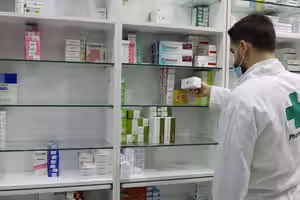
  • Drug prices jump up to 400% as shortages strain Iranian pharmacies

    Drug prices jump up to 400% as shortages strain Iranian pharmacies

Spotlight

  • Iran’s café culture buckles as everyday life contracts
    INSIGHT

    Iran’s café culture buckles as everyday life contracts

  • China’s Iran balancing act grows more costly
    ANALYSIS

    China’s Iran balancing act grows more costly

  • Tehran media sees rising risk of war as US talks stall
    INSIGHT

    Tehran media sees rising risk of war as US talks stall

  • Xi may help Trump on Iran, but at a price
    ANALYSIS

    Xi may help Trump on Iran, but at a price

  • How one Tehran hospital became a window into Iran’s January massacre
    SPECIAL REPORT

    How one Tehran hospital became a window into Iran’s January massacre

  • Iranians question official inaction over opium epidemic

    Iranians question official inaction over opium epidemic

•
•
•

More Stories

Iran’s café culture buckles as everyday life contracts

May 16, 2026, 08:37 GMT+1
•
Maryam Sinaiee

Iran’s deepening economic crisis is pushing cafés and coffee culture toward collapse, as soaring prices and falling incomes force both businesses and customers to cut back.

Mohsen Mobarra, head of the union overseeing coffee shops in Tehran, told economic daily Donya-e-Eqtesad that café operating costs have more than doubled while customer numbers have fallen by as much as 50 percent in recent months, with up to 40 percent of cafés shutting down.

“Continuing operations does not mean profitability,” he said. “The profits of these businesses are steadily shrinking. As a result, cafés that rent their locations or lack strong financial backing are heading toward closure.”

Over the past two decades, cafés became an important part of urban life in Iran, taking root in Tehran before spreading across the country.

With affordable entertainment options limited, they emerged as some of the few accessible spaces where young Iranians could socialize, work and spend time outside the home.

Many evolved into more than places to drink coffee or eat light meals. They hosted poetry nights, small music performances, photography exhibitions and informal gatherings, becoming rare spaces for social interaction at a time when few other public spaces remained accessible.

Until a few months ago, Tehran alone had around 6,000 cafés of different sizes in operation. But the collapse in consumers’ purchasing power has hit the industry hard.

Sanaz, a 28-year-old receptionist at a private company, said she and her friends used to visit cafés several times a week. But now, with sharp increases in the costs of food, transportation and housing, even such small pleasures require careful calculation.

“I have to calculate every expense, even this simple form of entertainment, just to make it to the end of the month — assuming I don’t lose my job,” she said.

“If I lose my job, after years of financial independence, I’ll have to move back to my parents’ home in my hometown.”

The closures and downsizing have also eliminated jobs for many workers, most of them young people and women.

Shana, 26, completed professional barista training before finding work at one of the branches of the well-known Saedi Nia café chain.

In January, the chain’s branches were abruptly shut down after the owner voiced support for opposition protesters. Shortly afterward, war broke out.

“Even cafés that have survived the economic downturn are not hiring new staff anymore,” she said. “Many are actually laying off existing employees.”

“I have no hope that even by learning new skills like cooking or other work, I’ll be able to find a job. The economy keeps getting worse every day, and the job market is shrinking.”

Coffee itself is also becoming a luxury.

Tea remains Iran’s dominant traditional drink, but coffee consumption expanded rapidly in recent years. Now, however, the sharp rise in foreign currency prices and disruptions to imports have pushed coffee prices so high that many households are cutting consumption or abandoning it altogether.

Although global coffee prices have declined, the cost of coffee beans in Iran — largely imported through the United Arab Emirates before the war — has nearly doubled compared to pre-war levels.

The increase has directly affected café prices. With rents and other expenses also rising, the price of a cup of coffee in some cafés has climbed by as much as four times.

One café owner told Donya-e-Eqtesad that even cafés specializing in basic coffee drinks are seeing falling demand because many people can no longer justify going out even for coffee.

Tara, the manager of an advertising company with ten employees, said coffee has become so expensive that even buying it for office use is increasingly difficult.

“For the first time in the past twenty years, I’ve had to stop buying coffee for the office kitchen, where it was always available for employees alongside tea,” she said.

“It’s not just about coffee prices. Since last summer’s war, work has effectively been frozen. Clients have even canceled half-finished projects, and everyone knows the company is taking its last breaths.”

“If this situation continues, we’ll have no choice but to shut down.”

Iran says Quran 'memorization' schools to expand

May 16, 2026, 03:43 GMT+1

Iran’s Education Ministry said Quran-related activities and prayer programs are continuing online as schools remain virtual, with 200 school for memorising Qur'an set to open this year.

Mikail Bagheri, director general for Quran, Etrat and Prayer Affairs at the ministry, told ILNA news agency that Quran instruction is continuing through online platforms alongside other school subjects.

He said Quran classes in primary schools are taught by general teachers, while specialized Quran instructors handle the subject in secondary education.

Bagheri also said Iran launched around 200 official Quran memorization schools across the country last year and plans to expand the program further.

Trial set for three defendants charged over alleged arson near Iran International

May 15, 2026, 11:36 GMT+1

A trial date has been set for three defendants charged over an alleged arson incident near Iran International’s studios in northwest London, with the case scheduled to begin on January 25, 2027, at the Central Criminal Court.

At a preliminary hearing on Friday that lasted about 30 minutes, Oisin McGuinness, 21, and Nathan Dunn, 19, appeared by video link before Mrs. Justice Cheema-Grubb at the Central Criminal Court.

A third defendant, who is under 16 and cannot be named for legal reasons, is also charged in the case.

No pleas were entered at Friday’s hearing. A Plea and Trial Preparation Hearing has been set for August 28, 2026, when pleas are expected to be heard. The trial is listed for three weeks.

McGuinness, Dunn and the third defendant are charged with arson with intent to endanger life, contrary to the Criminal Damage Act 1977.

The charges relate to an alleged incident on April 15, 2026, when an ignited container was thrown into a car park near the network’s studios in northwest London.

There were no reports of injuries or damage following the attempted attack. Officers pursued a black SUV which later crashed on Ballards Lane in Finchley.

  • Three charged over attempted arson at Iran International office in London

    Three charged over attempted arson at Iran International office in London

  • Statement by Iran International's Editorial Board on escalating threats and intimidation

    Statement by Iran International's Editorial Board on escalating threats and intimidation

McGuinness also faces a charge of dangerous driving, contrary to the Road Traffic Act 1988, in relation to alleged driving on Ballards Lane and Woodberry Way.

McGuinness and Dunn were remanded in custody. The third defendant is on remand under local authority supervision.

All charges are alleged and have not been proven.

In a statement, Iran International said the attack highlights increasing pressure on its journalists and their families, particularly following the recent war involving Iran.

The broadcaster said its staff and their relatives have faced threats and harassment, describing the situation as an effort to silence independent reporting.

Fuel shortages and rationing push Iranians into gasoline black market

May 15, 2026, 09:04 GMT+1
•
Saba Heidarkhani

Fuel shortages and tighter rationing are pushing drivers across Iran into a growing gasoline black market, with citizens describing long lines at gas stations and sharply inflated prices in messages sent to Iran International.

The accounts describe growing frustration over restricted access to subsidized gasoline and arbitrary limits imposed by operators, leaving many motorists dependent on costly unofficial sales.

“One day there’s quota left on your card, the next day it says your quota is finished,” one citizen said. “They even steal the few drops of gasoline they give people.”

Iran uses a subsidized fuel quota system controlled through electronic fuel cards. Every private vehicle receives a monthly gasoline allocation at discounted prices, while extra consumption is charged at higher rates.

Under Iran’s latest pricing system introduced in late 2025, the first 60 liters of gasoline each month cost 15,000 rials per liter (about $0.008), the next 100 liters cost 30,000 rials ($0.017), and any amount above 160 liters costs 50,000 rials ($0.028).

Despite heavy fuel subsidies, Iran’s minimum monthly wage is now worth less than $90 because of inflation and the sharp decline of the rial.

  • Iran begins pilot sales of imported gasoline at market price

    Iran begins pilot sales of imported gasoline at market price

Another driver said he could not use his personal fuel card on Wednesday because his monthly allocation had already run out. The station operator, he said, agreed to provide a fuel card only if payment was handed directly to him, and even then limited sales to 15 liters at 70,000 rials ($0.038) per liter.

President Masoud Pezeshkian said in late April that the country faced “some shortages” in sectors including energy and fuel.

On May 9, Esmail Saghab Esfahani, vice president and head of Iran’s Strategic Energy Policy and Management Organization, said damage during the war had affected parts of the country’s gas and fuel infrastructure and disrupted some gasoline production capacity.

He said Iran had “no choice but to conserve” fuel consumption for at least the next 18 to 24 months.

But Oil Minister Mohsen Paknejad said on April 29 there were no concerns over fuel supply or distribution.

File Photo: A worker adjusts fuel pumps at a gas station in Iran
100%
File Photo: A worker adjusts fuel pumps at a gas station in Iran

Black market prices rise

A resident of Bandar Abbas in southern Iran said drivers often wait more than an hour at gas stations, even with personal fuel cards, while gasoline is “widely available” on the black market at 150,000 rials, about $0.08, per liter.

In Zahedan, in southeastern Iran, one resident said gasoline shortages and tighter controls had accelerated illegal fuel sales.

“Everything has been left without oversight,” the resident said. “Sometimes 20 liters of gasoline is sold on the street for 10 million rials ($5.5).”

One driver from Isfahan said operators demanded between 1 million rials ($0.55) and 4 million rials ($2.22) to provide access to only 15 liters.

  • Iran officially rolls out higher gas price under new three-tier system

    Iran officially rolls out higher gas price under new three-tier system

Citizens also described growing congestion at gas stations nationwide, with drivers saying some stations on major routes had limited purchases to 15 liters.

A resident of Sistan and Baluchestan said 70 liters of gasoline now costs around 50 million rials, about $28, while many villagers must drive hundreds of kilometers to reach hospitals or provincial centers.

For many Iranians, the shortages have become less a matter of conservation than another daily pressure in an increasingly strained economy.

'Class internet' fuels anger in blackout-hit Iran

May 15, 2026, 04:37 GMT+1
•
Maryam Sinaiee

President Masoud Pezeshkian has ordered the creation of a special committee to end Iran’s internet blackout, but many Iranians doubt it can overcome resistance from powerful state institutions.

President Masoud Pezeshkian has ordered the creation of a special committee to end Iran’s internet blackout, but many Iranians doubt the government can override the powerful institutions controlling cyberspace policy.

Earlier this week, Pezeshkian tasked First Vice President Mohammad-Reza Aref with forming a body aimed at restoring access to the global internet after more than two and a half months of severe restrictions.

Reformist newspaper Shargh reported that the committee is expected to restore broader access within a month.

Pezeshkian announced the move on X, saying he had instructed Aref to carry out the task while considering “governance sensitivities, the Supreme Leader’s views, and the promise I made to the people.”

During his presidential campaign, Pezeshkian repeatedly promised to ease internet filtering and restrictions. But ordinary Iranians have effectively been cut off from the global internet since US-Israeli strikes began on February 28.

Before the war, some individuals had access to so-called “white SIM cards,” exempt from ordinary filtering restrictions. After the ceasefire, authorities expanded selective access to businesses and approved individuals through services branded as “Internet Pro.”

Many users responding to Pezeshkian’s X post expressed frustration and skepticism.

“Mr. President, don’t make us regret voting for you,” one voter wrote. “End this discrimination, these white SIM cards, these Pro subscriptions, and this class-based treatment of a natural right. We want free internet.”

Another user reminded Pezeshkian that during the election campaign he had said he would resign if he failed to fulfill major promises, including lifting internet restrictions.

It remains unclear whether recent decisions were made by the Supreme Council of Cyberspace (SCC) or the Supreme National Security Council (SNSC). Both are formally chaired by Pezeshkian, but other figures and institutions — including the Revolutionary Guards — wield significant influence within them.

The appointment of Aref to lead the new “Special Taskforce for Organizing and Guiding Cyberspace” also drew criticism from conservative figures.

Former Cultural Heritage Minister Ezzatollah Zarghami, himself a member of the SCC appointed by Khamenei, described the initiative as parallel decision-making overlapping with the council’s responsibilities.

“Transformation and restructuring in the decision-making system must be fundamental and involve changing the governance model in cyberspace,” he wrote on X.

One social media user responded sarcastically: “The president realized he can’t stand up to the Supreme Council of Cyberspace, so he created another council that can do absolutely nothing.”

‘Class-based internet’

The prolonged disruption of international internet access has created serious technical and economic problems inside Iran.

Domestic websites and online platforms have struggled because technical teams lost access to international tools and services. Software licenses expired, search engines failed to properly index Iranian sites, and server disruptions affected service delivery.

The impact on employment has also been severe. Millions of jobs linked to online businesses, social media and international digital services have been disrupted, including work done by programmers, online sellers and content creators.

Selective access programs such as “Pro Internet” and white SIM cards have meanwhile become symbols of inequality for many Iranians.

Some groups offered privileged access — including nurses and certain lawyers — refused to accept it, branding it institutionalized discrimination.

Restrictions on ordinary users have also fueled a growing black market.

According to Iranian media reports, while the official price for a 50-gigabyte Pro Internet package is around 20 million rials, the same service is being resold for as much as 120 million rials. White SIM cards are reportedly advertised on Telegram starting at 440 million rials, depending on the level of access provided.

Even before the current near-total shutdown, millions of Iranians already relied on paid VPN services to access blocked platforms such as Instagram and YouTube.

The high cost has effectively turned internet access into a luxury product many cannot afford in a country where some public sector workers, including teachers, earn roughly 150 million rials per month.

Journalist Sadegh Zangeneh wrote in Khabar Online: “The level of anger and dissatisfaction among the people over the internet shutdown and its divisive consequences should not be sought in reports written by those who have monopolized the internet themselves.”

He added: “Either those who deprive people of the internet in the name of security are betraying the country, or those who auction off national security under the label of ‘Pro Internet’ and other forms of class-based internet are doing so.”

Sociologist Mohammad Fazeli also warned about the social consequences of unequal access, arguing that “discriminatory internet” would become yet another reason for people to confront the state.