• العربية
  • فارسی
Brand
  • Iran Insight
  • Politics
  • Economy
  • Analysis
  • Special Report
  • Opinion
  • Podcast
  • Iran Insight
  • Politics
  • Economy
  • Analysis
  • Special Report
  • Opinion
  • Podcast
  • Theme
  • Language
    • العربية
    • فارسی
  • Iran Insight
  • Politics
  • Economy
  • Analysis
  • Special Report
  • Opinion
  • Podcast
All rights reserved for Volant Media UK Limited
volant media logo

Iranian official says possible US-Iran MoU would have four stages

Jun 3, 2026, 18:50 GMT+1

A possible memorandum of understanding between Tehran and Washington would be implemented through a four-stage mechanism if finalized and agreed, Saeed Ajorlou, a member of Iran’s negotiating delegation’s media team said in excerpts of an interview published by IRGC-affiliated Fars News Agency on Wednesday.

Ajorlou said the first stage would be the end of the war and the complete halt of military action, covering all parties and all fronts, including Iran, the United States and Tehran's regional allied groups.

He said the second stage would involve "executive and tangible measures," including arrangements related to the Strait of Hormuz, the lifting of the blockade, the removal of oil restrictions and sanctions, and the release of part of Iran’s blocked assets and resources.

The third stage would focus on talks about sanctions and the nuclear file, after the implementation of concrete and verifiable measures, Ajorlou said.

He added that the fourth stage would involve forming a monitoring committee to implement the understanding and follow up on the commitments of both sides.

Most Viewed

Will Israel's new Mossad chief carry on the push for regime change in Iran?
1
INSIGHT

Will Israel's new Mossad chief carry on the push for regime change in Iran?

2

Netanyahu says Iran’s ruling system ‘will fall in the end’

3

Mexico visas issued for Iran’s football team, US visas pending - report

4

Alleged mastermind of London attacks met Khamenei before war, indictment says

5
INSIGHT

Iran's internet is back, but still broken

Banner
Banner

Spotlight

  • Lebanon emerges as new obstacle to Iran-US talks
    INSIGHT

    Lebanon emerges as new obstacle to Iran-US talks

  • Calls for diplomacy grow in Tehran amid fresh escalation
    INSIGHT

    Calls for diplomacy grow in Tehran amid fresh escalation

  • Will Israel's new Mossad chief carry on the push for regime change in Iran?
    INSIGHT

    Will Israel's new Mossad chief carry on the push for regime change in Iran?

  • Leaked documents link Chinese firms to IRGC missile fuel network
    EXCLUSIVE

    Leaked documents link Chinese firms to IRGC missile fuel network

•
•
•

More Stories

Dual US-Iranian citizen arrested over alleged Iran tech sales

Jun 3, 2026, 18:24 GMT+1

A dual US-Iranian citizen in California was arrested on a federal criminal complaint accusing him of selling computer technology to Iranian companies and Iran's government, including technology allegedly intended to help Iran's military and nuclear program, Acting Deputy Attorney General Todd Blanche said.

Blanche identified the man as Jamshid Ghomi and said he lived in a $35 million mansion in Orange County, California.

"These allegations assert that the defendant violated U.S. sanctions against Iran, aided one of our nation’s enemies, supported Iran’s nuclear program, and got rich doing it," Blanche said in a post on X.

Blanche said authorities were also beginning the process of seizing Ghomi's mansion, which he said was bought with illegal proceeds.

Lebanon emerges as new obstacle to Iran-US talks

Jun 3, 2026, 17:55 GMT+1
•
Maryam Sinaiee
Lebanon emerges as new obstacle to Iran-US talks
100%
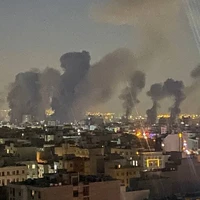
Smoke billows from southern Lebanon, following Israeli strikes, as seen from Nabatieh, Lebanon, June 2, 2026.

Lebanon has emerged as a key obstacle to negotiations between Tehran and Washington, as Israel says it will continue striking Hezbollah and Iran insists that any ceasefire must apply across the region.

The dispute intensified after Tehran suspended talks with Washington on Monday, arguing that Israeli military operations in Lebanon violated the broader ceasefire framework established after the recent US-Iran conflict.

While US President Donald Trump described the interruption as a temporary “little glitch,” Iranian officials have since made clear that a halt to Israeli military operations in Lebanon remains a prerequisite for renewed diplomatic engagement.

On Tuesday, Fars News Agency, which is affiliated with the Revolutionary Guards (IRGC), cited an informed source as rejecting Trump's claims about ongoing, high-speed negotiations.

According to the source, exchanges of messages between Tehran and Washington had stopped “at least for a few days,” while Iran's latest communication to the United States was described as “a clear warning regarding Lebanon.”

Mohammad Bagher Ghalibaf, speaker of parliament and head of Iran's negotiating team, accused the United States of failing to uphold ceasefire commitments, saying on X that enforcement of a naval blockade and Israel's attacks on Lebanon were “clear evidence of US non-commitment to the ceasefire.”

“Every choice has a price, and the bill comes due,” he added.

Ghalibaf later said he had informed Lebanese Parliament Speaker Nabih Berri that Iran would not only suspend negotiations but would also be “in direct confrontation with the enemy” if Israeli attacks on Lebanon continued.

Foreign Minister Abbas Araghchi echoed that position, writing on X that a “ceasefire between Iran and the US is unequivocally a ceasefire on all fronts, including in Lebanon.” He added that any violation on one front “shall be considered a violation across all fronts.”

Tehran sees leverage in talks

With Tehran linking progress in negotiations to developments in Lebanon, the fate of any future agreement increasingly appears tied to the trajectory of the Israel-Hezbollah confrontation.

Some Iranian lawmakers believe Washington will ultimately seek to restrain Israel to prevent a broader crisis.

Ahmad Bakhshayesh, a member of parliament's National Security and Foreign Policy Committee, told Tabnak that the United States would likely increase pressure on Netanyahu's government to avoid further escalation.

Tabnak itself argued that Tehran could use the negotiations as leverage.

“Given that Hezbollah—Iran's most powerful regional ally—entered the conflict immediately following the attacks on Iran, Tehran could leverage the threat of walking away from ongoing negotiations to pressure the United States into restraining Israel,” the outlet wrote.

Growing doubts about a deal

Despite such expectations, several analysts expressed pessimism about the prospects for a final agreement between Tehran and Washington.

Hassan Hanizadeh, a senior analyst on Middle Eastern affairs, told Fararu that Israel's intensified military campaign in Lebanon was “directly designed to pressure Iran and can pose a major risk to the formation of any understanding between Tehran and Washington.”

He argued that Tehran views the attacks as part of broader Western pressure tactics and added: “Evidence shows that Trump has no desire for a comprehensive agreement in the current atmosphere.”

Amir-Ali Abolfath, an expert on US affairs, also questioned the likelihood of a breakthrough.

Speaking to Fararu, he said Israel's confrontation with both Iran and Hezbollah had made negotiations significantly more complicated than in previous rounds.

“The Americans are negotiating to not reach an agreement,” he said. “America proposes conditions that make it seem as though they are shouting: ‘We do not want to reach an agreement with the Islamic Republic,’ because their conditions are unfeasible.”

Other commentators voiced similar doubts. Reza Ghobeishawi, writing in Asr-e Iran, argued that Trump has concluded a deal with Tehran is unattainable and is instead using discussions over reopening the Strait of Hormuz to buy time.

Rubio says Iran war is over

Jun 3, 2026, 17:10 GMT+1

US Secretary of State Marco Rubio said the Iran war was over during a heated exchange with Democratic Representative Sara Jacobs at a congressional hearing.

"We're no longer conducting sustained strikes inside of Iran to degrade their military, because Epic Fury is over," Rubio said.

Rubio said the United States had destroyed Iran's defense industrial base, significantly reduced its missile launchers and drone stockpile, destroyed what remained of its air force and wiped out its conventional navy.

"Those are all gone," Rubio said. "So, I consider that victory, and we did, too. And that was the purpose of Epic Fury."

Calls for diplomacy grow in Tehran amid fresh escalation

Jun 3, 2026, 16:18 GMT+1
•
Behrouz Turani
Calls for diplomacy grow in Tehran amid fresh escalation
100%
A few options depending on tone: **Straight news caption** > Children play in the waters of the Persian Gulf off Bandar Abbas, southern Iran, as cargo vessels sit offshore. **Slightly more evocative** > Children run along the shoreline in Bandar Abbas while ships wait in the waters of the Persian Gulf behind them. **For a story about war, trade, or diplomacy** > Children play on a beach in Bandar Abbas as commercial vessels are seen offshore in the strategic waters of the Persian Gulf. **Feature-style** > Children cool off in the waters off Bandar Abbas on a warm evening, with cargo ships visible on the horizon. **My pick** > Children play along the shore in Bandar Abbas, southern Iran, with cargo vessels visible in the Persian Gulf behind them, June 2, 2026

As Tehran reviews US proposals and influential figures increasingly speak openly in favor of negotiations, developments on the ground are pulling Iran and the United States in the opposite direction.

The contrast was on display this week as senior Shiite cleric Ayatollah Jafar Sobhani publicly endorsed negotiations with Washington while fresh military exchanges across the Gulf highlighted the risk of renewed escalation.

Quoted by several Iranian outlets on Tuesday, Sobhani said “we should back negotiations and follow a good outcome from them, and a good negotiation must be based on the collective and national interests of the country.”

The remarks were among the clearest signs yet that influential clerical circles are prepared to publicly back diplomacy.

Several newspapers also published composite images showing chief negotiator and parliament speaker Mohammad Bagher Ghalibaf alongside IRGC commander Ahmad Vahidi, appearing to emphasize unity among senior officials as Tehran reviews US proposals.

Ghalibaf has also been quoted as saying Iran is examining Washington’s suggestions, while US Secretary of State Marco Rubio said this week that negotiations over the language of a possible agreement could be be concluded within days if progress continues.

Yet the diplomatic signals have coincided with renewed escalation on the ground. Iranian attacks on Kuwait and Bahrain, and US strikes on Iranian targets in the early hours of Wednesday, underscored how fragile any diplomatic opening remains.

At the same time, hardline rhetoric has continued inside Iran. A group of lawmakers on Tuesday called for expanding the range of Iran’s missiles until they could reach Washington.

The competing narratives were also laid bare in an interview with veteran diplomat and US expert Abbas Maleki in Sharq newspaper, and another with conservative analyst Hassan Hanizadeh published by Fararu.

Hanizadeh outlined ongoing indirect contacts between Tehran and Washington while warning that President Donald Trump’s approach could amount to a delaying tactic aimed at securing broader strategic advantages.

Yet unlike many conservative commentators, he did not reject negotiations outright. Instead, he acknowledged that Iran had already conveyed a five-point proposal to Washington through Pakistani intermediaries and argued that talks could be acceptable if they safeguarded national interests and delivered sanctions relief.

Maleki placed greater emphasis on diplomacy itself, describing it as a pillar of national power and pushing back against factions that rely primarily on military force.

He characterized the current phase of Iran-US relations as one of “suspension,” requiring diplomatic engagement to manage the aftermath of the conflict and protect Iran’s interests.

Despite their differences, both men portrayed negotiations as a necessary component of statecraft rather than a concession.

The limits of establishment support for diplomacy were also underscored by the conservative daily Farhikhtegan, which revisited the experience of the 2015 nuclear deal and described it as a “strategic error.”

The paper argued that any future agreement must satisfy two conditions: reversibility and multilateral guarantees.

Iran, it said, should retain the ability to immediately reverse any commitments if Washington defaults, while financial and political mechanisms should involve other international actors to raise the cost of a future US withdrawal.

While influential clerics, politicians and commentators increasingly portray negotiations as necessary, military confrontation continues to shape the political environment.

The result is a moment in which preparations for a deal and preparations for further conflict appear to be unfolding simultaneously.

Iran official disputes Trump nuclear pledge claim - CNBC

Jun 3, 2026, 16:11 GMT+1

An Iranian official disputed US President Donald Trump's assertion that Tehran had agreed not to pursue nuclear weapons, calling the characterization "misleading" and inconsistent with Iran's longstanding position, CNBC reported.

The official, who asked not to be named to discuss private negotiations, told CNBC that Iran, as a signatory to the Nuclear Non-Proliferation Treaty, has always maintained that its nuclear program is exclusively peaceful and has "never sought nuclear weapons."

The official said framing the issue as a new agreement falsely implied that Iran had previously been pursuing nuclear arms, contradicting what Tehran describes as its "declared policy and international obligations," according to CNBC.