The developments unfolded along three parallel fronts: Iranian attacks on US facilities across the Persian Gulf, continued US strikes inside Iran and an intensifying contest over control of the Strait of Hormuz.
Iran said it launched drone attacks on US facilities in Kuwait and Bahrain early Friday, after a sixth consecutive night of American strikes on Iranian military targets.
Iran’s army said it targeted US force deployment and logistics centers in Kuwait, Iran’s IRGC-affiliated Fars news agency reported.
In Bahrain, the army said it struck US helicopters and reconnaissance aircraft at Sakhir Air Base. Sirens sounded in the country for the second time on Friday, according to the Interior Ministry.
In Qatar, several booms were heard after the government sent a second security alert to mobile phones, Reuters reported. The Defense Ministry said Qatar was intercepting several air attacks, while the Interior Ministry said a child was injured by shrapnel from an intercepted missile.
US Central Command has not confirmed the reported attacks in Kuwait or Bahrain.
At the same time, US forces continued striking targets in southern Iran.
CENTCOM said US fighter jets, drones and warships used precision munitions to hit dozens of military targets, including coastal surveillance and air defense sites, logistics infrastructure and maritime capabilities near Bandar Abbas and on Qeshm Island.
Hamshahri, a newspaper owned by Tehran Municipality, reported that five bridges in Hormozgan province were hit in the latest wave of attacks.
The death toll from strikes on bridges in Bandar Khamir rose to seven, Iran’s IRGC-affiliated Tasnim news agency reported. Iranian media also reported damage to a power substation on Kish Island and attacks on transport infrastructure in Bandar Abbas and Bandar Khamir.
The reports could not be independently verified.
Control over Strait of Hormuz
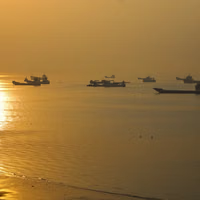
As the two sides exchanged attacks on land, their confrontation also deepened at sea.
CENTCOM said US forces redirected three commercial vessels attempting to breach the naval blockade against Iran, disabled another that failed to comply with orders and boarded the M/T Wen Yao in the Gulf of Oman to verify compliance.
US Defense Secretary Pete Hegseth shared an image from the boarding and wrote that Iran “does not control” the Strait of Hormuz.
CENTCOM said the strait and surrounding waters remained free and open, except for vessels attempting to violate what it called the US “steel wall” blockade.
Iran’s Revolutionary Guards, however, said Tehran remained in full control of the waterway and would prevent oil and gas exports through it for as long as US attacks continued.
Trump cast the military and maritime operations as signs of US momentum.
“You will see the fruits of that labor very, very shortly,” he said after declaring that Washington was “winning big in Iran.”
The possibility of a wider regional conflict emerged more clearly on Friday, when the Revolutionary Guards said they had struck a US special operations command center in Syria’s al-Tanf region, destroying a radar system and several helicopters and killing US personnel.
US Central Command has not confirmed the report.