Iran’s rial hits new low as dollar nears 1.92 million

The US dollar reached a record 1,918,000 rials on Iran’s open market Friday, surpassing its previous high as war, inflation and worsening economic prospects continued to weaken the currency.
The US dollar reached a record 1,918,000 rials on Iran’s open market Friday, surpassing its previous high as war, inflation and worsening economic prospects continued to weaken the currency.
The previous record was 1,900,000 rials, registered on May 4. Other foreign currencies also rose. The British pound reached 2,576,500 rials, while the euro climbed above 2,190,000 rials.#
At Friday’s open-market rate, Iran’s official monthly minimum wage of 166,255,500 rials is worth about $87.
The new low follows a sharp deterioration in Iran’s economic outlook. The International Monetary Fund expects the economy to contract by 6.1% in 2026, after previously forecasting modest growth.
Average inflation is projected to reach 68.9%, leaving households with fewer opportunities to earn money while the value of their income falls rapidly.
The IMF linked the downturn to damage to energy and transport infrastructure, lower production and exports, and disruption around the Strait of Hormuz.
The rial’s decline increases the cost of imported goods, raw materials and medicine, while feeding broader price rises in an economy already struggling with sanctions, war damage and years of economic mismanagement.
Iran operates several official and semi-official exchange rates, but the open-market rate is the price most closely watched by households and businesses seeking foreign currency.
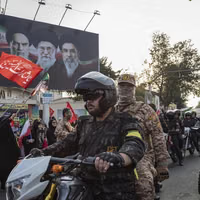
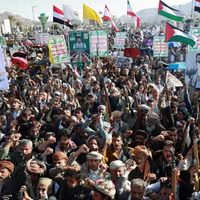
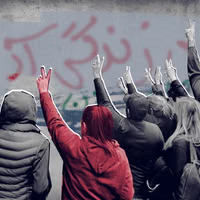






Britain formally designated Iran’s Islamic Revolutionary Guard Corps as a threat to national security on Friday, making public support for the organization or assistance to it punishable by up to 14 years in prison.
The IRGC was designated alongside the Iran-linked Islamic Movement of Companions of the Right and Russia’s GRU Volunteer Corps, the first organizations placed under powers created by the National Security (State Threats) Act 2026.
The designations took effect on July 17 after Parliament approved an order submitted by Home Secretary Shabana Mahmood four days earlier.
Under the new law, it is now a criminal offence to express support for the groups, including by glorifying or encouraging activity that threatens the safety of the United Kingdom.
Providing assistance or accepting money or another material benefit from a designated organization can also lead to prosecution. Those convicted could face prison sentences of up to 14 years.
People who commit sabotage, arson or other hostile acts on behalf of the groups could be charged separately under the National Security Act 2023 and face life imprisonment.
The designation is distinct from banning an organization under Britain’s terrorism legislation. It is designed specifically to address hostile activity linked to foreign governments, including espionage, political interference, intimidation, sabotage and physical attacks.
The government says the new framework will make it easier to prosecute people working for foreign organizations because prosecutors will not always have to establish a direct connection between an individual act and a foreign government.
Outgoing Prime Minister Keir Starmer said when the measures were announced that Britain would not be allowed to become “a playground for states who want to spread fear, division and violence on our streets.”
“We have already taken tough action against the Iranian regime and those linked to it, and against Russian operatives and networks targeting our country,” he said. “These new powers will make it easier to prosecute and lock up anyone carrying out their dirty work here in Britain.”
The IRGC is one of the Islamic Republic’s most powerful military and political institutions. Its overseas Quds Force oversees Tehran’s relationships with allied armed groups and has been accused by British authorities of directing operations against dissidents, journalists and Jewish or Israeli-linked targets in Europe.
The British government said the Islamic Movement of Companions of the Right had claimed responsibility for seven attacks this year against Persian-language media and locations linked to Jewish and Israeli communities in Britain.
Those incidents included an antisemitic arson attack that damaged four ambulances belonging to the Jewish emergency service Hatzola in Golders Green, north London, on March 23.
British authorities said Quds Force members were behind the organization and had “almost certainly” directed its attacks across Europe. The allegations have not been tested in court.
The government has also cited at least 20 potentially lethal Iranian-backed plots identified by the domestic intelligence agency MI5 over a one-year period.
“Iran and Russia are using proxies and thugs to do their dirty work on our shores,” Mahmood said when she announced the intended designations. “We will find you, and we will lock you up.”
The third designated organization, the GRU Volunteer Corps, is described by Britain as a network controlled by Russian military intelligence that recruits people online to carry out arson, sabotage, harassment and other hostile activity.
Foreign Secretary Yvette Cooper said the use of proxies by Iran and Russia to conduct operations on British soil was “reprehensible.”
The designation marks a significant escalation in Britain’s response to the IRGC. Rather than banning the organization as a terrorist group, the government has created a separate route to prosecute support, recruitment, financing and operational assistance linked to hostile foreign-state activity.
The sixth day of fighting since the collapse of the Iran-US ceasefire ended with five bridges hit in southern Iran, US forces turning back three commercial vessels near the Strait of Hormuz, and President Donald Trump declaring that Washington was “winning big in Iran.”
The developments unfolded along three parallel fronts: Iranian attacks on US facilities across the Persian Gulf, continued US strikes inside Iran and an intensifying contest over control of the Strait of Hormuz.
Iran said it launched drone attacks on US facilities in Kuwait and Bahrain early Friday, after a sixth consecutive night of American strikes on Iranian military targets.
Iran’s army said it targeted US force deployment and logistics centers in Kuwait, Iran’s IRGC-affiliated Fars news agency reported.
In Bahrain, the army said it struck US helicopters and reconnaissance aircraft at Sakhir Air Base. Sirens sounded in the country for the second time on Friday, according to the Interior Ministry.
In Qatar, several booms were heard after the government sent a second security alert to mobile phones, Reuters reported. The Defense Ministry said Qatar was intercepting several air attacks, while the Interior Ministry said a child was injured by shrapnel from an intercepted missile.
US Central Command has not confirmed the reported attacks in Kuwait or Bahrain.
At the same time, US forces continued striking targets in southern Iran.
CENTCOM said US fighter jets, drones and warships used precision munitions to hit dozens of military targets, including coastal surveillance and air defense sites, logistics infrastructure and maritime capabilities near Bandar Abbas and on Qeshm Island.
Hamshahri, a newspaper owned by Tehran Municipality, reported that five bridges in Hormozgan province were hit in the latest wave of attacks.
The death toll from strikes on bridges in Bandar Khamir rose to seven, Iran’s IRGC-affiliated Tasnim news agency reported. Iranian media also reported damage to a power substation on Kish Island and attacks on transport infrastructure in Bandar Abbas and Bandar Khamir.
The reports could not be independently verified.
Control over Strait of Hormuz
As the two sides exchanged attacks on land, their confrontation also deepened at sea.
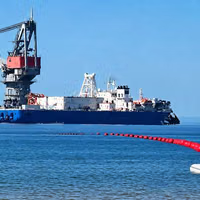
CENTCOM said US forces redirected three commercial vessels attempting to breach the naval blockade against Iran, disabled another that failed to comply with orders and boarded the M/T Wen Yao in the Gulf of Oman to verify compliance.
US Defense Secretary Pete Hegseth shared an image from the boarding and wrote that Iran “does not control” the Strait of Hormuz.
CENTCOM said the strait and surrounding waters remained free and open, except for vessels attempting to violate what it called the US “steel wall” blockade.
Iran’s Revolutionary Guards, however, said Tehran remained in full control of the waterway and would prevent oil and gas exports through it for as long as US attacks continued.
Trump cast the military and maritime operations as signs of US momentum.
“You will see the fruits of that labor very, very shortly,” he said after declaring that Washington was “winning big in Iran.”
The possibility of a wider regional conflict emerged more clearly on Friday, when the Revolutionary Guards said they had struck a US special operations command center in Syria’s al-Tanf region, destroying a radar system and several helicopters and killing US personnel.
US Central Command has not confirmed the report.
Rising daycare fees and mounting economic pressure are prompting more Iranian families to forgo kindergarten enrollment and rely on grandparents for childcare, raising concerns among sociologists about the long-term impact on children's social development.
The Hamshahri newspaper reported on Thursday that falling birth rates, coupled with soaring daycare costs, have reduced demand for kindergartens and preschool centers across the country.
Monthly daycare fees vary widely across Tehran, according to the report. In middle-income neighborhoods, tuition ranges from 50 million ($25) to 80 million rials (over $40), while families in wealthier districts pay between 250 million (around $130) and 300 million rials ($160).
The average monthly income in Iran is estimated at $150–$200, depending on fluctuations in the open-market exchange rate. By comparison, the minimum monthly cost of basic living expenses, including food and housing, is estimated at $385–$400, leaving many households unable to meet essential needs.
Daycare operators in affluent areas attributed the higher fees to rising rents and staff wages, saying the increased costs have discouraged many parents from enrolling their children.
More than 60% of kindergarten operating costs are spent on personnel under Iran's labor law, Hamidreza Sheikholeslam, head of the National Organization for Early Childhood Education, said in June.
Sheikholeslam said staffing costs, the number of teachers and children, operating hours, rent, facilities and equipment, and other operating expenses all influence tuition fees.
Many families, the report said, have responded to rising childcare costs and broader financial pressures by turning to lower-cost alternatives, most commonly asking grandparents to care for young children.
Experts warn of social consequences
Sociologists quoted by Hamshahri said removing daycare from household spending is not only an economic decision but could become a broader social challenge.
They argued that young children benefit from interacting with their peers in educational settings and warned that replacing daycare with care by relatives could undermine their social development.
The concerns follow earlier reports highlighting the growing burden on extended families. In May, the Shargh newspaper reported that prolonged preschool closures following the recent war left many working parents scrambling for childcare, with some relying on grandparents and relatives.
Another report published by Haft-e Sobh daily in February warned that rising daycare costs had effectively turned many grandparents into full-time caregivers, raising concerns about the physical and psychological burden on older adults as well as differences in parenting approaches across generations.
Iranian pensioners say their monthly income no longer covers basic living expenses, with many forced to seek additional work as inflation continues to erode their purchasing power.
“The pension is only enough to cover the equivalent of 13 days of basic work,” one woman receiving her late husband's pension told Iran International, describing monthly payments as far below the cost of supporting her family.
Other retirees also told Iran International that decades of contributions to the social security system have left them with pensions insufficient to meet basic expenses.
Several said that after 35 years of paying into the system, they now receive around 220 million rials ($117) a month, an amount they say does not even cover rent in many parts of the country.
The average monthly income in Iran is approximately $150 to $200, depending on fluctuations in the open market currency rate. This level of income falls far short of the cost of living, which requires around $385 to $400 per month to afford basic necessities like food and housing.
“Last year my husband's pension was 90 million rials ($48). This year it has increased by about 22% to 110 million rials ($58),” another woman supporting her two children told Iran International.
Many said they have turned to driving for ride-hailing services or other informal work after retirement to supplement their income.
Official data show year-on-year inflation for food and beverages has remained above 130% in recent months, placing further pressure on households already struggling with rising living costs.
Pension system under growing strain
The financial hardship described by pensioners reflects broader strains on Iran's retirement system, which has faced mounting funding shortages and growing concern over the sustainability of pension funds.
Mostafa Salari, head of the Social Security Organization, said on July 13 that the organization faces an 820 trillion rials ($436 million) funding gap to pay pension arrears for the first two months of the Iranian year and is also struggling to finance July payments.
The government has also moved to raise the retirement age as it seeks to ease pressure on the pension system, a step that has drawn criticism from labor advocates.
Economists have for years warned that demographic pressures, underfunding and broader economic problems have left Iran's pension funds increasingly vulnerable.
In 2022, Sajjad Padam, then director-general for social insurance at the Ministry of Labour and Social Welfare, warned that even selling three million barrels of oil a day without sanctions would not be enough to resolve Iran's pension crisis, underscoring the depth of the structural challenges facing the country's retirement system.
A week of heavy fighting has left parts of Iran’s southern coast looking unmistakably like a war zone. Yet in Tehran, many still struggle to believe the country is at war.
Watching explosions on television and social media from hundreds of kilometers away, many see the confrontation with the United States as another familiar cycle of pressure that may yet give way to negotiations.
Fatemeh Rajabi, the news anchor who first reported the U.S. strikes on ports and military sites in southern Iran on the YouTube program Hasht-e Shab, says many in the capital find it difficult to grasp that a war is unfolding along the northern shores of the Persian Gulf — the region they casually refer to as “down under.”
Reporter Ali Pakzad, who visited the area during the strikes, says missiles hit targets from Abadan near the Iraqi border to Chabahar and Saravan near Pakistan.
He described damaged fishing vessels, battered ports and communities whose livelihoods have been shattered by attacks documented in the program’s footage.
That contrast lies at the heart of an investigative report by journalist Mira Ghorbanifar in Toseh Irani, titled The South in the Fire of War and Ashes of Ceasefire.
Ghorbanifar writes that explosions now puncture the dawn along Iran’s southern coast. Smoke rises from damaged docks, charred dhows lie abandoned, and fish markets once full of noise now speak only of “a war for which no one has yet chosen a definite name.”
While officials speak of “understandings,” “ceasefires” and “crisis management,” she argues, people in Iran’s south are grappling with damaged infrastructure and disrupted shipping, trying to adapt to what increasingly resembles a war of attrition.
She also asks whether the so-called Islamabad Understanding still exists. Is the fighting along Iran’s southern coast part of the same hundred-day conflict, or the start of a new phase of controlled escalation? And can both sides return to negotiations before crossing a point of no return?
The concerns extend well beyond independent journalists.
Government-aligned newspapers have increasingly questioned whether Iran can sustain a prolonged confrontation while struggling to protect civilians and critical infrastructure.
Moderate daily Sharq describes the country’s predicament as “structural and accumulated,” arguing that damaged infrastructure, naval disruption and collapsing logistics have left even minor shocks capable of triggering major crises.
Centrist Etemad warns that public trust has eroded while the state remains unprepared for cascading emergencies.
Economic newspapers have echoed those warnings.
Jahan Sanat argues that Iran’s deterrence is steadily weakening under sustained pressure, while Donya-ye Eghtesad says military decisions are increasingly driven by political necessity rather than strategic advantage, leaving the country more vulnerable in a prolonged conflict.
Washington-based analysts Mohammad Ghaedi and Farzin Nadimi have voiced similar concerns in interviews with Persian-language media abroad.
Ghaedi argues that Iran’s governing system “has repeatedly refused to learn from past mistakes,” pointing to what he sees as a widening disconnect between insulated decision-makers and citizens bearing the costs of conflict.
Nadimi says Iran is confronting the United States at “a moment of maximum structural fragility,” with deterrence eroding and escalation driven more by political necessity than strategic advantage.
“Iran is not in a position to manage a prolonged conflict,” he warns, adding that every new attack “burns away another part of Iran’s deterrent capability.”
Even hardline media have shown hints of concern. Resalat recently urged Iran to “rebuild its defensive capacity” after recent military losses — a rare acknowledgement from a conservative newspaper that the country’s deterrence has been weakened.
For now, the divide remains striking. In Tehran, politicians and commentators continue to debate negotiations, ceasefires and diplomatic understandings.
Along the southern coast, many residents have already stopped asking what to call the conflict. They are simply living through it.


