• العربية
  • فارسی
Brand
  • Iran Insight
  • Politics
  • Economy
  • Analysis
  • Special Report
  • Opinion
  • Podcast
  • Iran Insight
  • Politics
  • Economy
  • Analysis
  • Special Report
  • Opinion
  • Podcast
  • Theme
  • Language
    • العربية
    • فارسی
  • Iran Insight
  • Politics
  • Economy
  • Analysis
  • Special Report
  • Opinion
  • Podcast
All rights reserved for Volant Media UK Limited
volant media logo

Rubio says Iran war is over

Jun 3, 2026, 17:10 GMT+1

US Secretary of State Marco Rubio said the Iran war was over during a heated exchange with Democratic Representative Sara Jacobs at a congressional hearing.

"We're no longer conducting sustained strikes inside of Iran to degrade their military, because Epic Fury is over," Rubio said.

Rubio said the United States had destroyed Iran's defense industrial base, significantly reduced its missile launchers and drone stockpile, destroyed what remained of its air force and wiped out its conventional navy.

"Those are all gone," Rubio said. "So, I consider that victory, and we did, too. And that was the purpose of Epic Fury."

Most Viewed

Will Israel's new Mossad chief carry on the push for regime change in Iran?
1
INSIGHT

Will Israel's new Mossad chief carry on the push for regime change in Iran?

2

Netanyahu says Iran’s ruling system ‘will fall in the end’

3

Mexico visas issued for Iran’s football team, US visas pending - report

4

Alleged mastermind of London attacks met Khamenei before war, indictment says

5
INSIGHT

Iran's internet is back, but still broken

Banner
Banner

Spotlight

  • Lebanon emerges as new obstacle to Iran-US talks
    INSIGHT

    Lebanon emerges as new obstacle to Iran-US talks

  • Calls for diplomacy grow in Tehran amid fresh escalation
    INSIGHT

    Calls for diplomacy grow in Tehran amid fresh escalation

  • Will Israel's new Mossad chief carry on the push for regime change in Iran?
    INSIGHT

    Will Israel's new Mossad chief carry on the push for regime change in Iran?

  • Leaked documents link Chinese firms to IRGC missile fuel network
    EXCLUSIVE

    Leaked documents link Chinese firms to IRGC missile fuel network

•
•
•

More Stories

Calls for diplomacy grow in Tehran amid fresh escalation

Jun 3, 2026, 16:18 GMT+1
•
Behrouz Turani
Calls for diplomacy grow in Tehran amid fresh escalation
100%
Children play along the shore in Bandar Abbas, southern Iran, with cargo vessels visible in the Persian Gulf behind them, June 2, 2026

As Tehran reviews US proposals and influential figures increasingly speak openly in favor of negotiations, developments on the ground are pulling Iran and the United States in the opposite direction.

The contrast was on display this week as senior Shiite cleric Ayatollah Jafar Sobhani publicly endorsed negotiations with Washington while fresh military exchanges across the Gulf highlighted the risk of renewed escalation.

Quoted by several Iranian outlets on Tuesday, Sobhani said “we should back negotiations and follow a good outcome from them, and a good negotiation must be based on the collective and national interests of the country.”

The remarks were among the clearest signs yet that influential clerical circles are prepared to publicly back diplomacy.

Several newspapers also published composite images showing chief negotiator and parliament speaker Mohammad Bagher Ghalibaf alongside IRGC commander Ahmad Vahidi, appearing to emphasize unity among senior officials as Tehran reviews US proposals.

Ghalibaf has also been quoted as saying Iran is examining Washington’s suggestions, while US Secretary of State Marco Rubio said this week that negotiations over the language of a possible agreement could be be concluded within days if progress continues.

Yet the diplomatic signals have coincided with renewed escalation on the ground. Iranian attacks on Kuwait and Bahrain, and US strikes on Iranian targets in the early hours of Wednesday, underscored how fragile any diplomatic opening remains.

At the same time, hardline rhetoric has continued inside Iran. A group of lawmakers on Tuesday called for expanding the range of Iran’s missiles until they could reach Washington.

The competing narratives were also laid bare in an interview with veteran diplomat and US expert Abbas Maleki in Sharq newspaper, and another with conservative analyst Hassan Hanizadeh published by Fararu.

Hanizadeh outlined ongoing indirect contacts between Tehran and Washington while warning that President Donald Trump’s approach could amount to a delaying tactic aimed at securing broader strategic advantages.

Yet unlike many conservative commentators, he did not reject negotiations outright. Instead, he acknowledged that Iran had already conveyed a five-point proposal to Washington through Pakistani intermediaries and argued that talks could be acceptable if they safeguarded national interests and delivered sanctions relief.

Maleki placed greater emphasis on diplomacy itself, describing it as a pillar of national power and pushing back against factions that rely primarily on military force.

He characterized the current phase of Iran-US relations as one of “suspension,” requiring diplomatic engagement to manage the aftermath of the conflict and protect Iran’s interests.

Despite their differences, both men portrayed negotiations as a necessary component of statecraft rather than a concession.

The limits of establishment support for diplomacy were also underscored by the conservative daily Farhikhtegan, which revisited the experience of the 2015 nuclear deal and described it as a “strategic error.”

The paper argued that any future agreement must satisfy two conditions: reversibility and multilateral guarantees.

Iran, it said, should retain the ability to immediately reverse any commitments if Washington defaults, while financial and political mechanisms should involve other international actors to raise the cost of a future US withdrawal.

While influential clerics, politicians and commentators increasingly portray negotiations as necessary, military confrontation continues to shape the political environment.

The result is a moment in which preparations for a deal and preparations for further conflict appear to be unfolding simultaneously.

Iran official disputes Trump nuclear pledge claim - CNBC

Jun 3, 2026, 16:11 GMT+1

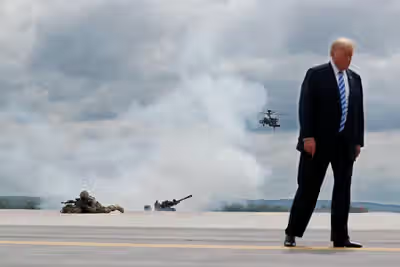
An Iranian official disputed US President Donald Trump's assertion that Tehran had agreed not to pursue nuclear weapons, calling the characterization "misleading" and inconsistent with Iran's longstanding position, CNBC reported.

The official, who asked not to be named to discuss private negotiations, told CNBC that Iran, as a signatory to the Nuclear Non-Proliferation Treaty, has always maintained that its nuclear program is exclusively peaceful and has "never sought nuclear weapons."

The official said framing the issue as a new agreement falsely implied that Iran had previously been pursuing nuclear arms, contradicting what Tehran describes as its "declared policy and international obligations," according to CNBC.

Netanyahu says Iran regime change expected but timing unclear - CNBC

Jun 3, 2026, 15:55 GMT+1

Israeli Prime Minister Benjamin Netanyahu said he expected regime change in Iran because the country's current leadership had been "enormously" weakened, but said he could not predict when that would happen.

"You can’t quite predict when a regime like that goes under," Netanyahu said in an interview with CNBC. "You didn’t predict it in a number of cases: Not in Romania, and not in the fall of the Berlin Wall, and nobody predicted it, but it happened. Why? Because the cracks were propagating underneath."

"In fact, you have enormous cracks right now in Iran, and you can’t predict when it’ll happen," he said.

"But I said yesterday in a public forum here ... 'Look, I believe that ultimately these cracks will propagate and the regime will fall, and we’ll do our best,'" Netanyahu added.

"I think that we have to help the Iranian people to bring down this regime, and that hasn’t changed, but it’s not going to happen, you know, exactly at the moment of our choosing," he said.

"I think they’ve been enormously weakened," Netanyahu added.

Iran Supreme Court upholds death sentence for political prisoner

Jun 3, 2026, 15:43 GMT+1
Iran Supreme Court upholds death sentence for political prisoner
100%

Iran's Supreme Court has upheld the death sentence of Hassan Mosallavi (Torfi), a 38-year-old political prisoner, on charges of "waging war against God" and "membership in Arab groups opposed to the Islamic Republic," Karun Human Rights Organization reported.

The rights group said the ruling was communicated to Mosallavi, in recent days at Sheiban Prison in Ahvaz, in southwestern Iran.

Mosallavi was arrested by security forces in 2022 and sentenced to death in absentia in August 2023 by Mehran Mehmannavaz, head of Branch 1 of the Mahshahr Revolutionary Court, the report said.

He had previously been arrested in 2019 along with several Arab cultural activists and spent more than 10 months in detention, the group added.

Netanyahu says Israel, US forces ready if needed in Iran

Jun 3, 2026, 15:38 GMT+1

Israeli Prime Minister Benjamin Netanyahu said in an interview with CNBC that Israel and US forces were ready if needed in Iran.

Netanyahu said he would leave it to US President Donald Trump to decide whether military escalation was needed.

He said opening the Strait of Hormuz was possible militarily and that Trump was weighing many options.

Netanyahu added that he and Trump speak once every two day.