Several commentators and state-linked outlets have suggested Qatar may be exploring financial mechanisms that would give Tehran access to some of its frozen assets without requiring direct US cash transfers to Iran.
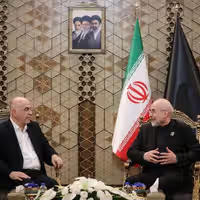
Parliament Speaker Mohammad Bagher Ghalibaf, Foreign Minister Abbas Araghchi and Central Bank Governor Abdolnaser Hemmati paid a highly publicized visit to Doha on Monday, fueling speculation that talks focused heavily on the frozen assets issue.
Iranian media widely linked Hemmati’s presence to negotiations over financial guarantees, though no official details of the discussions have been released.
CNN reported on Monday that Intense talks were ongoing in Doha in coordination with the United States, focusing on the Strait of Hormuz, Iran’s highly enriched uranium and frozen funds.
A day earlier, an informed source with direct knowledge of the negotiations told Iran International that Tehran has demanded guaranteed access to $12 billion in frozen assets during the first phase of any arrangement.
Iranian officials continue to insist that the country’s nuclear program and stockpile of highly enriched uranium should only be addressed in later stages of a broader agreement.
The current focus appears to center on roughly $6 billion in Iranian assets transferred from South Korea to Qatar in 2023 under a US-Iran prisoner exchange deal.
The funds were later re-frozen following the October 7 Hamas attack on Israel and the subsequent deterioration in relations between Tehran and Washington.
Mohammad Marandi, a commentator close to the Iranian government, suggested in a televised interview Sunday that Qatar could initially transfer the money to Iran before later being reimbursed by the United States.
Political analyst Shahir Shahidsaless wrote on X that such an arrangement would allow Washington to avoid directly paying Tehran while still meeting one of Iran’s principal demands.
Reuters previously reported, citing senior Iranian sources, that Washington had agreed in principle to release some frozen Iranian assets as part of efforts to secure safe passage through the Strait of Hormuz, though US officials later denied that any final agreement had been reached.
The IRGC-linked Tasnim news agency, citing what it described as an informed source, reported Sunday that Tehran had made clear it would reject any preliminary arrangement lacking a concrete first step by Washington on the assets issue.
“Iran has emphasized that without the release of a specific portion of the blocked assets in the very first step, and without a clear and guaranteed mechanism for the release of all frozen assets, no agreement will be possible,” the source told Tasnim.
Tasnim also claimed US officials were backtracking on earlier signals delivered through intermediaries regarding the funds.
“Based on past experiences of repeated American violations and obstruction,” the source said, “Iran will not allow the issue of asset release to be reduced to vague and unreal promises.”
Despite the tensions, Mashallah Shamsolvaezin, a member of President Masoud Pezeshkian’s Media Council, expressed cautious optimism, describing the frozen-assets dispute as “a small problem” in remarks to Fars News Agency.
He said the disagreement could be resolved within 48 hours and suggested future negotiations might move from Doha to Geneva or another location more accessible to the American delegation.
At the same time, hardline figures continue to insist on preserving what they describe as “Iran’s management” of the Strait of Hormuz.
Foreign Ministry spokesperson Esmaeil Baghaei denied Monday that Tehran was seeking to impose tolls on ships passing through the waterway, but said providing navigation and environmental protection services would require fees.
Hossein Shariatmadari, editor-in-chief of the hardline Kayhan newspaper, criticized reports suggesting Iran could agree to reopen the Strait of Hormuz under a broader understanding with Washington.
“If this news is true,” he wrote, “the real meaning of opening the Strait of Hormuz is the disarmament of Iran against military, economic and political attacks by enemies.”
The comments highlighted the enduring influence of hardliners advocating maximalist demands, a dynamic critics say has repeatedly helped sink fragile diplomatic openings between Tehran and Washington.