• العربية
  • فارسی
BrandBrand
  • Iran Insight
  • Politics
  • Economy
  • Analysis
  • Special Report
  • Opinion
  • Podcast
  • Live TV
  • Iran Insight
  • Politics
  • Economy
  • Analysis
  • Special Report
  • Opinion
  • Podcast
  • Live TV
  • Theme
  • Language
    • العربية
    • فارسی
  • Iran Insight
  • Politics
  • Economy
  • Analysis
  • Special Report
  • Opinion
  • Podcast
  • Live TV
All rights reserved for Volant Media UK Limited
volant media logo
INSIGHT

New strikes expose Tehran’s battle between diplomacy and revenge

Behrouz Turani
Behrouz Turani

Iran International

Jul 8, 2026, 18:07 GMT+1
A screen grab from a video released by IRGC-linked Tasnim purporting to show a missile launched toward US bases in the region, July 7, 2026

Iran’s attacks on vessels near the Strait of Hormuz and subsequent strikes on US bases in the region have exposed a widening battle inside Tehran between those trying to preserve diplomacy with Washington and those pushing for confrontation.

The escalation began Monday night with attacks on commercial navigation near Hormuz, continued Tuesday, and was followed Wednesday morning by strikes on US positions after CENTCOM forces hit more than 80 targets in southern Iran.

Tehran claimed it had struck 85 targets, all of them US interests.

Inside Iran, hardline media quickly framed the confrontation as proof that the June MoU with Washington had failed—or that it had only served to expose US intentions.

The Tehran municipal daily Hamshahri argued that the MoU was not a concession but proof Washington had recognized Iran’s missile capabilities and regional leverage.

It said the latest maritime confrontation showed any attempt by the US or its allies to impose terms during the 60-day implementation period would risk disruption of global energy routes.

Other hardline outlets, including Kayhan, went further.

Writing with vindicated fury, editor Hossein Shariatmadari declared that the “60-day diplomatic mirage” had vanished exactly as he predicted, calling the US strikes proof of “Washington’s innate treachery and structural inability to honor any MoU.”

More than a military confrontation, the attacks appear to reflect a growing divide among Iranian decision-makers: those seeking to advance an agreement with Washington and those who argue that only direct revenge against US President Donald Trump and Israeli Prime Minister Benjamin Netanyahu would be sufficient.

Over the past month, radical hardliners in Tehran—who portrayed their own survival and the system’s survival as victory over the United States—have sharply criticized President Massoud Pezeshkian for signing the MoU with Washington.

They argued that before the agreement, Trump was under pressure from politicians and markets, and that Iran could have extracted better terms.

While the anger surrounding Khamenei’s funeral cannot be dismissed, the divide between Tehran’s hardliners and pragmatists appears to be a major factor behind the renewed confrontation that followed Trump’s conciliatory comments about allowing a peaceful funeral for the man he had ordered killed.

Whatever the precise trigger, the escalation has strengthened the hand of hardliners.

Social-media videos from the funeral in Tehran showed radicals throwing stones at Foreign Minister Abbas Araghchi and chanting slogans against Pezeshkian.

On Wednesday, ultraconservative MP Hamid Rasai called for a missile strike on Trump’s residence during his visit to Ankara for a NATO meeting, while fellow hardliner Mahmoud Nabavian said Muslims worldwide were expected to attack Trump the way Salman Rushdie was attacked.

Trump said he had always known he was a target for “nasty Iranians,” adding that if they had nuclear weapons, they would certainly use them.

On Wednesday, Hamshahri went further, arguing that strikes on US assets in Kuwait and Bahrain demonstrated that the cost of confrontation would not remain limited to Iranian territory.

The paper said Washington’s move to revoke Iran’s oil-export waivers amounted to total economic warfare and justified an equivalent response: closing the Strait of Hormuz.

“If Iran cannot openly sell its crude, no state in the region will be permitted to export energy,” it warned.

Kayhan urged the Pezeshkian administration to abandon the June framework, restrict maritime access and shift to what it called an unrestricted defensive doctrine under the guidance of the new Supreme Leader, Mojtaba Khamenei.

Meanwhile, figures including parliamentary National Security Committee spokesman Ebrahim Rezai and Mojtaba Khamenei’s military adviser Mohsen Rezai declared Iran’s readiness for combat.

Chief of staff of the armed forces Habibollah Sayyari also warned against any ground operation.

“If the enemy deploys forces to the Iranian shores, their troops will enter a hell that has no exit,” Sayyari said—a remark widely circulated online, with critics joking that it unintentionally described conditions inside the Islamic Republic itself.

Most Viewed

Iran’s oil lifeline could run dry by mid-December, Kpler says
1
PODCAST

Iran’s oil lifeline could run dry by mid-December, Kpler says

2

US weighs strikes on Houthis and Iran after deadly Saudi airport attack

3

Iran turns to Turkey, Turkmenistan for power as war strains industry

4

Iran detains football coach over child sexual abuse allegations

5

'Absolute isolation': US outlines plan to cut off Iran’s economic lifelines

Spotlight

  • Russia fears a pro-Western Iran more than an Iranian atomic bomb
    ONE-ON-ONE

    Russia fears a pro-Western Iran more than an Iranian atomic bomb

  • War puts Iran’s nuclear ambiguity under scrutiny
    INSIGHT

    War puts Iran’s nuclear ambiguity under scrutiny

  • Iran’s oil lifeline could run dry by mid-December, Kpler says
    PODCAST

    Iran’s oil lifeline could run dry by mid-December, Kpler says

  • 'Three golden weeks': Trump’s no-strike pledge fuels calls in Iran to act first

    'Three golden weeks': Trump’s no-strike pledge fuels calls in Iran to act first

  • J’Accuse! Tehran defends French students, silences Iranian youth
    OPINION

    J’Accuse! Tehran defends French students, silences Iranian youth

  • US pressure hits Iranians harder than rulers, 68% in poll say
    VOICES FROM IRAN

    US pressure hits Iranians harder than rulers, 68% in poll say

Banner
Banner
Banner
Banner
•
•
•

More Stories

Khamenei funeral lays bare deep political divisions in Iran

Jul 8, 2026, 09:23 GMT+1
•
Maryam Sinaiee
100%
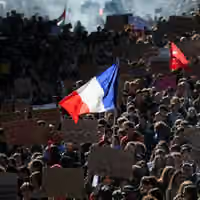
Participants in Ali Khamenei's funeral in Tehran are carrying red flags symbolizing vengeance. July 6, 2026

Ali Khamenei's funeral was intended to project national unity, but hardline attacks on the president and Iran's negotiators, the absence of former presidents, and renewed calls for revenge exposed deep divisions within Iran's political establishment.

The funeral processions in Tehran and Qom were overshadowed by hardline supporters chanting slogans against President Masoud Pezeshkian and Foreign Minister Abbas Araghchi, a sign of growing tensions over the government's diplomatic course.

Videos circulating on social media showed Pezeshkian being escorted through crowds by his security detail as mourners shouted "Death to the compromiser." Another video captured an even more hostile reception for Araghchi, with chants including "Death to the traitor," and "Shameless."

Yousef Pezeshkian, the president’s son and adviser, condemned the incident, writing: "If anger is directed against our own forces, targets Muslim unity and undermines domestic cohesion, it means we have become a tool in the enemy's hands and opened a window of hope for it to inflict further blows."

The attacks prompted strong criticism from reformists as well as some conservatives who support parliamentary speaker Mohammad-Bagher Ghalibaf's cooperation with the government and negotiations with the United States.

Conservative journalist Mohammad Mohajeri criticized senior officials, particularly Supreme National Security Council Secretary Mohammad-Bagher Zolghadr and some members of the Supreme National Security Council, for remaining silent. "Their silence is itself creating an even greater sedition."

Reformist journalist Ali Asghar Shafieian argued that the slogans damaged Iran's national interests. "On the day of the funeral, when even critics wore black out of respect for Iran and its leader, slogans against the state's decision to end the war and against negotiators seeking sanctions relief dealt a blow to national dignity and security."

Notable absences

The funeral also drew attention for the absence of former presidents Mohammad Khatami and Hassan Rouhani, despite official expectations that the ceremonies would showcase unprecedented national solidarity. Former foreign minister Mohammad-Javad Zarif was also absent, while images showed former president Mahmoud Ahmadinejad attending the public procession.

Authorities have not explained whether the former officials chose not to attend or were prevented from doing so.

Unlike Pezeshkian, Ghalibaf, and Hassan Khomeini – the grandson of Islamic Republic founder Ruhollah Khomeini – attended only the tightly controlled farewell ceremony at Tehran's Mosalla rather than the public street procession.

Political analyst Ahmad Zeidabadi argued that the hostile atmosphere explained the absences. "[The behaviour of] those who ignored the sanctity of the funeral by insulting the president and foreign minister clearly explains why figures such as Mohammad Khatami and Hassan Rouhani did not attend."

He added: "If they showed no mercy even to Pezeshkian, who enjoyed Khamenei's full trust and respect, it is obvious what they would have done had Khatami or Rouhani appeared."

The reformist-leaning website Rouydad24 described the absence of former presidents as "not merely a ceremonial issue, but the loss of an opportunity to demonstrate political consensus at one of the country's most sensitive moments."

Calls for revenge dominate messaging

During the mourning ceremonies, some participants repeatedly called for retaliation against the United States, Israel, and particularly US President Donald Trump, whom they blamed for Khamenei's death. Many mourners carried red flags symbolizing vengeance.

One supporter wrote: "Officials, do you see these flags of revenge? People will be calmed by revenge against the enemy – not by negotiations."

Hardline journalist Parisa Nasrabadi argued: "Avenging the martyred leader is a decisive step toward restoring lost deterrence, a duty to prevent future assassinations of leaders, and an absolute necessity to protect the position of Iran's young leader."

Hossein Shariatmadari, editor of the hardline Kayhan newspaper, called on the government to officially declare Trump and even the pilots allegedly involved in Khamenei's killing worthy of death wherever they are found, and proposed offering a bounty for anyone who kills Trump.

Another commentary published by Tabnak argued that the massive turnout and chants demonstrated that Iranian authorities had "no option but to exact retribution against the killers of the martyred leader."

Was the funeral a referendum?

Several pro-government figures portrayed the turnout as a public referendum endorsing the Islamic Republic.

Lawmaker Jafar Ghaderi described it as "the revolution's largest popular referendum," arguing that the government should now respond by addressing economic concerns and rewarding public loyalty.

Zeidabadi challenged the analogy, writing: "It would be good to explain exactly what this referendum is about and in which law a 'street referendum' is defined."

A social media user similarly argued that authorities have long portrayed public gatherings as proof of popular endorsement without specifying either the subject of the alleged referendum or its legal basis.

Foreign influencers welcomed

The funeral also featured several foreign journalists and pro-Iran commentators, including American media personality Jackson Hinkle, The Grayzone editor Max Blumenthal, and British journalist and blogger Bushra Sheikh, all of whom are known for criticizing Western policy toward Iran. Their presence was widely celebrated by government supporters online.

A widely shared video showed Hinkle standing on a stage in Tehran’s Enghelab Square, leading mourners in chants of “Death to Zionists,” “Death to Israel” and “Death to America,” with the crowd repeating the slogans after him.

Khamenei to end Eje'i’s judiciary tenure after one term

Jun 30, 2026, 20:48 GMT+1
100%

Iran's Supreme Leader Mojtaba Khamenei plans to remove judiciary chief Gholam-Hossein Mohseni Eje'i at the end of his first five-year term and appoint a new figure to lead the judiciary, sources familiar with the matter told Iran International.

Sources inside Iran told Iran International that Khamenei does not intend to extend Eje'i’s term for another five years, breaking with a practice followed for nearly four decades in which judiciary chiefs have usually served two consecutive five-year terms.

The sources, who spoke on condition of anonymity, said the decision is not aimed at judicial reform but is part of a broader reshaping of power after the recent war.

They said the new supreme leader is seeking to replace key officials in major state institutions with figures more closely aligned with him.

Eje'i’s expected removal could mark one of the first major signs of Khamenei’s effort to rebuild control over the Islamic Republic’s judicial, security and political apparatus after the transfer of power.

Hardliners step up pressure on Eje'i

The decision comes amid growing criticism of Eje'i from hardline figures after the names of Supreme National Security Council members who voted in favor of a memorandum of understanding with the United States were disclosed.

Critics say Eje'i’s vote was at odds with Khamenei’s stated position, after the leader said in a letter that he had, in principle, held a different view on the memorandum of understanding.

Signs of dissatisfaction with Eje'i’s five-year record have also appeared in recent official and semi-official commentary close to the power structure.

In a message marking Judiciary Week, Khamenei did not clearly endorse Eje'i’s continuation in office. Instead, he addressed the judiciary as an institution and called for the “actualization” of demands previously made by former Supreme Leader Ali Khamenei.

The message repeated calls for the implementation of the judicial transformation document, fighting corruption inside the judiciary, reviving public rights, blocking the use of recommendations and lobbying, and improving communication with the public.

Eje'i seeks to defend his record

A day later, Eje'i published a letter to Khamenei in deferential language, defending the judiciary’s performance and pledging to continue the path of “judicial transformation.”

“I and all components of the judiciary consider ourselves obliged to carry out Your Excellency’s binding commands precisely, swiftly and without any reduction,” Eje'i wrote.

Media outlets and figures close to the establishment criticized Eje'i for not publishing such a letter before Khamenei’s message. Some also described the new leader’s renewed emphasis on his father’s demands as a negative assessment of Eje'i’s record, arguing that their repetition showed the judiciary had failed to deliver practical results under him.

Rival factions inside the establishment have also stepped up attacks on Eje'i, accusing him of distancing himself from the leadership’s demands.

Media close to Parliament Speaker Mohammad Bagher Ghalibaf and President Masoud Pezeshkian have described the attacks as part of an effort by the faction aligned with Saeed Jalili, a member of Iran’s Supreme National Security Council, and the Paydari Front to create divisions among senior officials and weaken the postwar political path.

Media close to the judiciary and Eje'i’s supporters have sought to portray his five-year record as successful, citing reduced imprisonment, electronic court proceedings, shorter trials, anti-corruption efforts and public outreach.

Rights groups point to record of repression

Human rights groups and activists say Eje'i is not a reformist figure but a long-standing part of the Islamic Republic’s repressive judicial and security apparatus.

They point to his record in the Special Clerical Court, the Ministry of Intelligence, and later as first deputy and head of the judiciary, saying his tenure has been marked by continued heavy sentences against protesters, political activists, journalists, prisoners of conscience and minorities.

Rights advocates say the judiciary under Eje'i has continued to act as the legal and executive arm of security institutions in political and security cases.

They also argue that replacing Eje'i alone would not bring meaningful change without structural reform, an end to security interference in judicial cases, guaranteed access to lawyers, a halt to forced confessions, the annulment of political verdicts and respect for fair trial standards.