Pakistan army chief meets Ghalibaf and Pezeshkian in Tehran


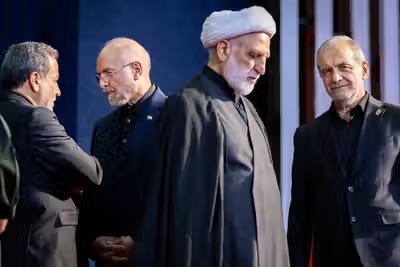
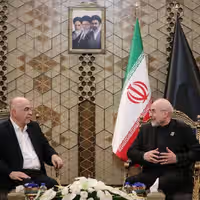
Pakistan’s army chief Asim Munir met Iranian President Masoud Pezeshkian and parliament speaker Mohammad Bagher Ghalibaf in Tehran as part of ongoing diplomatic efforts over regional tensions, Iranian state media reported.
Munir also met Iranian President Masoud Pezeshkian during his visit to Iran, with Foreign Minister Abbas Araghchi present, according to the report.
Al Arabiya, citing informed sources, reported that Munir had carried US messages to Tehran and that the messages included a threat to resume the war.


A senior Iranian cleric said women without proper hijab should not be excluded from wartime gatherings, while Nour News, affiliated with Iran’s Supreme National Security Council, called for reason and moderation over ideological confrontation.
Ayatollah Mohammad Javad Fazel Lankarani said Iranians should not be divided by issues such as hijab when the country and Islam were under threat.
He said the issue of hijab remained a religious duty, but argued that it would be wrong to tell women without proper hijab not to attend nightly gatherings organized in support of the war effort.
“When the country itself and the foundation of Islam are in danger, we should not deal with second- and third-tier issues... we should not ask the man who has taken up a weapon and entered the field whether he prays or not, let alone raise the issue of hijab,” Fazel Lankarani said.
The comments came as Nour News, affiliated with Iran’s Supreme National Security Council, published an essay calling for a return to “reason and moderation” in Iranian public life.
Marking the day honoring the philosopher Mulla Sadra, the outlet argued that Iran needed a form of rationality that sees religion “not as a tool of control, but as a light for illumination.”
The essay criticized what it described as emotional and irrational forms of religiosity, as well as currents that reject religion entirely in the name of modernity.
It said Iran needed dialogue instead of conflict, and a reinterpretation of tradition rather than either blind imitation or outright rejection.
The shift does not amount to a formal retreat from policies such as mandatory hijab, but it reflects a growing recognition inside parts of the system that ideological confrontation at home could weaken the wartime unity authorities are trying to preserve.
Iran’s Civil Aviation Organization said it had issued no new official aviation notice imposing restrictions on the country’s airspace and that flight conditions remained normal.
The organization’s spokesperson said flights were continuing according to schedule.
“Conditions in the country’s airspace remain as before, and flights are operating according to plan,” the spokesperson said.
Without giving details of the notice to airmen, or NOTAM, the spokesperson denied a notice recently circulated on social media.
The denial came after Iran’s Civil Aviation Organization said Friday that activity at airports in the western part of Iran’s flight information region, known as the Tehran FIR, had been suspended until Monday, with only a limited number of airports allowed to operate.
That earlier notice said several airports, including Urmia, Kerman, Abadan, Shiraz, Yazd, Kermanshah, Rasht and Ahvaz, were exempt from the restrictions but could operate only from sunrise to sunset.
Iran’s internet blackout has entered its 13th week, with international networks largely cut off for more than 2,016 hours, internet monitor NetBlocks said.
NetBlocks said daily life for most Iranians is now shaped by lost opportunities and limited access to information that people elsewhere can reach in seconds.
Iranian government spokesperson Fatemeh Mohajerani said Iran had stopped its enemies behind the country’s borders and secured its independence despite what she called aggression by the strongest military force in history, Mehr News Agency reported.
In a note defending President Masoud Pezeshkian’s “national unity” strategy, Mohajerani said the government had taken office at a critical moment after the death of Ebrahim Raisi and as tensions in West Asia were reaching a boiling point.
She said Iran had drawn on its military, logistical, economic,administrative and social capacity to withstand two wars – one in June and the more recent conflict that began in February.
She said Pezeshkian’s government had tried to avoid unnecessary political disputes, defend public rights, including women’s rights, and improve cooperation between branches of government.
“The government and the president will not take a step back from the path of national unity,” she wrote, adding that ignoring the government’s role in Iran’s wartime resilience would be unfair.
Iran’s Defense Ministry spokesperson Reza Talaei-Nik said President Donald Trump had “no choice” but to accept Tehran’s demands and recognize what he called Iran’s rights, warning that refusal would bring further costs.
“Trump has no choice but to accept the demands of the Iranian people and recognize our country’s rights,” Talaei-Nik said.
He said meeting Iran’s demands in both war and diplomacy was the only way out for what he called the “American-Zionist enemy” in the conflict.
“If the enemy does not submit to the rightful demands of the Iranian people, it will impose more costs and further consecutive defeats on Trump and the Zionist enemy,” he said.
He added that Trump’s “disregard” for US national interests, his alignment with Israel and what he called arrogant behavior would push the United States deeper into the “quagmire of war.”