Pakistan says Iran talks made 'encouraging' progress


Pakistan’s army said in a statement on Saturday that Field Marshal Asim Munir concluded a “highly productive” visit to Iran, where talks with senior Iranian officials made “encouraging progress” toward a final understanding.
“Negotiations over the last twenty-four hours have resulted in encouraging progress towards a final understanding," according to the statement, issued after Pakistani army chief and interior minister left Tehran earlier in the day.
“Field Marshal Syed Asim Munir concluded a short but highly productive official visit to Iran," it said. "Discussions remained focused upon expediting the consultative process underway to support peace and stability in the region."
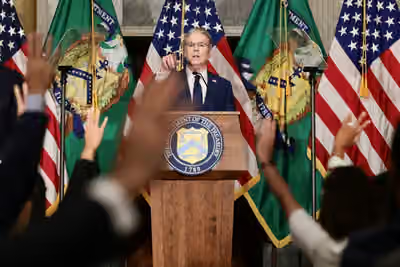




US Secretary of State Marco Rubio said on Saturday “some progress” had been made in talks on Iran and suggested there could be news later in the day, while cautioning that no breakthrough was certain.
"There may be news later today. I don't have news at this very moment, but there might be some news a little later today," Rubio told reporters in New Delhi. "There may not be. I hope there will be, but I'm not sure yet."
"There's been some progress done, some progress made, even as I speak to you now, there's some work being done," he said. "There is a chance that, whether it's later today, tomorrow, in a couple days, we may have something to say, but this issue needs to be solved, as the president said, one way or another."
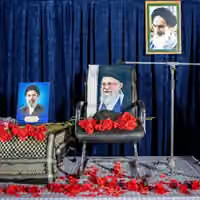
The United States and Israel are debating whether removing Mojtaba Khamenei would destabilize the Islamic Republic or risk producing a more radical power structure and a fragile nuclear deal similar to the 2015 agreement, Israel Hayom reported.
The Israeli newspaper said the question had become a new point of discussion in political and security circles after the killing of Ali Khamenei, with officials weighing whether Mojtaba Khamenei’s survival provides a degree of manageable stability or whether his removal could weaken the system further.
The report described Mojtaba Khamenei as weak, wounded and lacking full authority, while saying Iran’s ruling structure still has a command system and can project continuity as long as a member of the Khamenei family remains at the top.
Israel Hayom said some officials believe removing him could trigger a succession crisis and create space for a more pragmatic faction to reach a deal with the West.
Others, the report said, warn there may be no real moderates ready to take power and that such a move could instead produce a more radical structure or another time-limited nuclear agreement viewed by Israel as insufficient.
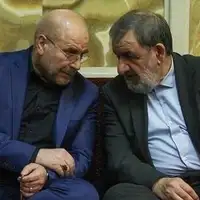
Iran’s parliament speaker Mohammad Bagher Ghalibaf told Pakistan’s army chief Asim Munir in Tehran that the Islamic Republic would not compromise on what he called the rights of the Iranian nation and country, state TV reported.
Ghalibaf said Iran’s armed forces had rebuilt their capabilities during the ceasefire and warned that if the United States “foolishly restarts the war,” the consequences would be “more crushing and bitter.”
Iranian state TV also reported that Foreign Minister Abbas Araghchi held a second meeting with Munir after talks on Iran’s proposals.
A Foreign Ministry spokesperson has said gaps in the talks remain wide.
The prosecutor in Qazvin province said authorities had identified and seized assets belonging to 96 people accused of working for hostile actors, including individuals inside and outside Iran.
Ali-Asghar Asgari said indictments had been issued against three people on espionage accusations and six others on charges of carrying out intelligence activities. He said the cases had been sent to the Revolutionary Court.
“Any operational or intelligence action in favor of the enemy aimed at endangering security and national interests carries the punishment of seizure of all assets and execution,” Asgari said.
Pakistan’s army chief Asim Munir met Iranian President Masoud Pezeshkian and parliament speaker Mohammad Bagher Ghalibaf in Tehran as part of ongoing diplomatic efforts over regional tensions, Iranian state media reported.
Munir also met Iranian President Masoud Pezeshkian during his visit to Iran, with Foreign Minister Abbas Araghchi present, according to the report.
Al Arabiya, citing informed sources, reported that Munir had carried US messages to Tehran and that the messages included a threat to resume the war.