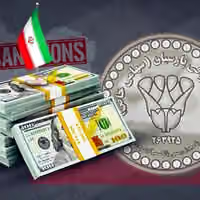
European Parliament backs wider Iran sanctions over rights abuses
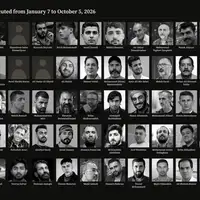
The European Parliament called on Thursday for expanded EU sanctions against Iranian officials over repression, executions and what lawmakers described as the largest mass killing of protesters in the country’s history.
“Parliament calls for more sanctions against Iranian officials, while Iranian people face the largest mass murder of protestors in the country's history,” it said in a statement.
MEPs condemned the use of the death penalty to deter political mobilization and urged Iran to abolish capital punishment and immediately release all political prisoners.
The resolution also criticized the secret execution of dissidents in March and April, including minors, and called for sanctions on officials and entities linked to repression, including the Revolutionary Guards and institutions associated with the Supreme Leader.
Lawmakers urged EU states to close Iranian diplomatic missions linked to transnational repression and provide Iranians with tools for safe and secure internet access amid an imposed internet blackout.
Iran’s Supreme Leader Mojtaba Khamenei has ordered that the country’s near-weapons-grade uranium not be sent abroad, Reuters reported on Thursday, citing two senior Iranian sources.
“The Supreme Leader’s directive, and the consensus within the establishment, is that the stockpile of enriched uranium should not leave the country,” one of the sources told Reuters.
The sources said Iranian officials believed sending the material abroad would make the country more vulnerable to future US or Israeli attacks.
Iran had previously signaled willingness to ship out half of its 60% enriched uranium stockpile, but that position changed after repeated threats by US President Donald Trump to strike Iran, according to the report.
One source said there were still “feasible formulas” to resolve the issue, including diluting the stockpile under International Atomic Energy Agency supervision.
Fraudulent emails demanding cryptocurrency payments for passage through the Strait of Hormuz are targeting shipping companies, maritime security firm Ambrey said on Thursday.
Ambrey issued a threat circular warning of email scams linked to Hormuz transit payments.
Iran’s national soccer team attended visa appointments in Ankara on Thursday ahead of the 2026 World Cup, with the squad applying for Canadian visas and some players also seeking US entry, Reuters reported, citing an Iranian football federation official.
The official said players who had not applied for US visas before the Iran war submitted applications in the Turkish capital.
Some foreign-based Iranian players joined the squad in Ankara before traveling to a training camp in Antalya, the official said.
The World Cup will be hosted by the United States, Canada and Mexico. Iran is scheduled to play all three group-stage matches in the United States, facing New Zealand and Belgium in Los Angeles before playing Egypt in Seattle.
Iran’s internet blackout entered its 83rd day on Thursday, with international networks largely barred for more than 1,968 hours, internet monitor NetBlocks said.
"A free and open internet is central to the protection of life, liberty and public accountability," it added.
A young Iranian woman’s account of temporarily caring for an infant under a state welfare program sparked debate across Persian-language social media this week over child privacy, foster care and the use of vulnerable children in online content.
Sara Kanaani, a social media influencer, documented what she described as “40 days of motherhood” after taking custody of a baby through Iran’s Mizban temporary foster care scheme run by the State Welfare Organization.
State-affiliated outlets including IRNA and Hamshahri newspaper amplified the story with emotional coverage focused on the woman’s attachment to the child and the separation that followed.
Images of Kanaani without mandatory hijab also circulated through state media, drawing further attention online.
Foster care program under spotlight
The Mizban program, launched in 2023, allows children from welfare institutions to be placed temporarily with approved families or individuals while remaining under state supervision.
Unlike adoption, custody under the program is limited in duration and does not transfer permanent parental rights.
The Iranian influcencer sits beside a baby placed through Iran’s Mizban temporary foster care program.
Iran’s Welfare Organization says applicants are assessed for financial stability, mental health and caregiving capacity before approval.
Similar foster care systems exist in many countries, where temporary family-based care is generally viewed by specialists as preferable to institutional care for infants and young children.
The controversy intensified after critics accused Kanaani of turning the experience into a sustained social media project through daily videos, emotional posts and photographs of the child.
Some users questioned whether a child unable to consent should become part of a personal online brand or public campaign.
Others raised concerns after Kanaani discussed details about the infant’s biological mother in social media posts.
Wider criticism follows media coverage
Psychologists and child welfare advocates also debated the emotional impact of repeated attachment and separation during infancy.
Some specialists argued temporary family care can still benefit children when conducted under stable and professionally supervised conditions.
Others pointed to a lack of public information about oversight, caregiver training and welfare standards in Iran’s implementation of the program.
Photos published and later removed by Iranian state media showed an influencer with a baby placed through Iran’s Mizban temporary foster care program.
Part of the attention surrounding the case focused on Kanaani’s status as a single woman.
Iranian law permits unmarried women over 30 to adopt girls under certain conditions, though couples remain prioritized in most custody arrangements.
Critics also questioned the role of state media, saying the extensive coverage reflected efforts to promote emotionally driven narratives centered on women, family and social solidarity during a period of economic and social strain in Iran.