• العربية
  • فارسی
Brand
  • Iran Insight
  • Politics
  • Economy
  • Analysis
  • Special Report
  • Opinion
  • Podcast
  • Iran Insight
  • Politics
  • Economy
  • Analysis
  • Special Report
  • Opinion
  • Podcast
  • Theme
  • Language
    • العربية
    • فارسی
  • Iran Insight
  • Politics
  • Economy
  • Analysis
  • Special Report
  • Opinion
  • Podcast
All rights reserved for Volant Media UK Limited
volant media logo

Iran teachers’ union warns over military training for children

May 20, 2026, 04:04 GMT+1

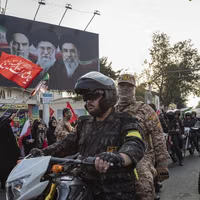
Iran’s teachers’ union has warned that reported military training for children and teenagers in mosques and Basij centers could violate international child protection standards.

In a statement citing videos circulating online, the union said some minors appeared to be receiving organized training involving weapons such as Kalashnikov rifles and Winchester firearms.

The group described the reported activities as a form of “militarization of childhood” and warned they could amount to a violation of Iran’s obligations under the UN Convention on the Rights of the Child.

The union called for an independent and transparent investigation by responsible domestic and international bodies.

Most Viewed

Iran’s president defends US talks as he lays bare economic strain
1

Iran’s president defends US talks as he lays bare economic strain

2
ANALYSIS

Iran finds a new weapon beneath Hormuz

3

Trump holds off planned Iran strike as Arab allies buy Tehran time

4

Amnesty says Iran drove global surge in executions in 2025

5

IRGC-linked propaganda posts targeted across platforms, Europol says

Banner
Banner

Spotlight

  • Tehran unsure whether Trump is bluffing or preparing for war
    INSIGHT

    Tehran unsure whether Trump is bluffing or preparing for war

  • Why Tehran threatens Trump while pursuing diplomacy
    ANALYSIS

    Why Tehran threatens Trump while pursuing diplomacy

  • How an IRGC-linked money laundering network operates from London
    EXCLUSIVE

    How an IRGC-linked money laundering network operates from London

  • Tehran Stock Exchange reopens under tight controls as key firms stay closed
    ANALYSIS

    Tehran Stock Exchange reopens under tight controls as key firms stay closed

  • Tehran and Washington betting the other side blinks first
    INSIGHT

    Tehran and Washington betting the other side blinks first

  • Two years after Raisi’s crash: Iran has no sanctuary
    ANALYSIS

    Two years after Raisi’s crash: Iran has no sanctuary

•
•
•

More Stories

Tehran Stock Exchange reopens under tight controls as key firms stay closed

May 20, 2026, 03:39 GMT+1

After an 80-day shutdown, the Tehran Stock Exchange reopened on Tuesday under heavy state controls, with 42 major firms still suspended and reported curbs on large-scale selling amid uncertainty over war damage and corporate losses.

Trading resumed on the Tehran Stock Exchange (TSE) under strict and highly managed conditions, with parts of the market reopening while 42 major, mostly export-oriented companies remained suspended.

The restart marked a procedural return to activity, but within a framework designed to tightly control selling pressure and limit volatility.

Steel and petrochemical companies — traditionally among the most influential drivers of the TEDPIX index — did not reopen.

Read the full article here.

Why Tehran threatens Trump while pursuing diplomacy

May 20, 2026, 03:37 GMT+1
•
Negar Mojtahedi

Even as Tehran engages in hardheaded diplomatic maneuvering with Washington, it is advancing a parliamentary proposal offering a €50 million reward for President Trump’s killing.

The ruling establishment, they argue, is trying to project strength after weeks of military and political pressure while using the prospect of talks not as a concession but as another arena of confrontation.

“The Iranian regime is trying to, in their own mind, basically say that we are on par,” Dr. Shahram Kholdi, a Middle East historian, told Iran International. “Even if you're not on par with Trump, we are actually beating him at all levels.”

The proposed bounty, he said, should be read partly as psychological warfare against Trump.

“This award to be passed as a piece of legislation by the Islamic Republic Parliament is effectively part of that psychological war that the Islamic Republic thinks it has to unleash upon Trump,” Kholdi said.

But the rhetoric is unfolding alongside more concrete threats. Tehran has also signaled it could disrupt navigation through the Persian Gulf and the Strait of Hormuz, while pro-government voices have floated attacks on satellite infrastructure, including systems such as Starlink.

'Not rational'

That combination of assassination rhetoric, military pressure and possible diplomacy may appear irrational from the outside. Kholdi argues the problem is that Washington is not dealing with a conventional negotiating actor.

“The problem with these people is that they think … if they behave sanely and rationally, that's insane and irrational,” he said. “That’s the kind of actor Trump is dealing with … The art of the deal does not work with an irrational actor.”

Dr. Eric Mandel, founder of the Middle East Political Information Network (MEPIN), framed the issue as a clash of political cultures and timelines. Western governments may look at the damage inflicted on Iran’s military and industrial infrastructure and conclude Tehran should be searching for a way out. The regime may see the same moment very differently.

“This is a perfect opportunity to realize they don't think like us,” Mandel said.

From Tehran’s perspective, he argued, the fact that the regime has survived is itself a form of victory.

“The Iranians think we have survived. We have survived and that means we are victorious,” he said. “We could outlast the Americans and eventually they're going to have to acquiesce to us.”

The time factor

That survival-first mindset helps explain why Tehran may threaten Trump while still leaving room for talks. In Mandel’s view, negotiations, ceasefires and delays all serve a purpose: they buy time.

“The Iranians got a ceasefire. They rebuilt, they rearm, they dug out missiles that were buried because they know that the longer they can either prolong negotiations, the longer they have ceasefires, that they believe that time will eventually make them the winner here,” he said.

This is why the apparent contradiction may not be a contradiction at all. The threats signal defiance. The talks buy time. The survival narrative sustains the regime internally.

Former State Department appointee Shayan Samii said Tehran’s assassination rhetoric may also backfire by strengthening Washington’s case for escalation.

“These numbskulls in Tehran don't understand that by the mere fact of just saying we want to assassinate the President of the United States—mind you, the sitting President of the United States—we're not talking about a national security threat anymore,” Samii said. “We're talking about a government apparatus coming under attack.”

That, he said, could allow the United States to frame any military response not simply as regional intervention, but as self-defense.

“They can tell the world these guys wanted to assassinate our president, we're not going to sit by,” Samii said.

'Military readiness'

Samii also rejected the idea that Trump’s latest delay should be read mainly as a response to pressure from Persian Gulf Arab states. He said the timing was more likely tied to military planning and target selection.

“It has nothing to do with the request of the Arab countries of the Persian Gulf region,” he said. “It has everything to do with machinations and military readiness and coming up with a solution for the targets that they want to hit.”

The danger, analysts say, is that both sides may be using time for very different purposes. Trump may be waiting for better military and economic conditions. Tehran may be trying to stretch the crisis into a war of attrition.

“They think that they are going to run the United States out of the stamina,” Kholdi said.

For Mandel, that gap in thinking is central to the crisis. American politics operates on elections, markets and public pressure. The Islamic Republic, he said, operates with a far longer and harsher sense of time.

“We're dealing with, trying to say from so many different angles, the calculus that they're making is so different than what ours is,” he said.

That difference may be what makes the current moment especially volatile. Tehran appears to believe threats increase leverage. Washington increasingly risks viewing those same threats as proof diplomacy cannot work.

UN cuts global growth forecast over Iran war shock

May 20, 2026, 03:11 GMT+1

The United Nations cut its global growth forecast to 2.5% for 2026 from an estimated 3% last year, citing higher energy costs and weaker trade linked to the US-Israel war on Iran.

In its latest World Economic Situation and Prospects report, the UN warned that low-income households in developing countries are being hit hardest as rising food and energy prices consume a larger share of spending while wages fail to keep pace.

According to the UN, some of the sharpest economic shocks are being felt in Western Asia, driven not only by higher energy prices but also by infrastructure damage and severe disruptions to oil production, trade and tourism caused by the conflict.

US regulator probes oil trades before Trump delayed Iran strikes - WSJ

May 20, 2026, 02:46 GMT+1

The US Commodity Futures Trading Commission is scrutinizing a surge in oil futures trading that occurred moments before President Donald Trump postponed planned strikes on Tehran’s energy infrastructure in March, the Wall Street Journal reported on Tuesday.

According to the report, more than $800 million worth of US and international oil futures changed hands within minutes before Trump announced on March 23 that he was delaying military action for five days following what he described as productive talks with Iran.

Oil prices plunged after Trump’s post, generating major profits for traders who had correctly bet prices would fall.

The Journal said the CFTC is examining activity involving at least three firms as part of an inquiry into whether anyone traded on advance knowledge of the president’s decision.

US and Israel wanted Ahmadinejad to lead postwar Iran - NYT

May 20, 2026, 01:38 GMT+1

The United States and Israel entered the war against Iran with an extraordinary plan to elevate former president Mahmoud Ahmadinejad after the collapse of the Islamic Republic’s leadership, according to a New York Times report published Tuesday.

The report said President Donald Trump had publicly suggested in the opening days of the war that “someone from within” Iran should take over after Israeli strikes killed Iran’s supreme leader and other senior officials.

But according to the Times, US and Israeli officials had a far more specific figure in mind: Ahmadinejad, the hardline former president known for his anti-American and anti-Israel rhetoric.

The paper reported that Ahmadinejad had been consulted about the plan, which was largely developed by Israel, but later became disillusioned after surviving an Israeli strike on his home in Tehran during the first day of the war.

The report, citing US officials briefed on the matter, said the broader regime-change effort quickly unraveled.