• العربية
  • فارسی
Brand
  • Iran Insight
  • Politics
  • Economy
  • Analysis
  • Special Report
  • Opinion
  • Podcast
  • Iran Insight
  • Politics
  • Economy
  • Analysis
  • Special Report
  • Opinion
  • Podcast
  • Theme
  • Language
    • العربية
    • فارسی
  • Iran Insight
  • Politics
  • Economy
  • Analysis
  • Special Report
  • Opinion
  • Podcast
All rights reserved for Volant Media UK Limited
volant media logo

Iran International journalist stabbed at Tehran's behest, UK court told

May 18, 2026, 14:38 GMT+1Updated: 18:57 GMT+1
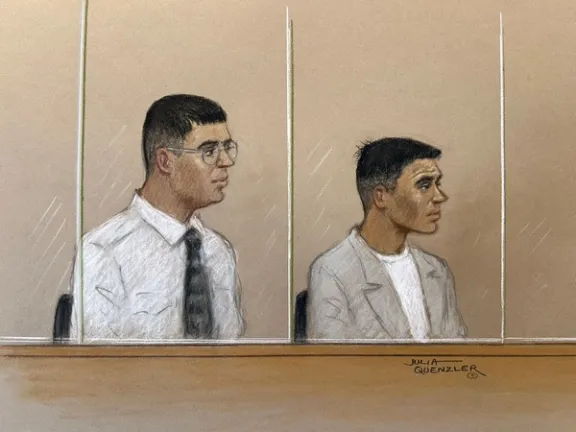
Nandito Badea and George Stana, two Romanian men accused of stabbing the Iran International journalist Pouria Zeraati near his home in Wimbledon in March 2024, appear at Woolwich Crown Court in London, Britain, May 18, 2026, in a courtroom sketch. / Courtesy of Reuters

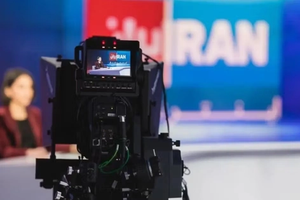
British prosecutors said on Monday that a team of Romanian men who carried out a 2024 knife attack on Iran International TV presenter Pouria Zeraati in London were acting as proxies for Iran.

Zeraati was stabbed three times in the leg near his home in Wimbledon, southwest London, in late March 2024. He was discharged from the hospital two days later.

Nandito Badea, 21, and George Stana, 25, were arrested in Romania in connection with the attack, and were extradited to Britain on December 17, 2024. They were later charged with allegedly “wounding with intent to cause grievous bodily harm", a charge they denied at a preliminary hearing in London last year.

On Monday, prosecutor Duncan Atkinson told Woolwich Crown Court that “this was no robbery, no fight that got out of control, it was deliberate, planned violence to achieve what it did, that is serious injury to its target."

They had "committed a planned attack preceded by reconnaissance, and which was ordered by a third party acting on behalf of the Iranian state," he added.

Iran has denied any involvement in the incident.

Atkinson said Zeraati was an “obvious and readily identifiable target for violence” by proxies acting for Iran.

He said posters had been put up in Tehran in November 2022 featuring pictures of journalists including Zeraati under the heading “Wanted: dead or alive.”

Use of criminal gangs

“In recent years, since 2005, the Islamic Republic has turned less to its own operatives and increasingly to use proxies such as criminal gangs to meet their threatened violence on their behalf,” Atkinson said.

“That has included attacks on persons in this country who have become targets of Iranian intimidation and, effectively, terror,” he added.

Atkinson said Zeraati had been subjected to “extensive reconnaissance.”

He said Stana had been arrested a year earlier in the garden of Zeraati’s apartment with another man while in possession of latex gloves, scissors and a mask.

On the day of the attack, Badea and Andrei confronted Zeraati as he crossed the street from his home to his car, Atkinson said. Andrei held him while Badea stabbed him at the top of his thigh before they fled to a getaway car driven by Stana, the prosecutor added.

The men, who were motivated by money, dumped the car and some clothing before taking a taxi to Heathrow Airport and flying to Geneva, Atkinson said.

A third man accused of involvement, David Andrei, was arrested in Romania but is not involved in the trial.

The trial which began on Monday is expected to last more than two weeks.

In a separate incident last month, three defendants were charged over an alleged arson incident near Iran International’s studios in northwest London, with their trial scheduled to begin on January 25, 2027, at the Central Criminal Court.

In a statement, Iran International said the attack highlights increasing pressure on its journalists and their families, particularly following the recent war involving Iran.

The broadcaster said its staff and their relatives have faced threats and harassment, describing the situation as an effort to silence independent reporting.

Most Viewed

Shortage of opium syrup threatens addiction treatment in Iran
1

Shortage of opium syrup threatens addiction treatment in Iran

2

Shared housing spreads in Iran’s deepening rent crisis

3

Iran’s president defends US talks as he lays bare economic strain

4

Pezeshkian says Iranians must accept inflation as country is in war

5

Amnesty says Iran drove global surge in executions in 2025

Banner
Banner

Spotlight

  • Iran’s café culture buckles as everyday life contracts
    INSIGHT

    Iran’s café culture buckles as everyday life contracts

  • China’s Iran balancing act grows more costly
    ANALYSIS

    China’s Iran balancing act grows more costly

  • Tehran media sees rising risk of war as US talks stall
    INSIGHT

    Tehran media sees rising risk of war as US talks stall

  • Xi may help Trump on Iran, but at a price
    ANALYSIS

    Xi may help Trump on Iran, but at a price

  • How one Tehran hospital became a window into Iran’s January massacre
    SPECIAL REPORT

    How one Tehran hospital became a window into Iran’s January massacre

•
•
•

More Stories

Amnesty says Iran drove global surge in executions in 2025

May 18, 2026, 11:12 GMT+1

Amnesty International said on Monday that executions worldwide rose to their highest recorded level in more than four decades in 2025, with the Islamic Republic responsible for the vast majority of the increase.

At least 2,707 people were executed across 17 countries in 2025, the rights group said in its annual report on the global use of the death penalty, describing the figure as the highest recorded since it began tracking executions in 1981.

Iranian authorities carried out at least 2,159 executions in 2025, more than double the figure recorded the previous year and by far the largest contributor to the global rise, according to the report.

“A shameless minority are weaponizing the death penalty to instill fear, crush dissent and punish marginalized communities,” Amnesty Secretary General Agnès Callamard said.

Drug-related executions drove increase

A resurgence of punitive anti-drug policies, Amnesty said, fueled much of the increase in executions globally.

  • Abroad they talk, at home they hang

    Abroad they talk, at home they hang

Nearly half of all known executions in 2025 – 1,257 cases – were linked to drug-related offenses, including in Iran, China, Saudi Arabia, Singapore and Kuwait.

Iran accounted for 998 of those executions, the highest number among countries identified in the report.

Saudi Arabia carried out at least 356 executions in 2025 and made extensive use of capital punishment in drug-related cases, Amnesty said.

The organization also reported increases in executions in several other countries, with Kuwait nearly tripling its total from six to 17 executions. Egypt’s number rose from 13 to 23, Singapore’s from nine to 17 and the United States from 25 to 47.

The report did not include the thousands of executions Amnesty believes continued to take place in China, which it said remained the world’s leading executioner.

Executing states remain minority

Despite the sharp rise in executions, Amnesty said countries carrying out the death penalty remained “an isolated minority.”

China, Egypt, Iran, Iraq, North Korea, Saudi Arabia, Somalia, the United States, Vietnam and Yemen have all carried out executions every year for the past five years, according to the report.

Four countries resumed executions in 2025 – Japan, South Sudan, Taiwan and the United Arab Emirates – bringing the total number of executing states to 17.

“It’s time for executing countries to step into line with the rest of the world and leave this abhorrent practice in the past,” Callamard said.

Amnesty highlights abolition efforts

The global trend toward abolishing the death penalty nevertheless continued, Amnesty said.

When the organization began campaigning against capital punishment in 1977, only 16 countries had abolished it. That number has now risen to 113, according to the report.

  • Iran executes at least five in week of wartime crackdown

    Iran executes at least five in week of wartime crackdown

Vietnam abolished the death penalty for eight offenses including drug transportation, bribery and embezzlement, while Gambia removed capital punishment for murder, treason and other offenses against the state.

The organization also pointed to legislative efforts in Lebanon and Nigeria aimed at abolishing the death penalty, while Kyrgyzstan’s Constitutional Court ruled attempts to restore executions unconstitutional.

“With human rights under threat around the world, millions of people continue to fight against the death penalty each year in a powerful demonstration of our shared humanity,” Callamard said.

Pezeshkian says Iranians must accept inflation as country is in war

May 18, 2026, 10:13 GMT+1

Iranian President Masoud Pezeshkian said on Monday that Iranians should expect inflation, shortages and economic hardship because the country is at war and facing mounting pressure on its energy infrastructure and oil exports.

“We will definitely have inflation,” Pezeshkian said at a gathering of public relations officials from state institutions.

“We are fighting and we must accept the hardship that comes with it.”

Some critics questioned why prices continued to rise, Pezeshkian said, but argued that economic pain was unavoidable under the current circumstances.

They want to have their cake and eat it too, he said, using a Persian idiom.

The war between the United States, Israel and Iran began with coordinated US-Israeli strikes on Iranian military, nuclear and government targets on February 28. Iran launched missile and drone attacks targeting Israel, the US allies in the region and their infrastructure, while tensions around the Strait of Hormuz disrupted global energy market.

Although direct fighting has eased amid ceasefire and mediation efforts, tensions remain high as disputes over Iran’s nuclear program, sanctions, regional influence and maritime security continue without a lasting diplomatic breakthrough.

  • Can Iran’s economy survive a twin squeeze from blockade and blackout?

    Can Iran’s economy survive a twin squeeze from blockade and blackout?

The president also opened his remarks with an unusual comment hinting at a lack of control over his own movements and schedule.

“I myself did not know where they were taking me. Suddenly they brought me here,” Pezeshkian said.

Damage and shortages acknowledged

Iran, Pezeshkian said, had suffered serious economic and infrastructure damage and could not pretend conditions were normal.

“It is not the case that we have not been harmed,” he said. “We must take on a wartime condition.”

Attacks, he said, had damaged around 230 million cubic meters of gas infrastructure as well as power plants, petrochemical facilities and major industrial sites, including Iran’s largest steel producer.

“We cannot say the enemy is collapsing and we are flourishing,” he said. “They have problems and we have problems too.”

The president said the public need to lower expectations and reduce consumption in order to withstand the situation.

Oil exports and fuel production under pressure

Pezeshkian also acknowledged growing difficulties in exporting Iranian oil and securing revenues under sanctions and regional pressure.

“They blocked the way and we are not exporting oil either,” he said. “We cannot export oil easily.”

Shoppers buy fruit and vegetables at a market in Tehran amid rising food prices. (undated)
100%
Shoppers buy fruit and vegetables at a market in Tehran amid rising food prices.

Tax collection, he added, had become increasingly difficult because businesses and trade sectors were under economic strain.

Pezeshkian warned that fuel shortages and inflation would worsen without tighter management of energy consumption, saying gasoline production had fallen after damage to production facilities.

“Our gasoline production capacity has fallen. They hit it,” he said.

According to Pezeshkian, Iran currently produces around 100 million liters of gasoline per day while domestic demand has reached roughly 150 million liters daily.

“Do we even have the dollars to import gasoline and burn it?” he said.

The president called for stricter management of water, electricity, gas and gasoline consumption, saying economic problems, unemployment and inflation would deepen without conservation measures.

  • Iran taps reserves again as inflation bites and layoffs mount

    Iran taps reserves again as inflation bites and layoffs mount

Trial set for three defendants charged over alleged arson near Iran International

May 15, 2026, 11:36 GMT+1

A trial date has been set for three defendants charged over an alleged arson incident near Iran International’s studios in northwest London, with the case scheduled to begin on January 25, 2027, at the Central Criminal Court.

At a preliminary hearing on Friday that lasted about 30 minutes, Oisin McGuinness, 21, and Nathan Dunn, 19, appeared by video link before Mrs. Justice Cheema-Grubb at the Central Criminal Court.

A third defendant, who is under 16 and cannot be named for legal reasons, is also charged in the case.

No pleas were entered at Friday’s hearing. A Plea and Trial Preparation Hearing has been set for August 28, 2026, when pleas are expected to be heard. The trial is listed for three weeks.

McGuinness, Dunn and the third defendant are charged with arson with intent to endanger life, contrary to the Criminal Damage Act 1977.

The charges relate to an alleged incident on April 15, 2026, when an ignited container was thrown into a car park near the network’s studios in northwest London.

There were no reports of injuries or damage following the attempted attack. Officers pursued a black SUV which later crashed on Ballards Lane in Finchley.

  • Three charged over attempted arson at Iran International office in London

    Three charged over attempted arson at Iran International office in London

  • Statement by Iran International's Editorial Board on escalating threats and intimidation

    Statement by Iran International's Editorial Board on escalating threats and intimidation

McGuinness also faces a charge of dangerous driving, contrary to the Road Traffic Act 1988, in relation to alleged driving on Ballards Lane and Woodberry Way.

McGuinness and Dunn were remanded in custody. The third defendant is on remand under local authority supervision.

All charges are alleged and have not been proven.

In a statement, Iran International said the attack highlights increasing pressure on its journalists and their families, particularly following the recent war involving Iran.

The broadcaster said its staff and their relatives have faced threats and harassment, describing the situation as an effort to silence independent reporting.

Iran to cast regional conflict as resistance to US power at BRICS meeting

May 14, 2026, 10:40 GMT+1

Iran sought to rally BRICS countries against US and Israeli military action on Thursday, casting the regional conflict as resistance to American power as concerns over maritime security and energy disruption dominated the bloc’s foreign ministers meeting in New Delhi.

Foreign Minister Abbas Araghchi urged the bloc to oppose what he called the politicization of international institutions and take action against countries violating the UN Charter.

“The West's false sense of superiority and immunity must be shattered by all of us,” Araghchi said in a statement during the gathering.

His remarks come as Iran faces deepening economic strain, a collapsing currency and growing public frustration at home, weakening the image of resilience officials have sought to project.

High inflation and repeated protests over living costs have laid bare Iran’s domestic vulnerabilities, even as Tehran seeks to project itself as a challenger to Western influence.

The two-day meeting opened under the shadow of the Iran-US-Israel war, exposing divisions within an expanded BRICS bloc split by competing regional interests and differing ties with Washington.

  • Fog of war meets fog of law in the Strait of Hormuz

    Fog of war meets fog of law in the Strait of Hormuz

The United States and Israel launched strikes on Iran on February 28 targeting military bases, missile infrastructure, nuclear facilities and senior commanders in an effort to weaken Tehran’s military capabilities and nuclear program.

Iran launched missile and drone attacks on Israel, US military assets and infrastructure linked to American allies in the Persian Gulf region.

Indian Foreign Minister Subrahmanyam Jaishankar warned that instability around key shipping lanes threatened the global economy.

India's Foreign Minister Subrahmanyam Jaishankar shakes hands with Iran's Foreign Minister Abbas Araqchi during the BRICS foreign ministers' meeting at Bharat Mandapam in New Delhi, India May 14, 2026.
100%
India's Foreign Minister Subrahmanyam Jaishankar shakes hands with Iran's Foreign Minister Abbas Araqchi during the BRICS foreign ministers' meeting at Bharat Mandapam in New Delhi, India May 14, 2026.

“Safe and unimpeded maritime flows through international waterways, including the Strait of Hormuz and the Red Sea, remain vital for global economic well-being,” Jaishankar said in opening remarks.

Iran has disrupted shipping through the Strait of Hormuz following joint US and Israeli strikes on its territory, issuing warnings to commercial vessels and tankers in the strategic waterway.

Traffic through the strait, which carries roughly one-fifth of global oil and gas trade, declined sharply as tanker operators suspended transit and vessels rerouted over security concerns.

The disruptions drew criticism from Western governments, Persian Gulf Arab states and shipping groups, which warned that threats to one of the world’s most important maritime chokepoints could destabilize global trade and energy markets.

BRICS was founded by Brazil, Russia, India and China before South Africa joined in 2011. The bloc later expanded to include Egypt, Ethiopia, Indonesia, Iran and the UAE.

  • IRGC-linked media calls for fees on Hormuz undersea internet cables

    IRGC-linked media calls for fees on Hormuz undersea internet cables

Iran presses bloc for response

Araghchi used his address to accuse Washington and Israel of carrying out attacks against Iran and urged BRICS countries to take a firmer position on the conflict.

“Iran is asking BRICS members and all responsible members of the international community to explicitly condemn violations of international law by the United States and Israel,” he said.

Araghchi also portrayed BRICS as part of an emerging global order less dominated by Western powers and said developing countries faced similar political and economic pressure from Washington.

India's Foreign Minister Subrahmanyam Jaishankar addresses the BRICS foreign ministers' meeting at Bharat Mandapam in New Delhi, India May 14, 2026.
100%
India's Foreign Minister Subrahmanyam Jaishankar addresses the BRICS foreign ministers' meeting at Bharat Mandapam in New Delhi, India May 14, 2026.

His comments did not address Iran’s own military and proxy activities across the region, including attacks by Iran-backed armed groups in Iraq, Yemen and Lebanon against neighboring countries and US-linked targets in recent years.

Tehran also launched missile and drone attacks on Arab states aligned with Washington during the conflict, targeting military facilities and energy infrastructure in the UAE, Qatar, Bahrain, Kuwait and Saudi Arabia.

The regional governments condemned the strikes as violations of sovereignty that threatened regional stability and energy supplies.

  • Iran-UAE breakdown leaves Iranian expats in limbo

    Iran-UAE breakdown leaves Iranian expats in limbo

Differences inside BRICS have complicated efforts to reach a unified position on the conflict, particularly between Iran and the UAE, which support opposing sides in the war.

Despite the divisions, diplomats said discussions were continuing toward a possible joint statement before the meeting concludes on Friday.

Cambridge probes Iran scholar over alleged fabricated interviews

May 13, 2026, 14:54 GMT+1
•
Benjamin Weinthal

A University of Arkansas Iranian-American professor fired from her tenured position in late March is now facing investigations in Britain over allegations of academic misconduct tied to her research on Iran.

Cambridge University Press, which published a book by University of Arkansas professor Shirin Saeidi based on her Cambridge PhD dissertation, is investigating claims that the work contains fabricated or unauthorized interviews with female victims of the Iranian government.

Iran International has also learned that Cambridge University is reviewing allegations related to Saeidi’s PhD dissertation itself.

University of Arkansas President Jay Silveria dismissed Saeidi over matters unrelated to the Cambridge investigations. She has appealed her termination, and the university’s Board of Trustees is set to review the case on May 21.

Saeidi’s book, Women and the Islamic Republic: How Gendered Citizenship Conditions the Iranian State, is now under scrutiny in Britain.

A spokesperson for Cambridge University Press told Iran International that the publisher “takes all complaints about our publications seriously” and is continuing to investigate the allegations “according to standard COPE guidelines.”

COPE, the Committee on Publication Ethics, is an organization that addresses ethical standards in scholarly publishing.

Iran International obtained a copy of a complaint submitted to Cambridge University Press by Maryam Nouri, author of the memoir In Search of Liberation, accusing Saeidi of fabricating interviews and using her work without permission.

Nouri, who was imprisoned by the Islamic Republic in 1985 while pregnant and later gave birth in prison, wrote that “I am writing to submit a formal complaint regarding the unethical and unauthorized use of my personal memoir and the fabrication of interview material by Dr. Shirin Saeidi.”

She added: “I never met with Ms. Shirin Saeidi, nor have I had any interview with her in the city of Cologne or in any other city in Germany.”

According to Nouri, Saeidi used material from her memoir “in both her doctoral dissertation and her published book without my written or verbal permission, for her own personal benefit, including advancing her academic credentials, university status, and professional position.”

“I consider this misuse a clear violation of my personal rights and dignity, and I strongly condemn it,” she wrote.

A Cambridge University spokesperson told Iran International that the university “takes allegations of academic misconduct seriously” and that concerns raised would be reviewed “in line with the relevant University policies and procedures.”

In a series of posts published on X in December, former Iranian political prisoner Nasrin Parvaz also denied ever being interviewed by Saeidi.

“I never knew Saeidi, and I never had an interview with her,” Parvaz wrote, adding that Saeidi had only used the Farsi version of her memoir published more than two decades earlier.

Numerous requests for comment sent by Iran International to Saeidi and her attorney, JJ Thompson, went unanswered.

Saeidi had already drawn controversy prior to her dismissal from the University of Arkansas. The university had previously disciplined her for allegedly using official university letterhead in an appeal seeking the release of Hamid Nouri, an Iranian official convicted in Sweden in 2022 over his role in the mass execution of political prisoners in 1988.

Saeidi has said she had permission to use the letterhead.

Lawdan Bazargan, director of the Alliance Against Islamic Regime of Iran Apologists (AAIRIA), who first publicized Saeidi’s support for Hamid Nouri, later began examining the sourcing in Saeidi’s academic work.

Bazargan told Iran International that several former political prisoners named in Saeidi’s dissertation and book had publicly denied being interviewed by her, raising broader questions about documentation, recordings, consent forms, and sourcing.

“The credibility of oral history research depends entirely on documentation, informed consent, and verifiable sourcing,” Bazargan said.

“If key testimonies cannot be substantiated, then the scholarly foundation of the book itself comes into question, because its central arguments rely heavily on those contested interviews.”

Bazargan also called for scrutiny of the supervisory process behind Saeidi’s Cambridge dissertation, including the role of her PhD supervisor, Professor Glen Rangwala. Iran International sent a request for comment to Rangwala.

Saeidi also drew criticism over social media posts praising former Supreme Leader Ali Khamenei and defending the Iranian establishment during the recent war. Her X account has since been suspended.