• العربية
  • فارسی
Brand
  • Iran Insight
  • Politics
  • Economy
  • Analysis
  • Special Report
  • Opinion
  • Podcast
  • Iran Insight
  • Politics
  • Economy
  • Analysis
  • Special Report
  • Opinion
  • Podcast
  • Theme
  • Language
    • العربية
    • فارسی
  • Iran Insight
  • Politics
  • Economy
  • Analysis
  • Special Report
  • Opinion
  • Podcast
All rights reserved for Volant Media UK Limited
volant media logo

Trump says Iran ‘destroyed,’ vows it will never have nuclear weapon

Apr 30, 2026, 22:43 GMT+1

US President Donald Trump said in an interview with Newsmax on Thursday that Iran been “destroyed,” adding its navy, air force, air defenses and leadership have been severely weakened.

"We've already won. But I want to win by a bigger margin. But we have we have already we have destroyed their navy, destroyed their air force, destroyed all of their. If you look at their anti-aircraft equipment, their radar equipment, their leadership, their leadership is destroyed. We've destroyed everything," Trump said.

"If we leave right now, it would take them 20 years to rebuild if they ever could rebuild. And. But it's not it's actually not good enough. We have to have guarantees. They will never have a nuclear weapon," he said.

"I will tell you that Iran would use the nuclear weapon if they had it. I deal with these people. I know people, they will use the nuclear weapon, and we're not going to give them a chance to do it. And I actually think it's very popular what I'm doing. I can tell you worldwide, the world is thanking me because I shouldn't be the one that's doing it. Other presidents should have done it long before me, and other countries should have done it. We were not helped by NATO at all. Other countries should have done it," he added.

"They're going to either have a nuclear weapon or they're not. And if they're not, they're in they're in big trouble, big, even bigger than they are right now.
And right now their economy is collapsing. Inflation is at close to 100% their their equivalent of our dollar is non-existent. I mean, it's literally non-existent. And they can't do any oil because we have a blockade that's 100% effective. So they can't sell oil. That's 500 million a day, $500 million a day," Trump said.


Most Viewed

Even state media sounds alarm as Iran’s economy sinks
1
INSIGHT

Even state media sounds alarm as Iran’s economy sinks

2
EXCLUSIVE

Iran football chief with IRGC ties sent back by Canada after arrival

3
EXCLUSIVE

Pezeshkian, Ghalibaf seek Araghchi’s ouster over 'subservience' to Guards

4
INSIGHT

As Tehran praises Moscow, critics ask where Russia was

5
INSIGHT

How the Taliban tilted toward Iran during wartime tensions

Banner
Banner

Spotlight

  • Ottawa on defensive after Iran football chief linked to IRGC entered Canada
    EXCLUSIVE

    Ottawa on defensive after Iran football chief linked to IRGC entered Canada

  • Even state media sounds alarm as Iran’s economy sinks
    INSIGHT

    Even state media sounds alarm as Iran’s economy sinks

  • Tehran is pricing out its daughters
    TEHRAN INSIDER

    Tehran is pricing out its daughters

  • Three layers of mistrust behind US-Iran deadlock
    ANALYSIS

    Three layers of mistrust behind US-Iran deadlock

  • Iran’s water crisis: Mafia or destruction by design?
    SPECIAL REPORT

    Iran’s water crisis: Mafia or destruction by design?

  • As Tehran praises Moscow, critics ask where Russia was
    INSIGHT

    As Tehran praises Moscow, critics ask where Russia was

•
•
•

More Stories

Economics may decide outcome of Iran-US standoff

Apr 30, 2026, 22:31 GMT+1
•
Behrouz Turani

The next phase of the Iran–US standoff may be decided not on the battlefield, but by how much economic pressure each side can withstand.

What remains unclear is how that pressure will play out. Will rising fuel prices and market instability in the United States push President Donald Trump toward compromise, or will Iran’s mounting economic strain force Tehran to accept US demands?

"Iran's economy is a disaster. So we'll see how long they hold out," Trump told reporters on Thursday.

In both Iran and the US, political messaging already points toward eventual claims of victory. For ordinary Iranians, however, the only positive outcome is one where their livelihood improves.

Ali Asghar Zargar, a political science professor in Tehran, describes the current moment as “as dangerous as the war itself.” Speaking to the reform-leaning Fararu website, he warned that “when diplomacy collapses, the likelihood of military action increases.”

Still, he noted that despite the lack of progress, “the path to dialogue has not been completely closed.”

Zargar characterized the current state of half-active diplomacy as a safety valve slowing the slide toward open conflict. But he cautioned that “an error on either side can trigger a clash at any moment,” pointing to the volatility of the situation in the Strait of Hormuz.

The two-week ceasefire between Tehran and Washington expired last week, with no clear indication that talks will resume soon.

Iranian diplomatic activity, particularly Foreign Minister Abbas Araghchi’s recent visits to Pakistan, Oman and Russia, has fueled speculation about both renewed negotiations and the possibility of further escalation.

Some Iranian analysts believe another round of US and Israeli strikes cannot be ruled out.

Israeli Defense Minister Israel Katz said on Thursday that Iran has suffered “very severe blows” over the past year and warned that further action may be needed “to ensure the achievement of our goals.”

Also on Thursday, Iran’s parliament speaker and lead negotiator Mohammad Bagher Ghalibaf said Tehran could use its position over the Strait of Hormuz to reshape regional dynamics and reduce US influence.

“Iran, by exercising control over the Strait of Hormuz, will ensure that it and its neighbors enjoy the precious blessing of a future free from the presence and interference of America,” he wrote on X.

Abbas Abdi, a reformist commentator who had largely avoided domestic political writing in recent months, returned this week with a stark assessment: “We are in an exceptional situation where everything is about survival.”

He argued that Iran needs a new framework that prioritizes ending the war above all else.

The economic cost of the standoff is already significant on both sides. Opposition to the war and its financial consequences has grown in the United States, while Trump has claimed Iran is “losing $500 million a day” under the U.S. blockade of the Strait of Hormuz.

As Tehran and Washington test each other’s resilience, distrust continues to deepen. A Fararu analysis described the situation as one of “active suspension”: relations are neither moving toward full confrontation nor showing any clear path to agreement.

For now, both sides appear to be probing how much pressure the other can endure without breaking. But the longer that calculation continues, the greater the risk that economic strain—and a single misstep—could tip the balance toward escalation rather than compromise.

Tehran billboard shows kneeling Trump offering Iran ‘$100B’ Hormuz windfall

Apr 30, 2026, 22:08 GMT+1

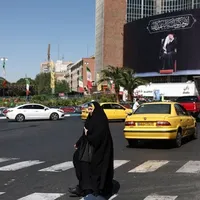
A billboard in Tehran’s subway shows President Donald Trump kneeling and offering money to Iran, citing a commentary piece by Reuters that says "Tehran could collect $110 billion a year" if it charges $2 million per vessel passing the Strait of Hormuz.

The state-backed visual message carries the caption: “Reuters: Iran earns $100 billion a year out of Hormuz Strait."

Iranian state TV pundit and Islamic Republic loyalist Foad Izadi praised Tehran’s municipality for displaying the billboard, saying it echoed the latest message by Iran’s Supreme Leader, who said “legal rules and the application of new management of the Strait of Hormuz” would bring “comfort and progress” for regional nations and economic benefits that would “make the nation’s heart happy.”

US decision-making takes place ‘elsewhere’, Iran’s Mohsen Rezaei says

Apr 30, 2026, 22:06 GMT+1

Mohsen Rezaei, former commander-in-chief of the Islamic Revolutionary Guard Corps (IRGC) and a member of Iran’s Expediency Discernment Council, said on Thursday the contradictory statements by Donald Trump show that real decision-making in the United States takes place “elsewhere.”

"The contradictory statements of Trump, shows that real decisions in US are being made somewhere else. What the behind‑the‑scenes power networks want doesn't match the "America First" slogan. This is the kind of deadlock America is facing, and its people are the ones paying the price," he posted on X.

US not serious on sanctions relief, Iran’s foreign ministry spokesperson says

Apr 30, 2026, 21:48 GMT+1

Iran’s foreign ministry spokesperson Esmaeil Baghaei said on Thursday that the United States is not serious about lifting sanctions and is acting contrary to its stated commitments.

“The United States is not serious about lifting sanctions and has acted contrary to its claims by escalating sanctions and engaging in maritime piracy,” Baghaei said. “When the other side is unable to fulfill its commitments during a ceasefire period, how can there be even minimal trust that it would abide by a longer-term agreement?

Baghaei added that negotiations between Tehran and Washington are “not conventional” and have a “very bloody history.”

UAE bans travel to Iran, Lebanon and Iraq

Apr 30, 2026, 21:39 GMT+1

The United Arab Emirates’ foreign ministry banned citizens from traveling to Iran, Lebanon and Iraq on Thursday, citing regional developments.

The ministry also urged all Emiratis currently in those countries to leave immediately and return to the United Arab Emirates as soon as possible.

The ministry called on citizens to follow its official guidance and advisories, and urged those in Iran, Lebanon and Iraq to contact authorities via a dedicated hotline as part of precautionary measures to safeguard their well-being.