Is the US blockade working? It depends who you ask
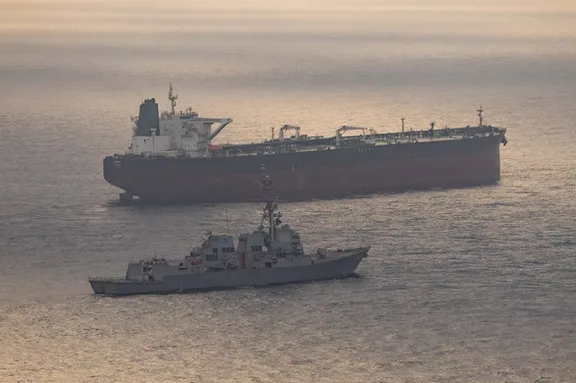
Recent tracking data suggesting Iran is still moving millions of barrels of crude despite a US naval blockade has raised fresh questions about the effectiveness of Washington’s effort to choke off Tehran’s oil exports.
TankerTrackers.com on Sunday cited satellite images that it said showed Iran loaded at least 4.6 million barrels of crude at export terminals in recent days, with another four million barrels appearing to have crossed the US blockade line.
The figures suggest Tehran retains at least some ability to keep oil flowing despite a US naval blockade launched nearly two weeks ago and repeated claims from Washington that the operation is crippling Iran’s maritime trade.
Read the full article here.






The Islamic Republic that has emerged from the killing of Iran's Supreme Leader Ali Khamenei may prove more operationally aggressive than the one it replaces, analysts say.
Dominated by the Revolutionary Guards, the leadership in Tehran may be less constrained by theology and more driven by revenge.
This is an assessment by analysts tracking the post-war power shift in Tehran, as a string of attacks on Jewish and Israeli targets have taken place since the Feb. 28 US-Israeli strikes.
Across Europe, an Iran-linked group calling itself Harakat Ashab al-Yamin al-Islamia has claimed several attacks, including the targeting of Jewish volunteer ambulances in London, a synagogue in Belgium and a synagogue and Jewish school in the Netherlands.
In Azerbaijan, an alleged Iranian plot targeting the Israeli embassy in Baku and Jewish community sites was foiled by authorities.
Danny Citrinowicz, a senior researcher at the Institute for National Security Studies in Tel Aviv, says the post-Ali Khamenei Islamic Republic is likely to become more operationally aggressive, with sleeper cells and lone-wolf attacks posing a growing threat to Tehran’s adversaries.
"Lone wolves are a bigger threat," Citrinowicz told Iran International, referring to the act of an individual committing a violent act alone without a direct order.
"You just need to create the atmosphere," Citrinowicz said. "It will lead to someone saying, I'm going to do something."
Citrinowicz describes the Islamic Republic in 2026 as "Iranian Revolution 3.0" — its third iteration since 1979 — in which a military junta has taken control of the founding doctrine of clerical rule, Velayat-e Faqih, with the IRGC dominating all meaningful decisions.
It is a regime that has demonstrated, through the foreign fighters it brought in to suppress its own population during the January 2026 uprising, that it harbors sizable loyal support outside its borders.
"The regime will try to present itself as a continuation of Ali Khamenei's regime," Citrinowicz said.
Yet the IRGC-dominated leadership still faces a limitation in its power, inheriting a government whose revolutionary appeal has long outlasted its domestic popularity.
Iran International reported that around 800 members of Iraqi militia groups — including Kataib Hezbollah and Harakat al-Nujaba — entered Iran days before the January 2026 crackdown that killed tens of thousands of protesters.
Proxy Shia forces from Turkey, Afghanistan and Pakistan have also been reported inside Iran.
The Pakistani contingent — the Zainabiyoun Brigade — is an armed wing rooted in Tehran's ideological network, drawn from South Asia's Shia communities. But one militia is only part of the picture.
Simon Wolfgang Fuchs, an associate professor at the Hebrew University of Jerusalem, describes Lahore-based cleric Jawad Naqvi as running a sprawling and sophisticated Shia seminary operation in Lahore, Pakistan.
The seminary produces Qom-trained scholars, high-quality social media content, and an explicit political model.
"He's really someone who says we have to implement the Iranian model in Pakistan," Fuchs told Iran International. Naqvi's political model draws inspiration from Hezbollah, Fuchs argues — a Shia minority that embraced Velayat-e Faqih and came to dominate Lebanon's political field.
"The vision and the boldness to simply claim that you could also dominate the state is definitely there," Fuchs said, though he cautioned the comparison has limits — Pakistan's Shia community has no history of armed resistance.
"Iran's efforts to gain a following as the legitimate leader of the Shia (community) has paid off somewhat in South Asia," said Cliff Smith, a fellow at the Middle East Forum who visited Indian-administered Kashmir and documented Iranian influence on the ground.
"The idea of Iran is stronger outside its borders than it is inside."
India, home to between 20 and 40 million Shia — the second-largest such population after Iran — has received less scrutiny than its neighbour.
Smith observed during time spent in Kashmir that New Delhi had effectively tolerated Iranian influence among the Shia community, calculating it served as a useful counterweight to Sunni radicalism from Pakistan.
The wave of protests and unrest that was seen in India following Khamenei's killing has prompted a reassessment, according to Smith.
"I had one of those people tell me, when they had seen the riots and demonstrations after Khamenei’s death, that I was right. We should have paid attention to this sooner," he said, recalling a contact at an Indian think tank.
Abhinav Pandya of India's Usanas Foundation argues the blind spot runs deeper than Kashmir, as Iran's influence among Indian Muslims is not confined to Shia communities.
India is home to around 200 million Muslims — the world's third-largest — and Pandya argues the Indian security establishment has been too focused on the Sunni threat to register how deeply the Islamic Republic's influence has taken root among the country's Shia groups.
"The biggest misunderstanding is that most of the jihadist problem comes from the Sunni Muslims, and the Shias — they don't need to bother about them, Shias are completely loyal," Pandya said.
"So far Shia Muslims have not majorly participated in any terrorist activity... But partly this understanding is problematic."
For Citrinowicz, the killing of Khamenei —a figure seen as much as a religious leader as a political one — risks transforming Iran's conflict with the US and Israel into something far harder to contain.
“The killing of him is potentially opening some sort of religious war that I think that we have to make sure it won't expand between the Shias and the state of Israel," he said.
Citrinowicz also warned of an increase in Iranian terror activity abroad. "While they have this kind of capabilities and shared communities all over the world, especially in places like India, definitely we'll see an uptick."
As Washington and Tehran navigate a fragile ceasefire, one of the biggest questions looming over the conflict may not be about Iran at all—but China.
Zineb Zineb Riboua, a research fellow at the Hudson Institute who specializes in Chinese influence in the Middle East and North Africa, told Eye for Iran that the broader significance of Operation Epic Fury may lie in weakening China’s strategic position through its deep ties to the Islamic Republic.
“I am in the group of those who think it is about weakening China,” Riboua said. “I don't think the administration says it this way… but I think it's a very important one.”
Read the full article here.
Iran’s economy is heading into a period of sharp deterioration following the March war, with mounting pressure from inflation, currency depreciation and damage to key industries raising the risk of a broader crisis.
Over the next two to four months, Iran’s economic conditions are expected to continue deteriorating sharply, with high inflation, rising unemployment, falling real incomes, and significant stress across key industries, the external sector, and the financial system, amounting to severe stagflation.
The economy entered the recent war from a weak starting point, and the combined effects of war-related damage, financial strain, and policy responses are likely to intensify these pressures.
Iran’s economy is heading into a period of sharp deterioration following the March war, with mounting pressure from inflation, currency depreciation and damage to key industries raising the risk of a broader crisis.
Over the next two to four months, Iran’s economic conditions are expected to continue deteriorating sharply, with high inflation, rising unemployment, falling real incomes, and significant stress across key industries, the external sector, and the financial system, amounting to severe stagflation.
The economy entered the recent war from a weak starting point, and the combined effects of war-related damage, financial strain, and policy responses are likely to intensify these pressures.
Under a continued ceasefire, the deterioration is expected to be gradual but persistent; under a strictly enforced naval blockade, the adjustment is likely to be faster and more severe, with risks of very high inflation and broader economic disruption.
However, hyperinflation and full economic collapse are less likely in the next two to four months. An effectively enforced blockade, combined with military operations focused on reopening and securing the Strait of Hormuz, will push Tehran to the edge of economic collapse.
Starting point: A weak economy before the war
Iran entered the war from an already fragile position. By late 2025, inflation was elevated above 50 percent, the rial had lost substantial value, and the banking system was under visible strain, notably by the collapse of Bank Ayandeh. These pressures had already reduced household purchasing power and severely weakened business activity.
The continued depreciation of the currency, which saw the rial lose more than 20 percent in less than 20 days by the end of 2025, and worsening economic conditions contributed to widespread unrest across the country, which was ultimately suppressed. This left the economy highly vulnerable even before the war began.
Impact on income-generating industries
The war has directly affected Iran’s main sources of export revenue. Damage to industrial infrastructure—especially in petrochemicals and metals—has disrupted sectors that generated roughly $25–30 billion in exports in 2024 (petrochemicals: $13–17 billion; metals: $12–13 billion).
Production in these sectors is now constrained by:
Even partial restoration of operations is expected to take time, and exports from these industries are likely to decline sharply in the near term.
Spillovers to other sectors are also significant. In the agriculture sector, fertilizer shortages and disrupted logistics are expected to reduce output. Heightened uncertainty, combined with likely shortages of steel and possibly cement, is contributing to a significant slowing of activity in the construction sector, particularly in private projects. The auto sector is also likely to suffer a setback due to the lack of steel and aluminum.
Internet blackout and business disruption
Domestic policy responses have added further strain. The widespread internet blackout has severely disrupted economic activity, especially small and medium-sized businesses reliant on digital platforms.
According to NetBlocks, the economic cost of internet shutdowns in Iran has been estimated to be at least $37 million per day during recent outages.
The blackout has:
These effects extend beyond online businesses and have slowed activity across the broader economy.
Financial system stress
The financial system, already under pressure before the war, is facing increased risks. The collapse of Bank Ayandeh in December 2025 highlighted underlying vulnerabilities in the banking sector. Other large banks were already under strain prior to the conflict.
Current conditions may lead to:
The disruption of the private trade credit system—often based on post-dated checks—has further constrained business financing. Recent signals from the judiciary suggesting reduced legal consequences for unpaid checks have weakened enforcement, discouraging sellers from extending credit and further restricting transactions.
Impact on households
Households are expected to reduce spending significantly. Private consumption accounts for roughly 50 percent of the economy, so this contraction will have broad effects.
Key drivers include:
These factors point to rising unemployment, a notable decline in private consumption, and a broad and significant decline in living standards.
Economic conditions over the next 2-4 months
Scenario 1: Continuation of ceasefire with the US and Israel
Under this scenario, large-scale hostilities do not escalate further, and oil exports continue, although under constraints. However, petrochemical and metals exports remain significantly disrupted due to infrastructure damage and ongoing restrictions on trade and financial channels, including limited access to regional intermediaries such as the UAE.
In this environment:
Economic conditions continue to deteriorate, with persistent pressure on household incomes and employment. The rial is likely to remain under depreciation pressure, sustaining elevated inflation in the 50-60 percent corridor. Resource allocation is expected to be heavily tilted toward military rebuilding—particularly missile and defense capabilities—while remaining funds are directed toward essential imports such as food and medicine.
Scenario 2: Rigorously enforced naval blockade
Under this scenario, a naval blockade is strictly enforced following recent actions by the United States administration. Iran would be largely unable to export oil through the Persian Gulf, with only limited alternative channels (such as “ghost fleet” activity) available.
In this case:
The loss of oil export revenue significantly weakens the government’s ability to stabilize the economy. Note that the “ghost fleet” overseas is likely to continue generating revenue for the next two to three months.
However, if the blockade is expected to continue, the government will ration this revenue for the near future. Inflation would rise sharply but most likely will not break the 100 percent ceiling, and the risk of broader economic breakdown increases, particularly if access to foreign currency becomes severely limited.
As in the first scenario, despite the dire economic situation, the government is expected to prioritize military spending to rebuild defense capabilities and prepare for future conflict.
Remaining resources would be directed toward securing basic goods such as food and medicine. Under a strict blockade, however, even if essential goods remain available, high inflation and rising unemployment would leave many households unable to afford them, sharply reducing living standards and intensifying public discontent. Even so, a full-scale economic collapse or hyperinflation is not expected within the next two to four months.
Scenario 3: Naval blockade plus major military operation in Iran's south
Under this scenario, strict enforcement of the naval blockade is coupled with a major military operation focused mainly on the south of Iran to reopen and secure the Strait of Hormuz.
Such an operation would render Iran not only unable to export oil but would also disrupt most of its trade through the Persian Gulf, including the import of food and other essential goods.
Securing basic goods would become extremely difficult for the government, which would be diverting its limited resources toward active military confrontation. Most economic activities are likely to come to a halt as inputs become extremely scarce and uncertainty rises sharply.
Inflation would spiral out of control, prompting the government to impose stricter limits on the payment system to prevent hyperinflation. These measures would, in turn, hinder economic activity even further. A full economic collapse within two to four months would not be inevitable, but it would remain a distinct possibility.
Iran-UAE ties have unraveled over the past two months, beginning with Iranian airstrikes on Emirati targets during the US-led war and escalating into a crisis that now threatens one of Tehran’s most vital trade and financial channels.
During the conflict, Iran struck civilian buildings, oil facilities, and sensitive infrastructure, including a data center linked to Oracle. In response, the UAE recalled its ambassador from Tehran, signaling a swift escalation in diplomatic tensions.
The diplomatic fallout deepened further this week when UAE state security authorities said they had arrested members of what they described as a “terrorist group linked to Iran’s ruling system” in Sharjah. The suspects were accused of planning attacks, undermining national security, and facilitating illicit financial transfers.
At the same time, Tehran has formally demanded compensation from several regional states, including the UAE, for allowing their airspace and bases to be used by the United States and Israel in strikes against Iran.
These developments have intensified a crisis that threatens to disrupt one of Iran’s most vital economic lifelines.
A deeply rooted economic partnership
Despite long-standing disputes, including disagreements over the islands of Abu Musa and the Greater and Lesser Tunbs, Iran and the UAE have built extensive and resilient economic ties over the past several decades.
Geographical proximity, advanced port infrastructure, and liberal trade regulations have transformed the UAE into a hub for Iranian commerce since the end of the Iran-Iraq War. Thousands of Iranian companies have established operations there, and a large share of Iran’s imports has flowed through re-export channels based in Dubai. Over time, the UAE became not just a trading partner but a critical gateway to global markets for heavily-sanctioned Iran.
For much of the past two decades, the UAE has ranked either first or second among Iran’s trading partners, often competing closely with China. Today, it remains one of the largest suppliers of goods to Iran, accounting for a significant share of its imports.
Roughly one-third of goods entering Iran—from mobile phones and electronics to auto parts, cosmetics, and clothing—have passed through the UAE, representing trade worth billions of dollars annually. The disruption of this flow is already being felt. In some sectors, such as mobile phones, prices have reportedly surged by 40 to 50 percent following the halt in imports.
With limited alternatives offering the same combination of proximity, infrastructure, and financial connectivity, any prolonged rupture could deepen Iran’s economic isolation and accelerate a costly realignment of its trade networks.
Trade imbalance and export structure
Iran’s exports to the UAE have largely consisted of oil products, petrochemicals such as fertilizers and industrial feedstocks, metals and minerals, agricultural goods including fresh produce and nuts, and construction materials like stone. However, much of this trade has been indirect, with the UAE serving as a re-export hub for Iranian goods destined for third markets.
At the same time, exports from the UAE to Iran have consistently exceeded Iran’s exports in the opposite direction, creating a significant trade imbalance. The UAE’s role as an intermediary—rather than a final destination—has been central to this asymmetry.
Sanctions and the UAE’s pivotal role
The importance of the UAE grew dramatically after the tightening of US and European sanctions on Iran, particularly following Washington’s withdrawal from the 2015 nuclear deal (JCPOA) in 2018. As direct trade routes narrowed, the UAE became the primary conduit for goods, capital, and financial flows into Iran.
Emirati exports to Iran rose from around $5.2 billion in 2018 to more than $20 billion in recent years. Dubai also became a financial hub for Iranian exchange houses, many of which played a key role in facilitating currency transfers and circumventing sanctions. Exchange rates set in Dubai’s markets often influenced the value of the Iranian rial domestically.
However, this system is now under pressure. UAE authorities have reportedly targeted Iranian exchange houses and so-called “trust companies,” freezing accounts, shutting offices, and detaining some operators. These actions could severely constrain Iran’s access to international financial channels.