IRGC threatens harsher crackdown if protests return
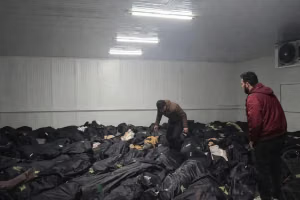
Bodies of victims on the grounds of Kahrizak Medical Examiners facility
Iran’s Islamic Revolutionary Guards Corps warned on Thursday that opponents could face a blow “even stronger than January 8,” signaling the possibility of a renewed and harsher crackdown if street protests resume.
The warning came from the intelligence organization of the Revolutionary Guards, which said street unrest would be treated as a precursor to military action. “Those we call the ‘Neo-ISIS elements’ should know that a blow even harsher than that of January 8 awaits them,” the statement said.
More than 36,500 Iranians were killed by security forces during a two-day crackdown on nationwide protests on January 8–9. Iran International confirmed the death toll after examining obtained classified documents along with field reports and accounts from medical staff, witnesses, and victims’ families.
In its statement, the Guards accused foreign adversaries of trying to stir unrest inside Iran after failing to achieve their goals on the battlefield. It said enemies were now attempting to “spread fear and provoke street protests.”
The warning came as Israeli Prime Minister Benjamin Netanyahu said Israel’s military campaign was intended in part to create conditions that could allow Iranians to protest against the Islamic Republic.
“We will create optimal conditions to do this, including airstrikes as we did yesterday, as we are doing these days, to try to give them the space needed to take to the streets,” Netanyahu said at a press conference on Thursday.
He said Israeli strikes were delivering “crushing blows” to the Revolutionary Guards and the Basij, the paramilitary force often deployed against protesters, but added that any effort to bring down the Islamic Republic would ultimately depend on action from within Iran.
The Iran war appears to be entering a new phase as attacks increasingly target checkpoints and street-level security units, while witness reports sent to Iran International suggest many of those positions are being moved or dismantled after their locations are exposed.
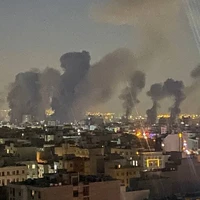
For days the conflict had focused largely on military bases, missile sites and command facilities, particularly in southern Iran, as part of the wider US-Israeli campaign that has struck thousands of targets across the country since the war began on February 28.
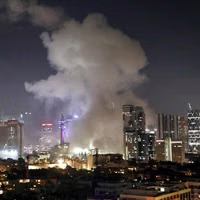
But since Wednesday evening, reported drone strikes on checkpoints in Tehran have pointed to a parallel line of pressure: the local security posts, patrol units and temporary deployments used to enforce control on the streets.
Iranian state-linked media said several checkpoints in Tehran were hit, killing members of the security forces and Basij militia. The reported locations included positions in multiple districts across the capital.
The development suggests the conflict is increasingly intersecting with the structures the state relies on to control neighborhoods rather than only its larger military infrastructure.
Since the start of the war, residents across Iran say checkpoints and patrols have multiplied in major cities as authorities attempt to prevent unrest and maintain control.
At the same time, Iran International has received a steady stream of messages from viewers describing the locations of checkpoints, security deployments and temporary bases.
Some reports describe armed units inspecting vehicles at major highway entrances or intersections. Others mention security forces using schools, sports halls and religious institutions as temporary accommodation or staging points.
Messages received in recent days pointed to deployments in locations ranging from major Tehran highways to entrances to cities such as Karaj, Shiraz, Mashhad and Qazvin. Residents also described units stationed beneath highway bridges, near parks or inside parking areas where buses and motorcycles were parked overnight.
In several cases, viewers reported that checkpoints they had previously seen disappeared within hours or days, while others appeared to move to nearby streets or disperse into smaller patrol groups.
Some messages described security forces sleeping inside buses or personal vehicles and conducting mobile patrols rather than remaining in fixed positions.
Others said checkpoints that had been inspecting vehicles were suddenly dismantled, leaving only a few officers nearby.
Such reports cannot be independently verified in each case. But taken together they suggest that many deployments are becoming more fluid, with positions shifting frequently rather than remaining in one place.
The Imam Reza security unit after sustaining damage, part of the IRGC’s Mohammad Rasulullah Corps in Greater Tehran.
A war over control of the neighborhood
The shift reflects a deeper pressure on the state’s local enforcement network.
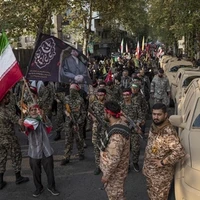
For years the Islamic Republic has relied on a dense web of Basij, police and Revolutionary Guards positions to control neighborhoods and quickly suppress unrest.
During the recent nationwide protests earlier this year, these same networks formed the backbone of the crackdown that sealed off districts and quashed the demonstrations.
In wartime, those local security units appear to be playing an even more central role.
As larger bases and installations come under pressure from airstrikes, authorities appear to be relying more heavily on mobile checkpoints and temporary deployments to maintain control on the ground.
Now those fallback positions are also being drawn into the conflict.
The result is a battlefield that increasingly overlaps with everyday urban space. Instead of remaining confined to distant military facilities, the war is beginning to touch the street corners, highway entrances and neighborhood patrol routes where the state exerts day-to-day authority.
Members of Iran’s women’s national football team, after some delegation members sought asylum abroad, are being kept under tight security during a camp in Kuala Lumpur, Malaysia, Iran International has learned.
Players who arrived on Wednesday are being kept at a hotel where journalists and media are not allowed to enter, according to sources familiar with the situation.
Some players had their mobile phones confiscated, while others were allowed to keep them only under the supervision of security personnel from the Iranian football federation.
Sources told Iran International that pressure on the players began in Tehran and has continued during the team’s camp ahead of the 2026 Asian Championship.
Mohammad Rahman Salari, a member of the Iranian Football Federation’s board, played a central role in enforcing the restrictions and repeatedly collected and inspected the phones of players and staff after the team’s first match.
Fatemeh Bodaghi, who is traveling with the delegation as manager of Iran’s women’s national team, was described by sources as acting on behalf of the federation’s security apparatus under the leadership of federation president Mehdi Taj, monitoring players’ social media accounts and reporting their activities to authorities in Tehran.
Sources also said Zeinab Hosseinzadeh, the team’s physiotherapist, was among those involved in exerting pressure on players.
Farideh Shojaei, the women’s vice president of the football federation, is also accompanying the team. She previously said options for the team’s return to Iran amid US-Israeli airstrikes were being examined, including a possible land route through Turkey, after attempts to return via the United Arab Emirates did not succeed.
The crisis surrounding the Iranian women’s national football team began on March 2, when the squad refused to sing the Iranian national anthem before their opening match against South Korea at the AFC Women's Asian Cup in Australia.
This silent protest, occurring shortly after the start of the Iran war and the killing of Supreme Leader Ali Khamenei, was immediately labeled an act of "wartime treason" by the state media. As the team progressed through the group stage, they were reportedly kept under strict surveillance by delegation minders, with international human rights groups and political figures warning that the athletes faced severe punishment, including the possibility of the death penalty, if they were forced to return to Tehran.
Six members of the delegation accepted humanitarian visas and remained in Australia to seek asylum, while the rest of the team boarded their flight to Malaysia.
Nearly every Senate Democrat urged Defense Secretary Pete Hegseth to open a swift investigation into a deadly strike on a girls’ school in Iran that killed scores of children, as new reporting raised questions about whether outdated US targeting data contributed to the attack.
In a letter signed by 46 senators, the lawmakers called the results of the Feb. 28 strike “horrific,” noting that most of those killed were girls between the ages of 7 and 12.
The senators also asked for a broader review of any US military actions that may have caused civilian harm during the opening phase of the conflict.
Reuters reported Wednesday that two people familiar with the matter said the strike—one of the deadliest incidents involving civilians in decades of US conflicts—may have resulted from the use of outdated intelligence in the targeting process.
The news agency had earlier reported that an internal US military review found American forces were likely responsible for the attack on the school in the southern city of Minab.
Video circulated online that experts say appears to show a US Tomahawk missile striking the area, though the exact sequence of events remains unclear.
The Pentagon has declined to comment on the specifics of the case, saying only that the incident remains under investigation.
According to archived copies of the school’s website reviewed by Reuters, the campus was located next to a compound operated by Iran’s Islamic Revolutionary Guard Corps (IRGC).
Iran’s ambassador to the United Nations in Geneva, Ali Bahreini, has said the strike killed 150 students, a figure that has not been independently verified.
The senators asked the Defense Department to clarify whether US forces carried out the strike, what steps had been taken to mitigate civilian harm and what role artificial intelligence tools may have played in the targeting process.
The letter was signed by every member of the Senate Democratic caucus except Senator John Fetterman of Pennsylvania.
Five members of Iran’s women’s national football team who left the squad while in Australia and sought refuge in the country have been granted humanitarian visas, Home Affairs Minister Tony Burke said as he met the players, now unveiled.
The players – Fatemeh Pasandideh, Zahra Ghanbari, Zahra Sarbali, Atefeh Ramezani-Zadeh and Mona Hamoudi –left the team’s hotel in the city of Gold Coast and are currently in a safe location. The development comes after days of tension surrounding the team during an Asian tournament in Australia.
The issue caught the attention of President Donald Trump who posted twice on Truth Social on Monday — first after learning that the players were seeking asylum following threats from senior Iranian officials, who warned them of harsh punishment for refusing to sing the Islamic Republic’s anthem.
Later, Trump confirmed he had spoken with Australia’s Prime Minister.
“I just spoke to Prime Minister Anthony Albanese of Australia concerning the Iranian National Women’s Soccer Team,” Trump wrote. “He’s on it! Five have already been taken care of, and the rest are on their way.”
In a heartfelt post, Australia’s Minister for Home Affairs, Tony Burke, shared photos with the football players on X and wrote that they are “welcome to stay in Australia to be safe and have a home here.”
The players were required to wear compulsory hijab during all public appearances while representing the national team.
Anthem protest triggered pressure and threats
The controversy surrounding the team began earlier in the tournament when members of the squad refused to sing the national anthem of the Islamic Republic before their first match against South Korea.
Images of the players and coaching staff standing silently during the anthem quickly spread on social media, with many interpreting the gesture as a protest against the government.
In their second match against Australia, however, the players were seen giving a military salute and singing the anthem after what reports described as threats and warnings from security officials accompanying the delegation.
An Iranian state television host later threatened the team on air, saying both the public and officials should treat them as “war-time traitors.”
Bus incident and support from Iranians abroad
Tensions escalated further after the team’s final match, when videos circulated online showing Iranians living in Australia attempting to stop the team bus as it left the stadium.
A witness told the Australian broadcaster SBS that several players had also remained seated on the field after the team’s final match against the Philippines and appeared reluctant to leave, raising concerns they were under pressure and did not want to return to Iran.
SBS earlier reported, citing two sources who visited the team’s hotel, that the players were under “very tight security measures” imposed by Iranian officials. The sources said authorities appeared concerned that some players might attempt to seek asylum.
Appeals for protection and uncertainty over return
The situation prompted appeals from activists and opposition figures who warned the players could face serious consequences if they return to Iran.
Exiled Prince Reza Pahlavi wrote on X that members of Iran’s women’s national football team were under significant pressure and ongoing threats from the Islamic Republic because of their refusal to sing the anthem, urging the Australian government to ensure their safety and provide support.
Journalist and activist Masih Alinejad also called on Australia to protect the players, saying they faced potential danger if returned to Iran.
Australian Foreign Minister Penny Wong said the Iranian authorities had a record of harsh repression.
“We know this regime has brutally murdered many of its own people. We know this regime has brutally oppressed many Iranian women, and we stand in solidarity with the men and women of Iran, particularly Iranian women and girls,” she added.
Meanwhile, Iranian football officials say the team’s return has been complicated after flights back to Iran were canceled following recent regional tensions. Farideh Shojaei, head of the women’s team delegation, said officials are exploring alternative routes for the team’s return.
According to Shojaei, Iranian football authorities have been in talks with airlines and other officials to arrange a new travel route. Some federation officials have reportedly traveled to Turkey to coordinate possible transit arrangements, raising the possibility that the team could be flown to Turkey and then transported overland by bus to Iran.
Iran’s women’s national football team, which had traveled to Australia to compete in the tournament, was eventually eliminated from the competition. It remains unclear when the remaining members of the team will leave Australia.
Iran’s judiciary said on Monday that Iranians living abroad could face the seizure of their assets if they cooperate with countries Tehran considers hostile, in a warning that appeared aimed at deterring support for the United States and Israel during the war.
The threat was issued in a statement by the Office of the Prosecutor General, which said such cooperation, if deemed harmful to national security, could bring confiscation of all assets and other legal penalties.
The statement cited Article 1 of a law passed in October that increased penalties for espionage and cooperation with Israel and other countries deemed hostile to Iran’s national security and interests.
Under that law, operational or intelligence activities carried out on behalf of Israel, the United States or other “hostile” governments or groups can lead to the confiscation of all assets and the death penalty, the statement said.
The warning came after some members of the Iranian diaspora seeking change in Tehran gathered in cities across Europe and the United States to celebrate the killing of Supreme Leader Ali Khamenei in the US-Israeli war against Iran.
At the same time, newly created Telegram channels have published details about prominent Iranians abroad who criticized Iran’s clerical establishment and backed the US-Israeli airstrikes that began on February 28.
Between 5 million and 10 million Iranians are estimated to live abroad, mostly in the United States and Western Europe, according to Iranian official data and domestic media reports.