UK watchdog warns charities on Iran-linked activity, vows action on extremist ties | Iran International
UK watchdog warns charities on Iran-linked activity, vows action on extremist ties
Britain’s charity regulator issued fresh guidance on Thursday warning charities to exercise caution in their activities related to Iran as tensions in the region intensify, and said it would act on any evidence of links to extremism or terrorism.
The Charity Commission said charities could be affected in different ways by the “volatile situation” in Iran and the wider Middle East and urged trustees to carefully assess the risks of political activity, public statements and overseas operations.
The watchdog said organizations working in or commenting on Iran should be mindful that individuals and groups in the country are subject to sanctions and other restrictions under UK law.
“As a civil regulator we will respond robustly to evidence of links between charities and extremism or terrorism,” a Charity Commission statement said. “We will make referrals to other agencies where appropriate including where there is evidence of criminality.”
Trustees were reminded that any political activity must directly support a charity’s stated purpose and comply with regulations governing campaigning and social media use.
“In the current context, the Commission urges charities to be careful to ensure that any political activity they are involved in furthers their charity’s objects and complies with our guidance,” the regulator said.
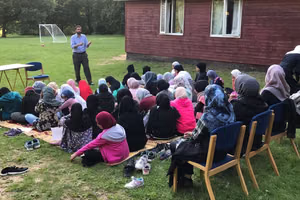
The statement comes amid longstanding concerns in Britain that networks connected to Iran have used charities and religious organizations to promote political influence.
Several UK-based charities have faced investigations in recent years over alleged links to groups aligned with Tehran.
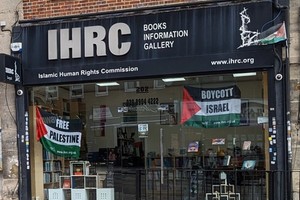
In 2024, the Charity Commission opened a compliance case involving the London-based Dar Alhekma Trust and the Abrar Islamic Foundation following a dossier alleging connections to organizations backed by Iran. Both groups deny wrongdoing.
Other organizations have drawn political criticism over activities seen by some lawmakers as promoting narratives aligned with the Islamic Republic. Conservative MP Bob Blackman last year accused Iran-linked groups of exploiting Britain’s charity sector to expand influence and “sow discord” in local communities.
Security officials and lawmakers have also warned that Tehran has used networks in Europe to extend ideological influence, even as regulators emphasize the need to balance scrutiny with protections for lawful religious and charitable activity.
Iran’s intelligence ministry said it had struck positions of Kurdish fighters it accused of preparing to enter the country through its western borders, inflicting heavy losses on them, according to a statement carried by state media on Thursday.
The ministry said the operation was carried out jointly with the Islamic Revolutionary Guard Corps and resulted in the destruction of bases and ammunition depots belonging to the groups.
“Separatist terrorist groups intended to enter the country through the western borders, with the support of the American and Zionist enemy, and carry out attacks in urban and border areas,” the ministry said. “A significant portion of their positions and facilities were destroyed and heavy losses were inflicted.”
The statement added that Iranian forces were coordinating with Kurdish residents in border areas to monitor movements and prevent attacks.
“Armed forces and intelligence units, with the cooperation of courageous Kurdish compatriots, will thwart the American-Zionist enemy’s plans for any aggression against the country’s territory,” the ministry said.
Border officials reject infiltration reports
Local authorities in the western border region denied reports that armed fighters had entered Iran.
“No report of infiltration or illegal movement of armed groups has been registered in this part of the border,” the governor of Qasr-e Shirin on the Iraqi border said, according to Iranian media.
The reports circulating on social media about armed groups crossing the western border had no factual basis, the governor added.
Meanwhile, Nechirvan Barzani, president of Iraq’s Kurdistan Region, said on Thursday that the autonomous region would not be part of any military confrontation or escalation.
A spokesperson for Iraq’s Kurdistan Regional Government also denied reports.
“Iraq's Kurdistan Regional Government denies reports claiming it is involved in plans to arm Kurdish opposition groups and send them into Iran,” the spokesperson said. “The Kurdistan Regional Government is not part of any campaign to expand war or tensions in the region.”
After joint Israeli-US strikes on Iran, the Islamic Republic and allied Shiite militias launched ballistic missile and drone attacks on Iraq’s Kurdistan Region, which hosts several Iranian Kurdish opposition groups in exile.
The strikes mainly targeted the regional capital, Erbil, where explosions, air-raid sirens and missile interceptions were reported.
Regional responses and US position
Regional officials and Washington also commented on Kurdish groups. Turkey said it was closely monitoring the activities of the Kurdistan Free Life Party (PJAK), an Iranian Kurdish opposition group linked to the Kurdistan Workers Party (PKK).
A fighter from the Kurdistan Freedom Party (PAK) takes part in a training exercise at a base near Erbil, Iraq February 12, 2026.
“The activities of groups that fuel ethnic separatism, such as the terrorist organization PJAK, negatively affect not only Iran's security but also the overall peace and stability of the region,” Turkey’s defense ministry told a weekly briefing in Ankara.
US Defense Secretary Pete Hegseth rejected reports that Washington planned to arm Kurdish groups.
“All I would say is none of our objectives are premised on the support or the arming of any particular force,” Hegseth said during a briefing on Wednesday.
White House press secretary Karoline Leavitt also dismissed reports that the administration was considering supplying weapons to Kurdish fighters to spark an uprising inside Iran, saying the claims had “no factual basis.”
The reports come amid speculation that Iranian Kurdish groups could play a role in the wider conflict.
Earlier this week, Axios reported that several Kurdish factions based in Iraq had recently formed a coalition and were preparing for a possible ground offensive into northwestern Iran, citing US and Israeli officials and a source within one of the groups.
The report said some fighters had moved closer to the border in recent weeks, though Kurdish factions have publicly denied launching any attack.
Axios also reported that US President Donald Trump had spoken with Kurdish leaders in Iraq about the war with Iran, while Israeli officials were said to be exploring ways Kurdish forces could increase pressure on Tehran.
Kurds are an ethnic group concentrated mainly in parts of Iran, Iraq, Turkey and Syria, with communities also elsewhere; because Iran does not publish official ethnic census data, estimates of the Kurdish population in Iran vary widely, commonly ranging from about 7 million to 15 million people, or roughly 8% to 17% of the population, with most living in Iran’s western and northwestern provinces near the borders with Iraq and Turkey.
Several Iranian Kurdish opposition parties based largely in Iraq’s Kurdistan Region – including Komala and the Kurdistan Democratic Party of Iran (KDPI) – have generally framed their demands around political rights and Kurdish self-rule within Iran, often describing that goal as autonomy in a federal system, while PJAK, an Iran-based Kurdish armed group aligned with the broader PKK-linked network, has advocated more sweeping political change and Kurdish self-determination.
The United States rejected Iranian claims that more than 100 Americans were killed in an attack in Dubai, calling the reports “complete disinformation,” a State Department spokesperson said on Wednesday.
In a statement, the spokesperson said no one was killed or injured in the strike on a US diplomatic facility in Dubai and urged media outlets to verify information with official US government sources before publication.
“Any claim that Iran has killed 100 US military or civilian personnel in Dubai is complete disinformation. No one was killed or injured by the strike on the US Consulate in Dubai.”
Iran’s Islamic Revolutionary Guard Corps said on Wednesday that a wave of attacks on US bases in Dubai killed more than 100 American military or civilian personnel.
The State Department said the world should condemn what it described as Iran’s “heinous and illegal attacks” on American diplomatic facilities and those of any country.
The department said it is in direct contact with Americans in the United Arab Emirates seeking information and assistance and is facilitating charter flights from the UAE.
It added that it is working through a 24/7 task force and regional teams to ensure Americans have accurate information and access to support. The department has also opened a crisis intake form for Americans in the UAE seeking departure assistance.
Separately, the United Arab Emirates said Iranian attacks since Saturday had killed three people and wounded 78 others.
The UAE defense ministry said those killed included one Bangladeshi, one Pakistani and one Nepali national.
The ministry said air defenses intercepted three ballistic missiles on Wednesday and detected 129 drones, destroying 121 of them while eight fell inside the country.
Since the start of the attacks, the UAE said it had detected 189 ballistic missiles, destroying 175, while 13 fell into the sea and one landed on its territory.
The ministry added that 941 Iranian drones had been launched toward the UAE, with 876 intercepted and 65 falling inside the country. It also said eight cruise missiles were detected and destroyed, and that interception operations caused some collateral damage.
The UAE condemned the attacks as a violation of its sovereignty and international law and said it reserves the right to respond.
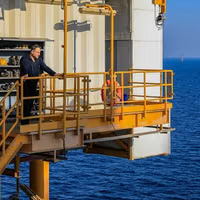
As war spreads across the Middle East and attention focuses on oil, the region’s most dangerous soft targets may be desalination plants.
A serious strike, sabotage operation, cyberattack, or contamination event affecting these facilities would not just damage commerce. It could trigger a rapid human security crisis by threatening drinking water, electricity, sanitation, and public order at the same time.
GCC countries account for around 40 percent of the world’s desalinated water and operate more than 400 desalination plants across the region. About 90 percent of Kuwait’s drinking water comes from desalination. The figure is 86 percent in Oman and 70 percent in Saudi Arabia.
In a region defined by extreme heat, scarce rainfall, overdrawn aquifers, and growing urban populations, desalination is not a technical supplement to national life. It is the infrastructure that makes national life possible.
Persian Gulf governments can absorb temporary shocks to tourism, reroute some trade, and rely on global markets to cushion part of an oil disruption. Water is different. It cannot be improvised at scale, and it cannot be politically rationed for long in cities that depend on the state to supply the basics of daily life.
Qatar’s prime minister warned last year that any attack on Iran’s nuclear facilities could “entirely contaminate” the region’s waters and threaten life in Qatar, the UAE, and Kuwait.
He also said Qatar had once assessed that it could run out of potable water after just three days in such a scenario, prompting the construction of 15 massive water reservoirs to expand emergency reserves.
Those comments were made before the current war reached today’s level of direct regional spillover.
The Middle East Institute warned in 2025 that the Gulf’s heavy reliance on centralized desalination infrastructure presents a clear strategic vulnerability for Iran’s Arab neighbors.
Research on Qatar’s water security has specifically warned that oil spills and red tides could interrupt desalination operations or force shutdowns for a considerable period. In peacetime, these are serious risks. In wartime, they become strategic liabilities.
A leaked 2008 US diplomatic cable from Riyadh stated that the Jubail desalination plant supplied over 90 percent of Riyadh’s drinking water and warned that the capital “would have to evacuate within a week” if the plant, its pipelines, or associated power infrastructure were seriously damaged or destroyed.
The same cable added that “the current structure of the Saudi government could not exist without the Jubail Desalinization Plant.”
That is why desalination plants may matter more in this conflict than many of the targets receiving greater attention.
Research on conflict-related water disruption has also shown that contamination or shutdown of desalination capacity can worsen water insecurity and heighten risks to public health.
Iran’s recent attacks across the region appear intended in part to internationalize the battlefield and raise the cost for Arab states of aligning with Washington. But targeting, or even credibly threatening, desalination infrastructure would raise those costs in a different and more dangerous way.
It would push GCC governments to treat water security as national survival rather than collateral risk. That, in turn, could draw them more directly into the conflict or harden support for wider retaliation.
A war that begins around missiles, nuclear facilities, and energy flows could therefore widen around something more elemental: whether people in the region can drink, cool their homes, and keep hospitals functioning in extreme heat.
The Arab nations surrounding the Persian Gulf can withstand price shocks, flight cancellations, and even temporary energy disruption more easily than they can withstand a major breakdown in potable water supply.
That is why the next phase of this war may not be defined by what happens to oil. It may be defined by whether anyone is reckless enough to turn the region’s water system into a battlefield.
Food distribution and access to basic supplies have been disrupted in parts of Tehran’s Evin prison following US and Israeli airstrikes, with some detainees reporting they are surviving on limited bread and water, according to families who spoke to Iran International.
Relatives said prison wards have been locked down and some staff have left their posts as explosions from strikes in Tehran continue to be heard around the clock.
Families said food distribution and cooking supplies in the women’s ward and Ward 7 had been halted, leaving inmates with only small quantities of bread. The prison store has also been closed since the attacks began, preventing detainees from purchasing additional food.
Some prisoners who managed to contact relatives said they had access only to “dry bread and water,” raising concerns about how long supplies could last.
In a letter from Evin prison, jailed human rights activist Reza Khandan wrote that thousands of detainees were being held while facing the risk of ongoing bombardment and that many services inside prisons had been disrupted. He warned that continued conflict could lead to shortages of food rations and hygiene supplies.
Khandan said responsibility for the safety of prisoners lies with Iran’s judiciary and the prison organization.
A campaign supporting political prisoner Varisheh Moradi also called for the immediate release of detainees, particularly political prisoners, saying their safety could not be guaranteed under wartime conditions.
Separately, the United Nations has raised concerns about the situation inside Iran following the escalation of the conflict.
A spokesperson for the UN High Commissioner for Human Rights said at least 787 people had been killed in Iran in the strikes, and expressed concern about civilian casualties, domestic repression, internet disruptions and the situation of political prisoners.
The UN also urged Iranian authorities to guarantee fundamental freedoms in line with international human rights law and called for the restoration of internet access, warning that communication outages could limit people’s access to vital safety information during wartime.
Evin prison in northern Tehran, known for holding political prisoners and activists, was hit during airstrikes on June 23 in last year’s 12-day war, damaging parts of the complex and raising concern about detainee safety.
Iran’s judiciary said at the time 71 people were killed, including guards, staff, inmates, visiting relatives, and nearby residents.
A boxing gym owned by an Iranian-Canadian political activist and vocal critic of the Islamic Republic was struck by gunfire early Sunday morning near Toronto, raising concerns within the community about possible intimidation targeting dissidents in Canada.
York Regional Police said officers responded shortly after 3 a.m. on March 1 to reports of gunfire at a commercial plaza north of Toronto, where investigators found damage consistent with multiple rounds fired at a business. The building was unoccupied at the time and no injuries were reported.
Surveillance footage shows a suspect dressed in dark clothing exiting a dark-colored sport utility vehicle before fleeing the scene, police said.
The targeted business, Saliwan Boxing, is owned by Salar Gholami, an Iranian-Canadian political activist and Canadian cruiserweight boxing champion who has organized demonstrations against the Islamic Republic across the Greater Toronto Area in recent months.
The shooting came hours after supporters gathered at the gym and elsewhere in Toronto following US and Israeli military strikes that killed Iran’s Supreme Leader, events that drew large crowds waving Iran’s Lion and Sun flag.
“Seventeen bullets in the middle of Toronto,” Gholami told Iran International. “This is not just about the Iranian community anymore. It’s about Canadians.”
Gholami said the gym is used by families, teenagers and children and could have been occupied when the shots were fired.
“Our gym is just a regular gym. Girls, teenagers, kids,” he said. “The shooting at the gym... is so dangerous.”
He said he believes the attack may have been intended as a warning linked to his activism, though police said no motive has been confirmed.
York Regional Police acknowledged concerns within the community that the incident could be connected to broader geopolitical tensions in the Middle East.
Investigators said they are working with policing and intelligence partners and reviewing all available evidence, including the possibility of politically motivated or transnational elements.
Canadian intelligence officials have previously warned that Iranian state actors and their proxies have targeted dissidents abroad, including individuals living in Canada. The Canadian Security Intelligence Service has said it has disrupted potentially lethal threats linked to foreign interference operations in past cases.
Former Canadian Justice minister Irwin Cotler, for example, was previously the subject of an alleged Iranian plot to kill him on Canadian soil.
Gholami said he has remained in contact with police following the shooting but expressed concern about security arrangements, saying he was told additional protection would need to be arranged privately.
“We came here for freedom,” he said. “Canada must protect its citizens. I’m Canadian too.”
Despite the attack, he said he intends to continue organizing demonstrations.
“I will not give up,” Gholami said. “They may be able to take my life, but they cannot take our honor.”
Iran International contacted Public Safety Canada to ask whether additional protections are being considered for Iranian-Canadian activists amid concerns about transnational repression. The department did not respond before publication.