Trump says Iran wants talks but it’s 'too late'

President Donald Trump said on Wednesday that Iran was seeking negotiations but warned it was “too late” as US-led strikes intensified in a widening conflict now entering its sixth day.

President Donald Trump said on Wednesday that Iran was seeking negotiations but warned it was “too late” as US-led strikes intensified in a widening conflict now entering its sixth day.
“They’re calling. They’re saying, how do we make a deal?” Trump said in remarks to reporters. “I said, you’re being a little bit late, and we want to fight now more than they do.”
The comments came after nearly a week of escalating exchanges in which US and Israeli forces struck targets across Iran while Tehran retaliated with missile and drone attacks across the region, raising fears of a broader Middle East war.
Trump framed the campaign as a decisive military effort, boasting of American power and claiming Iran had suffered sweeping losses.
“Their navy is gone,” he said. “Their anti-aircraft weapons are gone. So they have no Air Force. They have no air defense.”
Earlier Wednesday, Iran’s foreign minister, Abbas Araghchi, said Tehran was not seeking a ceasefire and saw no reason to negotiate.
“We are not asking for ceasefire. We don’t see any reason why we should negotiate when we negotiated with them twice and every time they attacked us in the middle of negotiations,” Araghchi told NBC News.
He also challenged Washington to attempt a ground invasion, saying Iran was prepared to confront US forces.
Araghchi later wrote on social media that Washington had squandered a diplomatic opening.
“Plan A for a clean rapid military victory failed, Mr. President. Your Plan B will be even bigger failure,” he said, adding that a “unique deal” had been lost after what he called the intervention of an “‘America Last’ cabal.”
Trump also urged defections from within Iran’s security establishment, calling on members of the Revolutionary Guards, military and police to lay down their arms and promising immunity to those who did so.
He said he wanted to see Iranians “take back” their country and added that the United States would ensure whoever leads Iran next “will not threaten America or its neighbors.”
The exchange underscored the widening gap between Washington and Tehran as diplomacy gives way to a fast-moving military confrontation whose scope continues to expand.


Britain’s charity regulator issued fresh guidance on Thursday warning charities to exercise caution in their activities related to Iran as tensions in the region intensify, and said it would act on any evidence of links to extremism or terrorism.
The Charity Commission said charities could be affected in different ways by the “volatile situation” in Iran and the wider Middle East and urged trustees to carefully assess the risks of political activity, public statements and overseas operations.
The watchdog said organizations working in or commenting on Iran should be mindful that individuals and groups in the country are subject to sanctions and other restrictions under UK law.
“As a civil regulator we will respond robustly to evidence of links between charities and extremism or terrorism,” a Charity Commission statement said. “We will make referrals to other agencies where appropriate including where there is evidence of criminality.”
Trustees were reminded that any political activity must directly support a charity’s stated purpose and comply with regulations governing campaigning and social media use.
“In the current context, the Commission urges charities to be careful to ensure that any political activity they are involved in furthers their charity’s objects and complies with our guidance,” the regulator said.
The statement comes amid longstanding concerns in Britain that networks connected to Iran have used charities and religious organizations to promote political influence.
Several UK-based charities have faced investigations in recent years over alleged links to groups aligned with Tehran.


In 2024, the Charity Commission opened a compliance case involving the London-based Dar Alhekma Trust and the Abrar Islamic Foundation following a dossier alleging connections to organizations backed by Iran. Both groups deny wrongdoing.
Other organizations have drawn political criticism over activities seen by some lawmakers as promoting narratives aligned with the Islamic Republic. Conservative MP Bob Blackman last year accused Iran-linked groups of exploiting Britain’s charity sector to expand influence and “sow discord” in local communities.
Security officials and lawmakers have also warned that Tehran has used networks in Europe to extend ideological influence, even as regulators emphasize the need to balance scrutiny with protections for lawful religious and charitable activity.
The United States rejected Iranian claims that more than 100 Americans were killed in an attack in Dubai, calling the reports “complete disinformation,” a State Department spokesperson said on Wednesday.
In a statement, the spokesperson said no one was killed or injured in the strike on a US diplomatic facility in Dubai and urged media outlets to verify information with official US government sources before publication.
“Any claim that Iran has killed 100 US military or civilian personnel in Dubai is complete disinformation. No one was killed or injured by the strike on the US Consulate in Dubai.”
Iran’s Islamic Revolutionary Guard Corps said on Wednesday that a wave of attacks on US bases in Dubai killed more than 100 American military or civilian personnel.
The State Department said the world should condemn what it described as Iran’s “heinous and illegal attacks” on American diplomatic facilities and those of any country.
The department said it is in direct contact with Americans in the United Arab Emirates seeking information and assistance and is facilitating charter flights from the UAE.
It added that it is working through a 24/7 task force and regional teams to ensure Americans have accurate information and access to support. The department has also opened a crisis intake form for Americans in the UAE seeking departure assistance.
Separately, the United Arab Emirates said Iranian attacks since Saturday had killed three people and wounded 78 others.
The UAE defense ministry said those killed included one Bangladeshi, one Pakistani and one Nepali national.
The ministry said air defenses intercepted three ballistic missiles on Wednesday and detected 129 drones, destroying 121 of them while eight fell inside the country.
Since the start of the attacks, the UAE said it had detected 189 ballistic missiles, destroying 175, while 13 fell into the sea and one landed on its territory.
The ministry added that 941 Iranian drones had been launched toward the UAE, with 876 intercepted and 65 falling inside the country. It also said eight cruise missiles were detected and destroyed, and that interception operations caused some collateral damage.
The UAE condemned the attacks as a violation of its sovereignty and international law and said it reserves the right to respond.
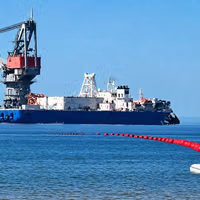
As war spreads across the Middle East and attention focuses on oil, the region’s most dangerous soft targets may be desalination plants.
A serious strike, sabotage operation, cyberattack, or contamination event affecting these facilities would not just damage commerce. It could trigger a rapid human security crisis by threatening drinking water, electricity, sanitation, and public order at the same time.
GCC countries account for around 40 percent of the world’s desalinated water and operate more than 400 desalination plants across the region. About 90 percent of Kuwait’s drinking water comes from desalination. The figure is 86 percent in Oman and 70 percent in Saudi Arabia.
In a region defined by extreme heat, scarce rainfall, overdrawn aquifers, and growing urban populations, desalination is not a technical supplement to national life. It is the infrastructure that makes national life possible.
Persian Gulf governments can absorb temporary shocks to tourism, reroute some trade, and rely on global markets to cushion part of an oil disruption. Water is different. It cannot be improvised at scale, and it cannot be politically rationed for long in cities that depend on the state to supply the basics of daily life.
Qatar’s prime minister warned last year that any attack on Iran’s nuclear facilities could “entirely contaminate” the region’s waters and threaten life in Qatar, the UAE, and Kuwait.
He also said Qatar had once assessed that it could run out of potable water after just three days in such a scenario, prompting the construction of 15 massive water reservoirs to expand emergency reserves.
Those comments were made before the current war reached today’s level of direct regional spillover.
The Middle East Institute warned in 2025 that the Gulf’s heavy reliance on centralized desalination infrastructure presents a clear strategic vulnerability for Iran’s Arab neighbors.
Research on Qatar’s water security has specifically warned that oil spills and red tides could interrupt desalination operations or force shutdowns for a considerable period. In peacetime, these are serious risks. In wartime, they become strategic liabilities.
A leaked 2008 US diplomatic cable from Riyadh stated that the Jubail desalination plant supplied over 90 percent of Riyadh’s drinking water and warned that the capital “would have to evacuate within a week” if the plant, its pipelines, or associated power infrastructure were seriously damaged or destroyed.
The same cable added that “the current structure of the Saudi government could not exist without the Jubail Desalinization Plant.”
That is why desalination plants may matter more in this conflict than many of the targets receiving greater attention.
Research on conflict-related water disruption has also shown that contamination or shutdown of desalination capacity can worsen water insecurity and heighten risks to public health.
Iran’s recent attacks across the region appear intended in part to internationalize the battlefield and raise the cost for Arab states of aligning with Washington. But targeting, or even credibly threatening, desalination infrastructure would raise those costs in a different and more dangerous way.
It would push GCC governments to treat water security as national survival rather than collateral risk. That, in turn, could draw them more directly into the conflict or harden support for wider retaliation.
A war that begins around missiles, nuclear facilities, and energy flows could therefore widen around something more elemental: whether people in the region can drink, cool their homes, and keep hospitals functioning in extreme heat.
The Arab nations surrounding the Persian Gulf can withstand price shocks, flight cancellations, and even temporary energy disruption more easily than they can withstand a major breakdown in potable water supply.
That is why the next phase of this war may not be defined by what happens to oil. It may be defined by whether anyone is reckless enough to turn the region’s water system into a battlefield.
The White House says Iran rejected a US proposal to establish a joint civilian nuclear program with American investment in exchange for dismantling its uranium enrichment infrastructure before Washington and Israel launched strikes on the country.
White House press secretary Karoline Leavitt said the offer was part of what she described as “good faith negotiations” conducted by President Donald Trump’s envoys in the weeks leading up to the attacks.
According to Leavitt, US negotiators offered to lift sanctions on Iran, supply nuclear fuel for peaceful purposes and support a joint civil nuclear program backed by American investment.
In return, Iran would have been required to permanently dismantle its enrichment facilities.
“They refused to say yes to peace,” Leavitt said. “And now they are reaping the consequences of that.”
The proposals emerged from three rounds of talks mediated by Oman before the strikes began. Iran’s Foreign Minister Abbas Araghchi met US envoys Steve Witkoff and Jared Kushner in discussions aimed at defusing tensions over Tehran’s nuclear program.
Oman’s foreign minister later said the US attacks came at a time when Tehran had already signaled readiness for unprecedented concessions related to its nuclear activities, raising questions about Washington’s characterization of the negotiations.
Iran has long maintained that its nuclear program is peaceful and insists it will not give up what it describes as its sovereign right to enrich uranium.
Iranian officials say enrichment for civilian purposes, including nuclear energy and medical uses, is permitted under international agreements, though they have expressed willingness in the past to accept limits and monitoring.
US President Donald Trump also suggested the conflict could further reshape Iran’s leadership.
“Their leadership is just rapidly going. Everybody that seems to want to be a leader, they end up dead,” Trump said on Wednesday, adding that the United States was in a “very strong position” in the conflict and rating the country’s military strength “about a 15” on a scale of 10.
The dispute over enrichment has remained the central obstacle in nuclear diplomacy between Tehran and Washington.
With negotiations now overtaken by military escalation, the collapse of the talks has pushed the long-running nuclear dispute into open conflict and raised fears the confrontation could widen across the region.
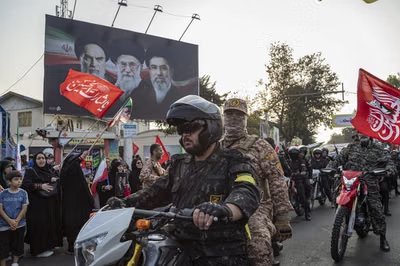
Iran’s clerical body, the Assembly of Experts, has elected Mojtaba Khamenei, the son of the late Ali Khamenei, as the Islamic Republic’s new Supreme Leader, according to his informed sources who spoke to Iran International on condition of anonymity.
The decision marks one of the most consequential moments in the history of the Islamic Republic, effectively transferring power within the same family for the first time since the 1979 revolution.
But who exactly is Mojtaba Khamenei?
A powerful figure behind the scenes
Mojtaba Khamenei, 55, has long been considered one of the most influential figures inside Iran’s ruling system despite rarely appearing in public or holding formal political office.
For years he operated from within the Office of the Supreme Leader, serving as a gatekeeper and power broker around his father. His position has often been compared to the role played by Ahmad Khomeini, the son of Islamic Republic’s founder Ruhollah Khomeini, who served as a key aide and confidant during the early years of the revolutionary state.
Analysts say Mojtaba gradually built influence across the regime’s political, security and clerical institutions.
Dr. Eric Mandel, director of the Middle East Political and Information Network (MEPIN), told Iran International that Mojtaba has long been a central but opaque figure in Tehran’s power structure.
“Mojtaba Khamenei, the son of former Supreme Leader Ali Khamenei, has long operated behind the scenes in Tehran, building deep ties with the Islamic Revolutionary Guard Corps and consolidating influence within the regime’s power structure. He is widely viewed as one of the architects of the regime’s repression," Mandel said.
Author and Iran analyst Arash Azizi told Iran International Mojtaba is viewed with deep suspicion. "This is why he has been a bete noire of democratic movements at least since 2009 when he was rumored to have helped orchestrate the repression. He is also known to be a favorite of some sections of the establishment such as those close to Mohammad-Bagher Ghalibaf who has ambitions of becoming Iran’s strongman."
Ties to Iran’s security establishment
A key source of Mojtaba’s influence lies in his close connections to the Islamic Revolutionary Guard Corps (IRGC).
During the Iran-Iraq War in the 1980s, Mojtaba served in the Habib Battalion, a unit made up largely of volunteers connected to the Islamic Republic’s emerging revolutionary networks. The battalion operated under forces linked to the IRGC and took part in several major battles of the war.
Service in the Habib Battalion proved significant for Mojtaba. Many of the men who fought alongside him later rose to senior positions in Iran’s security and intelligence apparatus, including figures who would go on to lead parts of the IRGC’s intelligence organization and security commands responsible for protecting the regime.
Those wartime relationships are widely believed to have helped Mojtaba build lasting connections inside Iran’s powerful security establishment.
Over the years, opposition figures and political rivals have accused Mojtaba of playing a role in shaping election outcomes and coordinating crackdowns on dissent.
Questions over religious credentials
Iran’s constitution requires the Supreme Leader to possess deep knowledge of Islamic jurisprudence and be recognized as a senior religious authority.
Mojtaba, however, is not widely considered to be among the highest-ranking clerics in Iran. He studied in the seminaries of Qom under several prominent conservative scholars but does not hold the rank of ayatollah.
Despite that, Iran’s political system has historically shown flexibility when elite consensus forms around a candidate.
A controversial succession
Mojtaba’s elevation is likely to intensify criticism that the Islamic Republic founded as a revolutionary Islamic system is evolving toward dynastic rule.
For years speculation about his succession drew comparisons to hereditary monarchies.
For a man who has spent decades operating largely in the shadows of Iran’s power structure, Mojtaba Khamenei now finds himself at the center of one of the most consequential periods in the country’s modern history.



