• العربية
  • فارسی
Brand
  • Iran Insight
  • Politics
  • Economy
  • Analysis
  • Special Report
  • Opinion
  • Podcast
  • Iran Insight
  • Politics
  • Economy
  • Analysis
  • Special Report
  • Opinion
  • Podcast
  • Theme
  • Language
    • العربية
    • فارسی
  • Iran Insight
  • Politics
  • Economy
  • Analysis
  • Special Report
  • Opinion
  • Podcast
All rights reserved for Volant Media UK Limited
volant media logo

Washington says Tehran rejected offer of nuclear cooperation before strikes

Mar 4, 2026, 20:47 GMT+0
Iran's nuclear facility at southern city of Bushehr - undated file photo

The White House says Iran rejected a US proposal to establish a joint civilian nuclear program with American investment in exchange for dismantling its uranium enrichment infrastructure before Washington and Israel launched strikes on the country.
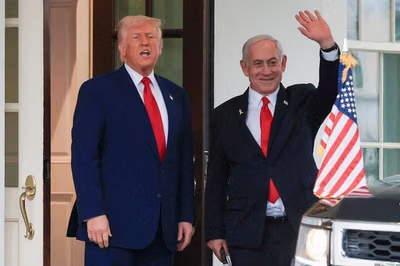
White House press secretary Karoline Leavitt said the offer was part of what she described as “good faith negotiations” conducted by President Donald Trump’s envoys in the weeks leading up to the attacks.

According to Leavitt, US negotiators offered to lift sanctions on Iran, supply nuclear fuel for peaceful purposes and support a joint civil nuclear program backed by American investment.

In return, Iran would have been required to permanently dismantle its enrichment facilities.

“They refused to say yes to peace,” Leavitt said. “And now they are reaping the consequences of that.”

The proposals emerged from three rounds of talks mediated by Oman before the strikes began. Iran’s Foreign Minister Abbas Araghchi met US envoys Steve Witkoff and Jared Kushner in discussions aimed at defusing tensions over Tehran’s nuclear program.

Oman’s foreign minister later said the US attacks came at a time when Tehran had already signaled readiness for unprecedented concessions related to its nuclear activities, raising questions about Washington’s characterization of the negotiations.

Iran has long maintained that its nuclear program is peaceful and insists it will not give up what it describes as its sovereign right to enrich uranium.

Iranian officials say enrichment for civilian purposes, including nuclear energy and medical uses, is permitted under international agreements, though they have expressed willingness in the past to accept limits and monitoring.

US President Donald Trump also suggested the conflict could further reshape Iran’s leadership.

“Their leadership is just rapidly going. Everybody that seems to want to be a leader, they end up dead,” Trump said on Wednesday, adding that the United States was in a “very strong position” in the conflict and rating the country’s military strength “about a 15” on a scale of 10.

The dispute over enrichment has remained the central obstacle in nuclear diplomacy between Tehran and Washington.

With negotiations now overtaken by military escalation, the collapse of the talks has pushed the long-running nuclear dispute into open conflict and raised fears the confrontation could widen across the region.

Most Viewed

100 days after carnage: Iran economy reels from war, inflation, unemployment
1
INSIGHT

100 days after carnage: Iran economy reels from war, inflation, unemployment

2
OPINION

The Hormuz get out of jail card turned to a grave

3

State media slam Araghchi's Hormuz tweet, say it let Trump claim victory

4
EXCLUSIVE

Iranian assaulted in London amid concern over threats to regime critics

5
PODCAST

Too early to tell who is winning Iran war, experts say

Banner
Banner

Spotlight

  • From instability to influence: Pakistan’s pivotal role in US-Iran diplomacy

    From instability to influence: Pakistan’s pivotal role in US-Iran diplomacy

  • A nation in limbo: 100 days after the massacre, has the world moved on?
    INSIGHT

    A nation in limbo: 100 days after the massacre, has the world moved on?

  • 100 days after carnage: Iran economy reels from war, inflation, unemployment
    INSIGHT

    100 days after carnage: Iran economy reels from war, inflation, unemployment

  • The Hormuz get out of jail card turned to a grave
    OPINION

    The Hormuz get out of jail card turned to a grave

  • How Tehran bends its own red lines to boost state rallies
    INSIGHT

    How Tehran bends its own red lines to boost state rallies

  • Iran blackout cripples freelancer, small business incomes
    VOICES FROM IRAN

    Iran blackout cripples freelancer, small business incomes

•
•
•

More Stories

Iran holds press conference at school as concerns grow over use of civilian sites

Mar 3, 2026, 13:07 GMT+0

Iran’s foreign ministry spokesperson held a televised press conference on Tuesday from a Tehran classroom that state-linked media said had been damaged in recent strikes, as questions persist over the authorities’ use of civilian sites during wartime.

Images from the briefing showed spokesperson Esmail Baghaei speaking from a podium inside Mahalati School in Tehran. Iranian outlets said the school had been hit in recent attacks and presented the setting as evidence that educational facilities were being targeted.

Holding an official briefing in a classroom also prompted renewed speculation online that some officials may be seeking to operate from civilian buildings.

In recent days, social media users have circulated videos and photographs that appear to show security forces stationed inside schools in Tehran and Shiraz.

Iran International has also reported on security activity inside medical facilities. In one case, it cited a hospital employee who said military commanders held meetings inside a Tehran hospital.

  • IRGC commanders hold meetings in hospitals, sources say

    IRGC commanders hold meetings in hospitals, sources say

Military presence in civilian sites

Teachers’ unions have voiced alarm. The Coordinating Council of Iranian Teachers’ Trade Associations published an image a day before US-Israeli strikes began showing what it said was military equipment positioned inside a school, warning that classrooms were being turned into “shields for deadly equipment.”

Uniformed officers sit in a school courtyard beneath an Iranian flag in an image  shared on social media on March 3, 2026.
100%
Uniformed officers sit in a school courtyard beneath an Iranian flag in an image shared on social media on March 3, 2026.

Earlier this week, an image was released from a meeting of the interim leadership council, attended by President Masoud Pezeshkian, Judiciary Chief Gholamhossein Mohseni Ejei and cleric Alireza Arafi.

Hours later, social media posts suggested the meeting had taken place in a ward at Tehran’s Arman Hospital.

Members of Iran’s leadership council meet at an undisclosed location on March 1 with social media users saying the low ceiling and iron door behind them suggest the meeting was held inside Tehran’s Arman Hospital.
100%
Members of Iran’s leadership council meet at an undisclosed location on March 1 with social media users saying the low ceiling and iron door behind them suggest the meeting was held inside Tehran’s Arman Hospital.

International humanitarian law requires parties to distinguish between civilians and combatants, and between civilian objects and military objectives.

Schools and hospitals are protected unless, and for such time as, they are used for military purposes, and the use of civilians to shield military objectives is prohibited.

Disputed strike in Minab

The controversy intensified after Iranian media reported that an elementary and preschool complex in Minab, Hormozgan province, adjacent to an IRGC compound, was struck on February 28, killing more than 160 people.

Asked about the incident, US Secretary of State Marco Rubio said the United States would not deliberately target a school and that its objectives were focused on missiles, related manufacturing and launch capabilities, and drones.

"We would have no interest and frankly no incentive to target civilian infrastructure.”

Security forces gather with motorcycles and armored vehicles inside a school courtyard in an image shared on social media in January ahead of a crackdown.
100%
Security forces gather with motorcycles and armored vehicles inside a school courtyard in an image shared on social media in January ahead of a crackdown.

Israel’s ambassador to the United Nations, Danny Danon, said on Monday he had seen differing accounts of what happened in Minab, including claims that Iran’s Revolutionary Guards were responsible. He said Israel targets military assets and expressed regret for civilian casualties.

“We regret the loss of life of any civilian. And we pray for the people of Iran. But we have the intelligence and we target military assets. That’s what we do. The Iranians, they do exactly the opposite,” he said.

As the conflict deepens, any overlap between official or security activity and civilian sites could increase the risks for densely populated areas and raise further legal and humanitarian concerns.

IAEA says no damage at Iran nuclear sites, envoy says Natanz was hit

Mar 2, 2026, 09:45 GMT+0

The UN atomic watchdog said on Monday it has no indication that Iran’s nuclear facilities were damaged in recent military attacks, even as Tehran’s ambassador to the agency said the Natanz enrichment site was targeted a day earlier.

“Regarding the status of the nuclear installations in Iran, up to now, we have no indication that any of the nuclear installations, including the Bushehr Nuclear Power Plant, the Tehran Research Reactor or other nuclear fuel cycle facilities have been damaged or hit,” Rafael Grossi, Director General of the International Atomic Energy Agency, told an emergency meeting of the Board of Governors.

“Efforts to contact the Iranian nuclear regulatory authorities through the IEC continue, with no response so far. We hope this indispensable channel of communication can be reestablished as soon as possible,” he added.

  • IAEA says cannot assure Iran’s nuclear program is exclusively peaceful

    IAEA says cannot assure Iran’s nuclear program is exclusively peaceful

The agency’s Incident and Emergency Centre, Grossi said, was fully operational and coordinating with regional safety networks. “So far, no elevation of radiation levels above the usual background levels has been detected in countries bordering Iran,” he said.

Warning against strikes on nuclear facilities

Armed attacks on nuclear sites, Grossi said, carry risks that extend beyond national borders.

“Let me again recall past General Conference resolutions that state that armed attacks on nuclear facilities should never take place and could result in radioactive releases with grave consequences within and beyond the boundaries of the State which has been attacked,” he said.

He urged restraint by all sides. “Consistent with the objectives of the IAEA, as enshrined in its Statute, I reiterate my call on all parties to exercise maximum restraint to avoid further escalation,” Grossi added.

The IAEA chief also said negotiations over Iran’s nuclear program must start again. “To achieve the long-term assurance that Iran will not acquire nuclear weapons and for maintaining the continued effectiveness of the global non-proliferation regime, we must return to diplomacy and negotiations,” he said.

Iran envoy cites Natanz

Separately, Reuters reported that Iran’s ambassador to the IAEA said the United States and Israel attacked Iranian nuclear facilities on Sunday. Asked which facility was struck, the ambassador replied “Natanz,” according to Reuters.

The Natanz nuclear facility is Iran’s main uranium enrichment site and has long been central to international concerns about Tehran’s nuclear activities.

Grossi added that while no radiological release has been detected, the situation remains serious. “Let me underline that the situation today is very concerning. We cannot rule out a possible radiological release with serious consequences,” he said.

Iran calls for IAEA condemnation

During the session, Iran’s ambassador to the IAEA, Reza Najafi, called on the agency to condemn the attacks on Iran’s nuclear facilities.

He rejected that Iran is seeking nuclear weapons, calling them “completely false.”

Najafi said Iran’s response would continue, adding that such measures would remain in place as long as what he described as “aggression” continues.

'Your time is up': EU lawmaker says negotiations with Tehran must end

Feb 28, 2026, 04:39 GMT+0
•
Negar Mojtahedi

A senior member of the European Parliament is calling for a fundamental shift in Europe’s approach toward Iran, arguing that continued negotiations with the Islamic Republic are no longer defensible after Tehran’s deadly crackdown on protesters.

Daniel Attard, a Maltese Member of the European Parliament who serves as Vice-Chair of the European Parliament’s Delegation for Relations with Iran, urged European governments to move beyond statements of concern and adopt concrete political and economic measures against Tehran, he said in an interview on Eye for Iran podcast.

“Responsibility to protect is not just a slogan, it is a commitment,” Attard said. “When a regime turns on its own people, when the regime kills its own people to stay in power, sovereignty cannot be used as a shield.”

Rising tensions amid military buildup

Attard’s remarks come as tensions surrounding Iran continue to escalate, with Washington increasing its military posture in the region.

In recent weeks, US naval assets, including aircraft carrier strike groups and advanced fighter aircraft have been repositioned closer to the Middle East, a move analysts say is intended to deter further escalation while signaling readiness should diplomacy fail.

The heightened military presence coincides with ongoing diplomatic talks in Geneva and growing concern in Europe over Iran’s ballistic missile program, which US officials warn could eventually threaten both European territory and American forces abroad.

Against that backdrop, Attard argued Europe cannot remain a passive observer.

“The time for negotiation is over,” he said. “We should be decisive, we should show leadership, we should match the courage of the people of Iran — the students, the women, the youth, the elderly — who have showed great courage.”

A full-spectrum pressure strategy

Attard outlined what he described as a comprehensive pressure strategy targeting the regime politically, economically and diplomatically.

“We need to halt all trade incoming from Iran either directly or indirectly,” he said. “Iranian embassies are still operating like it was business as usual in Europe. So we need to be more decisive. No more business as usual — be it politically, be it economically, and be it diplomatically.”

The European Parliament has already pushed for the designation of Iran’s Islamic Revolutionary Guard Corps (IRGC) as a terrorist organization, a step Attard described as “very long overdue.” But he stressed that enforcement now matters as much as designation.

“We should enforce those sanctions without any possibility of any loopholes,” he said.

He added that EU member states have the authority to take further steps immediately.

“Governments can decide to close or to restrict severely the operation of Iranian diplomatic embassies within the Union. This is something which member states can actually do, and they can do it right now.”

Europe’s credibility at stake

Attard acknowledged that divisions among EU member states and competing geopolitical interests have slowed action in the past but warned that Europe’s credibility now depends on consistency.

“We cannot claim to defend human rights if we look away to what’s happening on the streets of Iran,” he said. “Our credibility demands consistency.”

He expressed confidence that pressure from lawmakers would continue to grow.

“As long as the Iranian regime thinks it can silence its people, we will echo and amplify their voices,” Attard said.

Message to Iranians and to Tehran

Addressing Iranians directly, Attard praised protesters’ resilience and framed their struggle as one rooted in universal values.

“Your courage is seen and we shall not look away,” he said. “This is a fight about universal values — human rights, dignity and equality.”

His message to Iran’s leadership was considerably shorter.

“My message is clear,” Attard said. “Your time is up.”

Tehran downbeat after Geneva talks, pins hopes on Oman mediation

Feb 27, 2026, 18:37 GMT+0
•
Behrouz Turani

Tehran appeared noticeably downbeat about the outcome of Thursday’s negotiations with Washington in Geneva, with signs of disappointment emerging first on the website of the government’s news agency.

In a commentary published Friday, IRNA said the two sides’ clashing positions were jeopardizing the talks, laying the blame for such an outcome at Washington’s door.

It also made clear that Tehran is placing considerable hopes in Oman’s foreign minister, Badr Albusaidi, whose quiet mediation has been central to the negotiations.

Albusaidi now carries a “grave responsibility,” the piece argued, with his role beginning in Muscat, continuing through two rounds of talks in Geneva and now entering “another important step” when he meets US Vice President JD Vance in Washington.

Tehran’s official outlet even hinted at the mediator’s message to the American side: a warning that a war with Iran would not remain limited, that regime change is unattainable and that even heavy damage to Iranian targets would not achieve the goals emphasized by President Donald Trump, “just as they did not in the June attacks.”

Iranian media outlets have also begun outlining the main sticking points in the negotiations.

The news website Fararu reported Friday that the talks remain deadlocked over fundamental issues including enrichment levels, sanctions relief and the dismantling of parts of Iran’s nuclear infrastructure.

Another major obstacle, it said, is Iran’s refusal to export enriched nuclear material, with Tehran insisting on maintaining domestic fuel production.

Axios reported that some of Trump’s advisers, including Jared Kushner and Steve Witkoff, were disappointed with Araghchi’s proposals, arguing that they fell short of US expectations.

Trump himself signaled frustration with Tehran on Friday, telling reporters he was “not happy” with Iran but expected further talks to take place.

Asked about the possibility of using military force, the president said he hoped it would not be necessary but did not rule it out.

Speaking before leaving the White House for a trip to Texas, Trump said he still wants to reach an agreement with Iran but reiterated that Tehran “cannot have a nuclear weapon.”

Fararu suggested Washington may be pursuing a dual-track strategy, combining diplomacy with the threat of limited military strikes to maintain pressure.

The negotiations, it concluded, have entered a “complex and decisive” phase: a potential framework is beginning to take shape, but deep structural disagreements and continued US military signaling are sustaining a high level of uncertainty.

In a separate interview with the website, foreign policy analyst and former Iranian diplomat Jalal Sadatian said President Trump’s tone toward Iran had recently become noticeably “sharper, more decisive and more alarming.”

Sadatian also warned that Iran’s “asymmetric capabilities” mean that even limited military action could quickly escalate in unpredictable ways.

Why Tehran’s business pitch to Trump won’t end nuclear deadlock

Feb 27, 2026, 17:05 GMT+0
•
Umud Shokri

Reports in major outlets that Tehran has floated a “commercial bonanza” to the Trump administration should be understood less as an investment roadmap than as a survival strategy.

As Donald Trump’s 10-to-15-day deadline for a “meaningful” deal with Iran enters its decisive phase, Iranian officials appear to be reframing diplomacy as a commercial opportunity rather than a strategic concession.

The Financial Times reported on February 26—as talks were underway in Geneva—that Tehran had offered access to major energy and mineral resources in an effort to steer Washington away from military escalation.

This is a shrewd pitch to the current White House. Trump has long favored foreign-policy outcomes he can present as concrete transactions, and Iran appears to be speaking directly to that instinct.

By holding out the prospect of access to one of the world’s largest underdeveloped energy systems, Tehran is trying to make de-escalation look like a win for American business rather than a concession to an adversary. It is hoping that profit would help create a future constituency for restraint in the United States.

In that sense, the proposal is about more than upstream contracts. It is an effort to reshape Washington’s political calculus.

Iran can make such a pitch because the underlying resource base is genuinely exceptional.

According to the US Energy Information Administration, Iran holds the world’s third-largest proven crude oil reserves and the second-largest proven natural gas reserves. The agency’s most recent country brief notes that full sanctions relief could raise output significantly within months.

Most of Iran’s crude and condensate exports already go to China, underscoring both the scale of the prize and the distortions created by sanctions. Tehran is trying to turn geological weight into diplomatic leverage at a moment of vulnerability.

That is also why the offer should be treated with caution. A regime confident that time is on its side does not place strategic sectors in front of an American president who is openly threatening it.

Trump has warned that “bad things” will happen if no meaningful deal is reached within roughly two weeks. The third round of talks ended without agreement, and major gaps remain over the terms of any settlement. The offer is being made because the central dispute remains unresolved, not because it is close to resolution.

On February 25, the US Treasury sanctioned more than 30 individuals, entities, and vessels tied to Iran’s shadow fleet and networks supporting ballistic-missile and advanced weapons procurement.

That is not the legal environment in which American firms begin planning long-term upstream projects. Even if some restrictions were waived, companies would still face compliance risks, financing obstacles, insurance complications, and the danger that any opening could be reversed by the next administration.

For corporate boards, Iran is not simply a market with upside. It is a sanctions minefield. American firms may also remember how quickly Iranian openings can collapse.

During the JCPOA window, Boeing signed a $16.6 billion agreement to sell 80 aircraft to IranAir, widely seen as a symbol of potential commercial normalization. The reimposition of sanctions after Washington left the nuclear deal turned that optimism into a lesson in sovereign and political risk.

Nor is the Venezuela analogy reassuring. Exxon chief Darren Woods was reported to have called the country “uninvestable” without major legal reforms even after Washington encouraged US companies to return.

If Venezuela appears risky even with direct US political backing, Iran looks far more uncertain.

Iranian officials have said they did not offer to suspend enrichment and that the United States did not explicitly demand zero enrichment in earlier exchanges. Yet Washington’s broader position remains that any agreement must prevent Iran from moving toward a nuclear weapon.

Reuters reported on February 26 that the United States is still seeking strict caps on enrichment and stockpiles, while the Associated Press said Iran remains resistant to shipping enriched uranium abroad.

This is not a minor technical disagreement. No serious US company is likely to regard Iran as bankable while that gulf exists. Investors move when the political architecture is credible, not when it is still being contested in Geneva hotel rooms.

That is why Iran’s “commercial bonanza” matters as leverage but not yet as policy. It is a sophisticated attempt to buy time, flatter Trump’s instincts, and raise the perceived cost of escalation by dangling future profits before Washington.

It may help preserve diplomacy for another round and give the White House an off-ramp it can market as commercially rational rather than strategically soft. But it is not a breakthrough. Oil and mining rights alone cannot override sanctions law, congressional hostility, nuclear mistrust, or the coercive logic that still governs US policy toward Iran.

Tehran is offering treasure. The problem is that the minefield around it remains fully intact.