• Iran Insight
  • Politics
  • Economy
  • Analysis
  • Special Report
  • Opinion
  • Podcast
All rights reserved for Volant Media UK Limited
volant media logo
  • العربية
  • فارسی
Brand
  • Iran Insight
  • Politics
  • Economy
  • Analysis
  • Special Report
  • Opinion
  • Podcast
  • Iran Insight
  • Politics
  • Economy
  • Analysis
  • Special Report
  • Opinion
  • Podcast
  • Theme
  • Language
    • العربية
    • فارسی

US slaps new sanctions on Iran oil, missile networks ahead of talks

Feb 25, 2026, 18:24 GMT
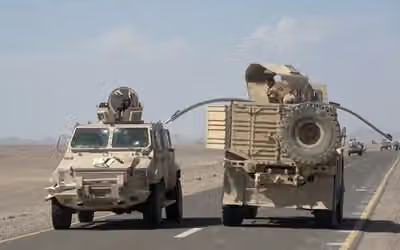
Iran made combat drones on display in this undated file photo

The United States on Wednesday imposed sanctions on more than 30 individuals, companies and vessels linked to Iran, escalating economic pressure a day before a third round of talks between Washington and Tehran in Geneva.

The Treasury Department said the measures target networks involved in Iranian oil exports as well as procurement channels supporting the country’s ballistic missile and advanced conventional weapons programs.

“Iran exploits financial systems to sell illicit oil, launder the proceeds, procure components for its nuclear and conventional weapons programs, and support its terrorist proxies,” Treasury Secretary Scott Bessent said.

“Under President Trump’s strong leadership, Treasury will continue to put maximum pressure on Iran to target the regime’s weapons capabilities and support for terrorism, which it has prioritized over the lives of the Iranian people.”

A significant portion of the designations focused on vessels operating in Iran’s so-called “shadow fleet,” which US officials say transports sanctioned petroleum to foreign markets.

Among them was the Panama-flagged HOOT, accused of shipping Iranian liquefied petroleum gas to Bangladesh in 2025, and the Barbados-flagged OCEAN KOI, which Treasury said has carried millions of barrels of Iranian fuel oil and condensate over the past year.

Treasury also designated individuals tied to Iran’s drone and missile infrastructure.

Mohammad Abedini and Mehdi Zand, employees of Qods Aviation Industries, were sanctioned for allegedly providing technical support in Russia for Iranian-designed Mohajer-series unmanned aerial vehicles.

Two other Qods Aviation employees—Mehrdad Jafari and Ebrahim Shariatzadeh—were cited for supporting UAV activities abroad, including in Venezuela.

In addition, companies in Türkiye and the United Arab Emirates were targeted for allegedly facilitating payments and procurement of sensitive machinery and missile precursor chemicals for entities linked to the Islamic Revolutionary Guard Corps’ aerospace arm.

The sanctions were imposed under multiple executive orders related to Iran’s energy sector and weapons proliferation, and form part of what the administration describes as a continuing campaign of maximum pressure.

The action comes as negotiators prepare to meet in Geneva on Thursday for what officials on both sides have described as a potentially pivotal round of discussions, amid reports that Washington has set informal timelines for progress.

Most Viewed

Trump says regime change in Iran will happen but not ‘immediately’
1

Trump says regime change in Iran will happen but not ‘immediately’

2
INSIGHT

Checkpoint attacks open new front in Iran war

3

Iran’s unseen new leader issues first message in writing

4
ANALYSIS

Iran raises ‘human shield’ fears by rallying supporters to the streets

5
EXCLUSIVE

Iran pays Lebanon parliament speaker $500,000 a month to maintain influence

Banner
Banner

Spotlight

  • Iran raises ‘human shield’ fears by rallying supporters to the streets
    ANALYSIS

    Iran raises ‘human shield’ fears by rallying supporters to the streets

  • Russia gains from Iran war but risks more if it drags on
    OPINION

    Russia gains from Iran war but risks more if it drags on

  • Allies rally, rivals brace after Mojtaba Khamenei’s rise
    INSIGHT

    Allies rally, rivals brace after Mojtaba Khamenei’s rise

  • Checkpoint attacks open new front in Iran war
    INSIGHT

    Checkpoint attacks open new front in Iran war

  • Power vs piety: Khamenei Jr inherits legitimacy dilemma of Iran's theocracy
    ANALYSIS

    Power vs piety: Khamenei Jr inherits legitimacy dilemma of Iran's theocracy

  • Can widening the war save Iran’s rulers?
    ANALYSIS

    Can widening the war save Iran’s rulers?

•
•
•

More Stories

China refiners turn to Russian oil as Iran faces rising uncertainty

Feb 25, 2026, 15:30 GMT
•
Dalga Khatinoglu

China appears to be replacing disrupted Venezuelan oil shipments with Russian crude rather than Iranian barrels, despite steeper discounts being offered by Tehran.

According to data from commodity intelligence firm Kpler, shared with Iran International, China discharged an average of 1.138 million barrels per day (bpd) of Iranian crude at its ports this month—about 115,000 bpd less than in January.

Separate figures from Vortexa show China’s average purchases of Iranian oil this month at just over 1.03 million bpd, marking a decline of 220,000 bpd compared to January.

The disruption began after a maritime blockade targeting Venezuelan tankers and the subsequent detention of former Venezuelan president Nicolás Maduro by US commandos on January 3. As a result, deliveries to China were interrupted, and several Chinese refiners halted purchases altogether.

Vortexa data indicate that Russian crude rapidly filled the gap.

This month, China received an average of 2.07 million bpd of Russian oil—370,000 bpd more than in January. Notably, this increase roughly matches Venezuela’s average crude exports to China in 2025, suggesting a near one-for-one replacement.

Supply stability

The decline in Iranian crude discharges comes despite a Reuters report that Iran is offering even deeper discounts than Russia to Chinese refiners.

This month, Iran is reportedly offering discounts of $10–11 per barrel on its light crude, roughly 16% of benchmark value and similar to those offered by Russia.

Beijing appears to be prioritizing supply stability over marginal price differences, given Iran’s uncertain trajectory amid ongoing nuclear talks and the shadow of potential military escalation.

China’s small independent refiners, known as “teapots,” are effectively the only buyers of sanctioned Iranian and Venezuelan oil. A significant portion of Russia’s crude exports to China also flows to these refiners.

Teapot refiners account for about 20% of China’s total crude imports. Unlike major state-owned refiners, they lack extensive strategic storage capacity and cannot rely on large internal inventories or risk sudden feedstock disruptions such as the Venezuelan supply shock.

Under these circumstances, relying on a relatively more stable supplier such as Russia appears commercially safer than depending on Iran, which currently faces escalating threats of potential US military action.

Almost a fifth of global crude consumption is transported through the Straits of Hormuz that Tehran has repeatedly warned it could close in the event of a major war.

Last year, the United States sanctioned 84% of the tankers involved in lifting Iranian crude. Those measures contributed to a decline in Iranian deliveries to Chinese refiners in the final months of the year, with the downward trend continuing into the current year.

US President Donald Trump signed an executive order imposing a 25% tariff on Iran’s trading partners in 2026. Given that China exported over $400 billion worth of goods to the United States in 2025, it is unlikely that Beijing will ignore the potential impact of such tariff threats.

Money is leaving Iran faster as oil income falls and uncertainty mounts

Feb 18, 2026, 16:50 GMT
•
Dalga Khatinoglu

Capital flight from Iran is accelerating just as oil revenues decline, according to new data from the Central Bank of Iran—a convergence that helps explain the sharp fall of the national currency in recent months.

Central bank (CBI) figures show that, even before accounting for sanctions-evasion costs or discounts offered to Chinese buyers, the nominal value of Iran’s oil exports fell about 10 percent to $30.7 billion in the first half of the current Iranian fiscal year, which began on March 21, 2025.

Additional CBI data show that the nominal value of Iran’s total exports—including oil, non-oil goods and services—reached about $59 billion in the first six months of the fiscal year, while imports totaled roughly $48 billion.

On paper, that left a trade surplus of $11 billion. Yet during the same period, nearly $15 billion in capital left the country. That’s a record outflow that more than offset the surplus.

The outflows appear to be intensifying as Iran remains suspended between uncertain nuclear negotiations and the persistent risk of military escalation.

Earlier this month, US Treasury Secretary Scott Bessent said Iranian leaders were “wiring money out of the country like crazy,” but did not offer any more details.

CBI does not specify how much revenue was lost through sanctions circumvention. But a member of parliament’s Budget and Planning Commission recently said Iran earned only $20 billion from oil exports in the first eight months of the fiscal year—far below the nominal value of shipments.

Put simply, Iran’s actual oil income over eight months was substantially lower than the nominal value of exports recorded over six months, pointing to significant losses through price discounts and restricted access to proceeds.

Even those reduced revenues have not fully reached the government. Last month, Gholamreza Tajgardoon, head of parliament’s Joint Budget Commission, said only $13 billion of the $20 billion in oil export earnings had actually been received.

The figures underscore a dual constraint: Iran is not only earning less from its oil exports but is also struggling to access the revenue it does generate, limiting its ability to finance imports or stabilize domestic markets.

The gap has forced the government to rely increasingly on domestic borrowing.

Central bank data show that by November 2025, government debt to the banking system had risen 41 percent from a year earlier, while its debt to the central bank surged 68 percent. Commercial banks’ own borrowing from the central bank rose 63 percent over the same period.

In effect, the state has compensated for lost oil income by drawing on the banking system and expanding the money supply. Liquidity—a key driver of inflation and currency depreciation—rose more than 40 percent in November 2025 compared with a year earlier.

The consequences are visible in the exchange rate. The rial has depreciated roughly 75 percent since February last year.

Taken together, declining oil revenues, restricted access to export proceeds, record capital flight and rapid monetary expansion are reinforcing one another.

The prolonged state of geopolitical limbo appears to be amplifying those pressures, encouraging businesses and elites alike to move assets abroad and leaving the economy increasingly exposed to further instability.

Tehran’s oil lifeline shows signs of strain under tightening sanctions

Feb 16, 2026, 01:00 GMT
•
Dalga Khatinoglu

Iran’s oil exports declined sharply at the start of 2026, new tanker-tracking data show, raising fresh questions about the durability of Tehran’s most important economic lifeline under renewed US sanctions pressure.

Crude oil loadings from Iran’s Persian Gulf terminals fell to below 1.39 million barrels per day in January, a 26 percent drop from a year earlier, according to data from commodity intelligence firm Kpler reviewed by Iran International.

The decline extends a steady downward trend since October, suggesting sustained pressure rather than a temporary disruption.

The slowdown is most visible in China, Iran’s primary—and effectively only—major oil buyer under sanctions. Daily discharges of Iranian crude at Chinese ports fell to 1.13 million barrels per day last month, down from an average of around 1.4 million barrels per day in 2025.

Unsold Iranian crude is also accumulating at sea. The volume of oil stored on tankers has nearly tripled over the past year to more than 170 million barrels, a sign that shipments are becoming harder to sell or deliver.

Keeping that oil afloat is costly. Chartering a Very Large Crude Carrier typically costs more than $100,000 per day, and tankers carrying sanctioned Iranian oil command even higher rates due to legal and insurance risks. Analysts estimate that roughly one-fifth of Iran’s oil revenue is effectively consumed by these transport and storage costs.

Much of the oil remains stranded in Asian waters. About one-third of Iranian tankers are anchored offshore, while others move continuously or conduct ship-to-ship transfers to evade sanctions enforcement—tactics that have become standard within Iran’s so-called shadow fleet.

Sanctions are increasingly targeting those networks. According to Kpler, 86 percent of the tankers transporting Iranian oil over the past year have themselves been sanctioned by the United States, highlighting the expanding scope of enforcement.

The pressure has forced Iran to offer steep discounts to maintain sales. Iranian crude is currently priced about $11 to $12 per barrel below comparable benchmarks, up from a discount of roughly $3 per barrel early last year, significantly reducing Tehran’s net income.

The decline extends beyond crude oil. Exports of petroleum products such as fuel oil fell to about 350,000 barrels per day in January, down from 410,000 barrels per day a year earlier, with China and the United Arab Emirates among the main buyers.

Additional pressure may be coming. President Donald Trump recently signed an executive order imposing a 25 percent tariff on trade partners of Iran, a measure that could further deter companies and countries from handling Iranian oil.

The mounting economic strain provides important context for renewed indirect talks between Washington and Tehran.

For Iran’s leadership, easing sanctions remains the most direct path to stabilizing oil revenues and relieving fiscal pressure. But deep differences over Iran’s nuclear program, missile development, and regional activities make an agreement unlikely unless one side decides to compromise on core demands.

Taken together, the data suggest that Iran’s ability to sustain oil exports under sanctions—long a cornerstone of its economic resilience—is becoming more constrained.

Iran to let basic goods importers sell oil under expanded barter scheme

Feb 15, 2026, 10:08 GMT

Iran will allow importers of basic goods to receive and sell oil cargoes from next year under an expanded barter scheme aimed at securing essential supplies, Agriculture Minister Gholamreza Nouri Ghezeljeh said on Sunday.

Under the new arrangement, companies that import staple goods will be introduced by the Agriculture Ministry to the Oil Ministry to receive oil shipments, which they will sell in order to finance their imports, he said.

“One of the good methods of supplying goods is barter with oil, and we have increased the ceiling for oil barter with basic goods imports,” Nouri Ghezeljeh said, according to IRIB.

He said the value of oil bartered for basic goods imports this year had been raised from $1 billion to $1.5 billion by year-end. The share allocated to basic goods and animal feed imports will increase further next year, alongside changes in the implementation method.

Previously, the Oil Ministry provided cargoes to oil traders, who sold the shipments and then arranged imports. From next year, importers themselves will be introduced to receive oil cargoes directly, he said.

Iran has increasingly relied on barter arrangements to secure essential goods amid US sanctions restricting its access to the global financial system.

Trump, Netanyahu agree to step up pressure on Iranian oil sales to China

Feb 15, 2026, 09:48 GMT

US President Donald Trump and Israeli Prime Minister Benjamin Netanyahu agreed at a White House meeting this week to increase economic pressure on Iran, including efforts to curb its oil exports to China, Axios reported.

The understanding, reached during talks on Wednesday, would form part of a renewed “maximum pressure” campaign running alongside indirect nuclear negotiations with Tehran, according to two US officials briefed on the discussions.

“We agreed that we will go full force with maximum pressure against Iran, for example, regarding Iranian oil sales to China,” a senior US official said.

China buys more than 80% of Iran’s oil exports, making it Tehran’s main source of crude revenue. Any significant reduction in those purchases would sharply increase economic strain on Iran and could affect its calculations in nuclear talks with Washington.

An executive order signed by Trump earlier this month allows the administration to expand economic measures against Iran. The order authorizes the secretaries of state and commerce to recommend tariffs of up to 25% on countries that conduct business with Iran.

Such steps could further complicate already tense US-China relations. Beijing said on Sunday that “normal cooperation between countries conducted within the framework of international law is reasonable and legitimate, and should be respected and protected,” when asked about the reported discussions.

US officials said the pressure campaign would proceed in parallel with diplomacy and a US military buildup in the Middle East, as Washington prepares contingency plans in case negotiations fail.

Behind closed doors, Trump and Netanyahu agreed on the objective of preventing Iran from acquiring nuclear weapons capability, one US official said. However, they differed on strategy.

Netanyahu argued that it was impossible to secure a reliable agreement with Iran and that Tehran would not abide by any deal, the official said.

Trump said he believed there was still a chance to reach an agreement.

“We’ll see if it’s possible. Let’s give it a shot,” Trump said, according to the official.

Trump has tasked advisers Steve Witkoff and Jared Kushner with leading the talks. The two are scheduled to meet Iranian officials in Geneva on Tuesday for a second round of negotiations, after earlier contacts mediated by Oman.

A US official said Witkoff recently conveyed messages to Tehran through Oman’s foreign minister and that Washington expects an Iranian response at the Geneva meeting.

“We are sober and realistic about the Iranians. The ball is in their court. If it is not a real deal, we will not take it,” one US official said. Another said he believed there was “zero chance” that either side would accept the other’s core demands.

US and Iranian diplomats held indirect talks through Omani mediators last week in an effort to revive diplomacy over Iran’s nuclear program.