China refiners turn to Russian oil as Iran faces rising uncertainty

China appears to be replacing disrupted Venezuelan oil shipments with Russian crude rather than Iranian barrels, despite steeper discounts being offered by Tehran.

China appears to be replacing disrupted Venezuelan oil shipments with Russian crude rather than Iranian barrels, despite steeper discounts being offered by Tehran.
According to data from commodity intelligence firm Kpler, shared with Iran International, China discharged an average of 1.138 million barrels per day (bpd) of Iranian crude at its ports this month—about 115,000 bpd less than in January.
Separate figures from Vortexa show China’s average purchases of Iranian oil this month at just over 1.03 million bpd, marking a decline of 220,000 bpd compared to January.
The disruption began after a maritime blockade targeting Venezuelan tankers and the subsequent detention of former Venezuelan president Nicolás Maduro by US commandos on January 3. As a result, deliveries to China were interrupted, and several Chinese refiners halted purchases altogether.
Vortexa data indicate that Russian crude rapidly filled the gap.
This month, China received an average of 2.07 million bpd of Russian oil—370,000 bpd more than in January. Notably, this increase roughly matches Venezuela’s average crude exports to China in 2025, suggesting a near one-for-one replacement.
Supply stability
The decline in Iranian crude discharges comes despite a Reuters report that Iran is offering even deeper discounts than Russia to Chinese refiners.
This month, Iran is reportedly offering discounts of $10–11 per barrel on its light crude, roughly 16% of benchmark value and similar to those offered by Russia.
Beijing appears to be prioritizing supply stability over marginal price differences, given Iran’s uncertain trajectory amid ongoing nuclear talks and the shadow of potential military escalation.
China’s small independent refiners, known as “teapots,” are effectively the only buyers of sanctioned Iranian and Venezuelan oil. A significant portion of Russia’s crude exports to China also flows to these refiners.
Teapot refiners account for about 20% of China’s total crude imports. Unlike major state-owned refiners, they lack extensive strategic storage capacity and cannot rely on large internal inventories or risk sudden feedstock disruptions such as the Venezuelan supply shock.
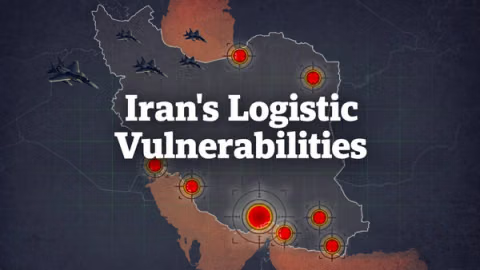
Under these circumstances, relying on a relatively more stable supplier such as Russia appears commercially safer than depending on Iran, which currently faces escalating threats of potential US military action.
Almost a fifth of global crude consumption is transported through the Straits of Hormuz that Tehran has repeatedly warned it could close in the event of a major war.
Last year, the United States sanctioned 84% of the tankers involved in lifting Iranian crude. Those measures contributed to a decline in Iranian deliveries to Chinese refiners in the final months of the year, with the downward trend continuing into the current year.
US President Donald Trump signed an executive order imposing a 25% tariff on Iran’s trading partners in 2026. Given that China exported over $400 billion worth of goods to the United States in 2025, it is unlikely that Beijing will ignore the potential impact of such tariff threats.