Craig and Lindsay Foreman, a British couple sentenced to 10 years in prison on espionage charges in Iran, said they would begin a hunger strike on March 4, accusing authorities of violating the country’s constitution.


In a message from Tehran's Evin prison, the couple said they would reach fourteen months in detention on March 4, 2026, and vowed to continue their hunger strike until they are freed.
The Foremans, both in their 50s, were arrested in January 2025 while on a motorcycle trip through Iran. Their family says they had valid visas, a licensed guide and an approved itinerary. They deny the espionage charges.
In their letter, the couple said their detention violates Iran’s own constitution, citing Article 39, which guarantees dignity, and Article 37, which presumes innocence.
They described being summoned on January 24, 2025, for questioning.
“We were then aggressively bundled into the back of an unmarked car… We were blindfolded and aggressively maneuvered to a 2.5-meter square dirty, furniture-less cell, after stripping naked and given prison clothes to wear,” they wrote.
‘No explanation’
They said they received “no explanation, no information” and were held in solitary confinement for 56 days, spending up to nearly 24 hours a day alone.
Within 24 hours, they said, interrogators told them: “We know you are a spy, no one is coming to save you, and we will show you how bad we can be unless you cooperate fully.”
The couple said repeated requests to choose their own lawyer were denied. Their first court-appointed lawyer met them more than three months after their arrest and submitted a defense letter “declaring our innocence."
‘No proof’
Lindsay Foreman said she was repeatedly questioned about her personal beliefs.
“I was told I was a Jew, I was told I was a feminist, I was told I supported Israel, and I was told I thought that Iran was dark,” she wrote.
On July 29, 2025, they said they were informed they had been convicted of espionage “with no accompanying proof and no trial.”
The only evidence presented against her, Lindsay Foreman said, was “a photo of a conference pass for the European Positive Psychology Conference, showing the name of a man who may have been from Israel.”
“For Craig, there is no evidence whatsoever,” they wrote. “We’ve had no justice in the seven months since our first court session.”
Britain’s foreign secretary, Yvette Cooper, called their sentence “completely appalling and totally unjustifiable,” pledging to pursue the case “relentlessly” until they are returned to the UK.
Senior Iranian clerics used Friday Prayers to attack the course of negotiations with Washington and issue warnings of retaliation, as a major US military buildup in the region fuels fears of renewed conflict.
Tehran’s interim Friday prayer leader said on Friday that Israel is “unwilling to attack Iran” after the “12-day war,” saying the episode showed Iran’s strength.
Mohammad Hassan Aboutorabi Fard said the experience of the 12-day conflict meant that “the Zionists are seriously preventing aggression against Iran,” because they fear war and “know they have no defense shield against Iran’s power.”
Aboutorabi argued that the confrontation last year, which included US strikes on Iranian nuclear sites during Israel’s 12-day campaign, altered the regional balance. He linked that assessment to the current round of talks with Washington, saying negotiations are unfolding within a broader strategy set by Supreme Leader Ali Khamenei.

“These negotiations are one of the important issues that have affected the political atmosphere of the world, the region and the country,” Aboutorabi said. “The strategy determined by the Supreme Leader has enabled the effective and commanding presence of the diplomatic teams on the international stage.”
Negotiations, he said, are advancing in close connection with active diplomacy, nuclear policy and military capability, arguing that continued threats from the United States would be costly and unproductive.
The rhetoric comes as Washington expands its military presence in the Middle East. US officials say 13 warships are now deployed in the region, including the aircraft carrier USS Abraham Lincoln, supported by destroyers and littoral combat ships. A second carrier, the USS Gerald R. Ford, is en route with additional escorts. Fighter jets and refueling aircraft have also been repositioned.
US media also reported that American forces could be ready to launch strikes within days, although President Donald Trump has not announced a final decision. Trump has repeatedly warned that military action remains an option if talks fail to produce a new agreement to replace the 2015 nuclear deal he withdrew from in 2018.
White House Press Secretary Karoline Leavitt said there had been “a little bit of progress” in Iran talks held in Geneva but acknowledged that significant gaps remain. She added that there are “many reasons and arguments” for a potential strike and said Iran would be “very wise” to reach a deal.
Hardline messaging from provinces
In Mashhad, Friday Prayer leader Ahmad Alamolhoda questioned the value of negotiations, saying if talks result in what he described as a “wrong and foolish” outcome, their course must be tightly defined.
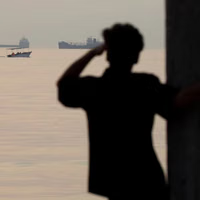
Alamolhoda threatened that Iran can close the Strait of Hormuz, pointing to what he described as a “heroic exercise” there and warning that Tehran has the ability to shut the strategic waterway and “entangle and exhaust the world.”
“That is the message,” he said. “This is who we are. Can you confront us? Can you match us?”
In Karaj, cleric Mohammad Mahdi Hosseini Hamedani referred to the unveiling of a hypersonic missile by the Islamic Revolutionary Guards Corps, saying its speed and multiple-warhead capability sent a message to Iran’s adversaries. The United States, not Iran, is in greater need of negotiations, he said.
Separately, Iranian lawmaker Amir Hayat Moghaddam said it is possible that a US warship could be sunk and American forces captured if war breaks out, warning that Iran would respond forcefully to any attack.
“If the Americans attack, we will immediately give a crushing response,” Moghaddam told Didban Iran.
Moghaddam, a member of parliament’s national security and foreign policy commission, said Iran could target all US bases in the region and that any response would not be “limited or symbolic.”
“In case of war, we can harm American forces, whether soldier or general,” he said, adding that Iran could also target the United States itself, including “the palace of Trump.”
At the same time, parliamentarian Salar Velayatmadar sought to temper alarm over US naval deployments, saying the proximity of American vessels does not automatically signal war. Such movements, he said, do not necessarily indicate imminent conflict, even as he warned that US bases in the region remain within Iran’s reach.
Araghchi pushes back on zero enrichment reports
Meanwhile, Iran’s Foreign Minister Abbas Araghchi said on Friday that the United States has not asked Tehran to permanently halt uranium enrichment, countering reports that Washington was demanding zero enrichment as a condition for a deal.
Speaking on MSNBC’s Morning Joe, Araghchi described recent talks in Geneva as “constructive” and said both sides had agreed on guiding principles for a possible agreement.
“The US side has not asked for zero enrichment,” Araghchi said, adding that Iran had not offered to suspend enrichment either.
“What we are now talking about is how to make sure that Iran’s nuclear program, including enrichment, is peaceful and would remain peaceful forever,” he said.
Araghchi said there was “no military solution” to Iran’s nuclear program and that diplomacy remained the only viable path forward, though he added that Iran was prepared for both negotiation and war.
According to Araghchi, the two sides have agreed to begin drafting a framework for a potential agreement at their next meeting, calling it “a normal way of any international negotiations.”
He also warned that if Iran were attacked again, it would defend itself, saying that after the previous 12-day conflict its “enemies had no way but to ask for an unconditional ceasefire.”
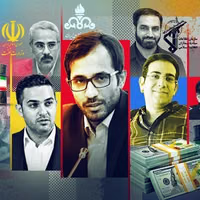
Three Iranians working as engineers in Silicon Valley were charged with stealing sensitive trade secrets from leading US technology firms and transferring confidential data to unauthorized locations, including Iran, US authorities said on Thursday.
A federal grand jury in the Northern District of California indicted Samaneh Ghandali, 41, Mohammadjavad Khosravi, 40, and Soroor Ghandali, 32, on counts including conspiracy to commit trade secret theft, theft and attempted theft of trade secrets, and obstruction of justice. The three, all residents of San Jose, were arrested and made initial court appearances on Thursday.
According to the indictment, the defendants gained employment at major technology companies involved in developing mobile computer processors. Samaneh Ghandali and her sister Soroor Ghandali worked at Google before moving to another firm identified as Company 3, while Khosravi, who is married to Samaneh Ghandali, worked at a separate company identified as Company 2.
Prosecutors allege the defendants used their positions to access confidential information, including trade secrets related to processor security and cryptography. The indictment says they transferred hundreds of sensitive files to unauthorized third-party platforms, personal devices, and work devices linked to each other’s employers, as well as to Iran.
“As alleged, the defendants exploited their positions to steal confidential trade secrets from their employers,” United States Attorney Craig H. Missakian said. “Our office will continue to lead the way in protecting American innovation and we will vigorously prosecute individuals who steal sensitive advanced technologies for improper gain or to benefit countries that wish us ill.”
FBI Special Agent in Charge Sanjay Virmani described the alleged conduct as a “calculated betrayal of trust,” saying the defendants took deliberate steps to evade detection, including submitting false affidavits and manually photographing computer screens to avoid digital tracking.
The indictment also details travel to Iran in December 2023, when prosecutors say some of the exfiltrated material was accessed from a personal device.
If convicted, each defendant faces up to 10 years in prison for each trade secret-related count and up to 20 years for obstruction of justice.
Iran’s Revolutionary Guards intelligence chief has confirmed he is driving efforts to tighten restrictions on social media, linking the initiative directly to the country’s security apparatus and the expansion of the so-called “national internet.”
Majid Khademi, head of intelligence for the Islamic Revolutionary Guard Corps (IRGC), said in an interview published on February 19 that a total ban on foreign social media platforms is intended to “prevent enemy plots and immunize Iranians against them.”
He also revealed that Supreme Leader Ali Khamenei had tasked him with overseeing the expansion of Iran’s domestic intranet, often referred to as the “national internet,” and stressed the importance of what he described as “proper governance of the Internet.”
“Sianat”—meaning protection—is the term Iranian officials use to describe legislation aimed at restricting social media under the stated goal of shielding citizens from perceived dangers.
The original proposal, often referred to as Sianat-1, was approved by parliament in March 2022 but implementation was halted shortly afterward amid concerns among senior officials that sweeping restrictions could provoke public backlash.
Since then, the bill has remained under discussion among parliament, the Guardian Council and the Supreme National Security Council.
Targeting platforms
Despite the absence of a comprehensive ban, access to major platforms remains restricted, with most users relying on virtual private networks (VPNs). Recent media reports suggest that WhatsApp, which had previously been accessible, has faced renewed restrictions, while authorities continue expanding policies granting limited access to selected users.
In recent weeks, Iranian media outlets have reported renewed efforts to advance what has been informally described as “Sianat-2,” a broader initiative aimed at strengthening state oversight of online activity and expanding domestic internet infrastructure.
Leaked information cited by Iranian media suggests audiovisual content on platforms such as Instagram, YouTube and Telegram could face tighter regulation, potentially placing greater authority in the hands of state institutions including the Islamic Republic of Iran Broadcasting (IRIB), which holds a legal monopoly over broadcasting.
‘Urban terrorism’
Authorities imposed a near-total internet blackout during the widespread protests of January 8 and 9, cutting off access to global platforms and isolating much of the country digitally.
The shutdown coincided with a violent crackdown in which human rights organizations and independent media reported large numbers of protesters killed, injured and detained.
Khademi framed such measures as necessary to counter foreign threats. He accused outside actors of attempting to spread instability, encourage “urban terrorism,” and undermine public trust in the government, though he did not provide evidence.
“These platforms are used to organize and guide hostile activities,” he said, adding that Khamenei had instructed him: “Do not forget the proper governance of the Internet.”
The blackout in January highlighted the central role of internet controls in Iran’s response to political unrest—a strategy that officials have increasingly framed as a matter of national security.
Khademi’s confirmation of the IRGC’s leadership role underscores the extent to which internet governance has become integrated into Iran’s broader security strategy.
Iranian courts sentenced Christians to more than 280 years in prison in 2025, according to a joint report by four rights groups, in what advocates describe as a widening use of national security laws to suppress religious dissent.
The findings reveal a sharp escalation in repression as authorities increasingly label those who leave Islam as "security threats" and "Mossad mercenaries" following regional conflicts.
The report, titled "Scapegoats" and released on Thursday, documents 254 arrests in 2025, nearly double the number recorded the previous year. Rights advocates say the surge reflects a strategic shift by the Islamic Republic to use national security frameworks to crush religious dissent.
"The Islamic Republic is a religious apartheid state where non-recognized minorities like Christian converts are not considered citizens but just 'ghosts' in the eyes of the regime," said Fred Petrossian, an Iranian-Armenian researcher and journalist specializing in religious minorities, based in Brussels, who collaborates with Article 18.
The study was a collaborative effort by Article 18, Open Doors, Middle East Concern (MEC), and Christian Solidarity Worldwide (CSW).

Regional tensions fuel domestic raids
The report describes the 12-day war with Israel in June 2025 as a "pivotal moment" for domestic targeting. In the single month following the June 24 ceasefire, at least 54 Christians were detained across 19 cities.
Petrossian told Iran International that the state has moved to "choke the freedoms" of converts by framing their faith as an extension of foreign hostility.
"A religious holiday becomes criminalized when it represents both faith and collective identity outside state-approved boundaries," Petrossian said.
He pointed specifically to Christmas, which in recent years has gained wide popularity among ordinary Iranians despite official disapproval from clerics.
Shops in major cities openly sell Christmas trees and decorations, cafés display festive themes, and large crowds, many of them Muslims, gather outside churches such as those in Tehran and Isfahan.
Authorities, however, often respond to private Christmas gatherings of converts with raids, arrests, and intimidation.
Petrossian added that the struggle for Christian freedom in Iran is inseparable from the broader fight for human rights and civil liberties for all citizens.
He said that at least 19 Christians have lost their lives in the recent violence and unrest, reflecting how deeply intertwined religious persecution is with the wider crackdown affecting the Iranian society.
Authorities have increasingly weaponized Article 500 bis of the penal code, which criminalizes "propaganda contrary to the holy religion of Islam". The report found that nearly 90% of all charges against Christians in 2025 were brought under this amended article, which carries sentences of up to 10 years.
Systematic mistreatment in detention
The report paints a horrifying picture of the conditions faced by converts in the Iranian prison system, including psychological torture and the deliberate denial of healthcare.


The 'two-tier' propaganda machine
Petrossian pointed to a "two-tier" system where the state uses recognized ethnic Christians, such as those of Armenian or Assyrian descent, to project an image of tolerance while criminalizing the larger community of converts.
While ethnic Christians may worship in their own languages, they are strictly prohibited from preaching in Persian or welcoming converts.
"Recognition does not mean they have all rights," Petrossian said. "The moment members of these communities do not follow the state’s red line, they face repression similar to that experienced by converts."
The Islamic Revolutionary Guard Corps (IRGC) has taken an increasing role in these crackdowns, often acting with more brutality than traditional intelligence agencies.
In February, 20 plainclothes IRGC agents raided a gathering in Gatab – a town in Mazandaran province where they reportedly tore cross necklaces off several people and blocked emergency medical personnel from assisting the injured.
"IRGC agents go to homes without a legal warrant and arrest people. They say obscene and offensive things and insult and humiliate them," one convert testified in the report.
Petrossian added that the state’s efforts to control even personal life create a "dystopian system" where religious holidays like Christmas are criminalized because they represent a "collective identity outside state-approved boundaries".
The report concludes by calling on the international community to hold Iran accountable under Article 18 of the ICCPR, which guarantees the freedom to adopt and practice a faith of one's choosing.
A British couple detained in Iran have been sentenced to 10 years in prison on espionage charges, their family said on Thursday, prompting renewed calls on London to secure their release.
Lindsay and Craig Foreman, both in their 50s, were arrested in January 2025 while on a motorcycle trip through Iran. They deny the charges.
The couple were tried in October at Branch 15 of Tehran’s Revolutionary Court and were not allowed to present a defense, according to their son, Joe Bennett. A judge delivered the verdict in recent days, the family told BBC.
“We are deeply concerned about their welfare,” Bennett said, urging the British government to “act decisively and use every available avenue” to bring them home.
He said Iranian authorities had presented no evidence of espionage and that their lawyers had been told there was no legal basis for the case. Applications for bail were ignored, he added.
Foreign Secretary Yvette Cooper has decried their sentence as "completely appalling and totally unjustifiable".
"We will pursue this case relentlessly with the Iranian government until we see Craig and Lindsay Foreman safely returned to the UK and reunited with their family," she said.
Britain’s Foreign, Commonwealth and Development Office has previously said it was “deeply concerned” by the couple’s detention and that it continued to raise the case directly with Iranian authorities.
The Foremans are being held in separate wings of Tehran’s Evin prison, which rights groups have long criticized over alleged torture and inhumane conditions.
Bennett has said the couple endured 13 months in dire conditions, surrounded by “dirt, vermin, and violence,” and that they had been losing weight.
In November, Bennett said his mother had begun a hunger strike inside Evin, telling him during a brief phone call that “not eating was the only power she’s got.”
The couple were first detained in the southeastern city of Kerman, where they spent 30 days in solitary confinement before being transferred to Tehran, the family has said. They had entered Iran with valid visas, a licensed guide and a cleared itinerary, Bennett added.
Rights groups and Western governments have long accused Iran of engaging in so-called “hostage diplomacy” by detaining foreign nationals to gain political or economic concessions, an allegation Tehran rejects, saying it faces Western intelligence infiltration.