Sam Afshari, 17, was shot during protests in Karaj and later killed in hospital, according to his father, who says security forces fired the fatal shot.
The breathing tube was already in his mouth when, according to his father, the final shot was fired. It is one of many accounts emerging from Iran’s January protest crackdown.
Seventeen-year-old Sam Afshari had been taken to Madani Hospital in Karaj, near Tehran, after being shot on January 8 during protests near Mehran Square in the city’s Azimieh district. Witnesses later told his family that doctors were attempting to save him and that he was still conscious when asked his name.
“He had the breathing tube in his mouth. They came and shot him. A final bullet,” his father, Parviz Afshari, told Iran International’s English podcast Eye for Iran.
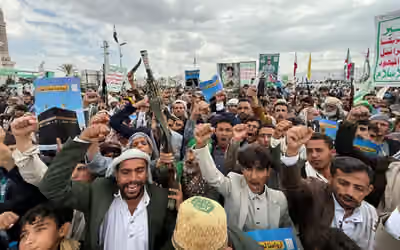
That day, protests spread across Iran as demonstrators took to the streets demanding an end to the Islamic Republic. Sam was among them.
“They went for a free Iran,” Parviz said. “They went out to protest with bare hands. But they returned to their families with bullets in the back of the head and bullets in the back.”
Sam was his only child—an unimaginable loss, his father said, that many Iranian families are now struggling to understand and explain.
Sam Afshari as a toddler in Iran.
Sam was born in 2008 in Karaj and had turned 17 just weeks before his death. He was studying computer networks and hoped to continue his education abroad.
“This year he was supposed to come here so we could sort out his papers,” his father said, speaking from Germany. “He wanted to continue his studies, go to university and study computer engineering.”
His father described him as cheerful and ambitious.
“He joked a lot. We laughed so much,” Afshari said. “We were always in video contact, talking about the future.”
“I don’t think he went out because of poverty,” he added. “He went out because of his beliefs. He wanted democracy and the right to speak his mind.”
According to accounts later gathered by the family, Sam was shot from behind near a security police post at Mehran Square. Residents in a nearby apartment building attempted to pull the wounded teenager into their parking area to protect him.
Security forces arrived shortly afterward and took him away, his father said.
“They took my child with them.”
A hospital employee later informed the family that Sam had been transported to Madani Hospital along with other injured protesters. Witnesses told relatives that when medical staff asked his name, he answered “Sam,” indicating he was still conscious.
Hours later, he was dead.
"At the hospital they finished him off with a shot to the back of the head. The bullet came out through his cheek," Parviz said.
Because internet access had been cut during the unrest, Afshari said he did not learn what had happened until days later, when communication was briefly restored. Family members searched hospitals and morgues before his brother located the name “Sam Afshari” on a list of the dead at Beheshte Sakineh morgue in Karaj.
When Sam’s mother was brought to identify the body, she initially could not recognize him because of severe injuries.
“One side of my child’s face was destroyed,” Afshari said. “The back of his head too.”
She confirmed his identity only after asking officials to uncover a tattoo on his chest bearing the word “Mother” written in Latin script.
“When they saw the tattoo, they realized, yes, tragically — it was Sam.”
According to the family, authorities initially ordered that Sam be buried quietly at night in a remote area. After negotiations and payments, relatives secured permission to bury him closer to Karaj, but cemetery space was scarce.
“There were so many graves,” his father said. “They said there was simply no space.”
At Kalak-e Bala cemetery in Karaj, Sam was buried above another young protester because burial plots were already filled.
“Under his grave there is another martyr, Amir Bayati, and above is my son, Sam Afshari,” Afshari said.
Relatives described morgue halls crowded with bodies and refrigerated trucks waiting outside — scenes they said reflected the scale of deaths families were confronting in the days after the crackdown.
'He wanted a free Iran'
As the interview continued, Afshari’s grief gave way to anger and appeals for accountability.
“This is no longer the time for my tears. Now I feel rage,” he said. “If nothing happens, the blood of our children will be trampled. Our people—90 million human beings—are now hostages. Hostages of the Islamic Republic.”
He urged the international community not to remain silent. “The terrorist Islamic Republic must be brought to an end,” he said.
Throughout the interview, he returned repeatedly to the future his son never had.
“He had so many dreams, and I had so many dreams for him,” he said. “We buried this child with thousands of dreams.”
For Afshari, the story ends where it began—with a teenager who left home hoping for a different future. “He went for a free Iran,” his father said. “And we buried him instead.”
A Revolutionary Court in Tehran has sentenced seven protesters, including a 19-year-old, to death after accusing them of setting fire to a Basij base during nationwide protests in January, according to documents reviewed by Iran International.
The sentences were issued on February 6, the source said, despite the defendants’ claims that they were trapped inside the building after it was set ablaze.
Mohammad Amin Biglari, 19, and six other men were convicted of arson of public property, “corruption on earth,” collusion against national security, and “enmity against God”—capital charges under Iranian law.
The others sentenced to death are Shahin Vahedparast Kalur, Shahab Zohdi, Abolfazl Salehi Siavashani, Amirhossein Hatami, Yaser Rajaeifar and Ali Fahim.
Their lawyer, Hassan Aghakhani, told the Emtedad news outlet that the defendants were tried jointly before Judge Abolghasem Salavati, who is under US sanctions, and received the maximum punishment.
Aghakhani said he had been denied access to the case file and that it remained unclear what confession his client was alleged to have made.
19-year-old Mohammadamin Biglari
State television previously aired what it described as confessions by several detainees. In the broadcast, men with blurred faces and closely shaved heads said they had entered the building but did not set it on fire and were trapped inside after others ignited the entrance, blocking their exit.
The charges stem from a January 7 fire at the Kaveh Basij Base near Namjoo Street in eastern Tehran.
Two eyewitnesses who spoke to Iran International said they saw several men set motorcycles ablaze outside the base before others were pushed inside and the entrance was set on fire. One witness said security forces were present but did not intervene.
Iran International cannot independently verify these accounts.
Biglari, who works at a men’s hair salon, was arrested on January 7 and is being held in Qezel Hesar prison, according to information received by Iran International. The detention conditions of the other six defendants remain unclear.
Iran’s judiciary has previously announced thousands of indictments linked to arrests made during the January protests.
Craig and Lindsay Foreman, a British couple sentenced to 10 years in prison on espionage charges in Iran, said they would begin a hunger strike on March 4, accusing authorities of violating the country’s constitution.
In a message from Tehran's Evin prison, the couple said they would reach fourteen months in detention on March 4, 2026, and vowed to continue their hunger strike until they are freed.
The Foremans, both in their 50s, were arrested in January 2025 while on a motorcycle trip through Iran. Their family says they had valid visas, a licensed guide and an approved itinerary. They deny the espionage charges.
In their letter, the couple said their detention violates Iran’s own constitution, citing Article 39, which guarantees dignity, and Article 37, which presumes innocence.
They described being summoned on January 24, 2025, for questioning.
“We were then aggressively bundled into the back of an unmarked car… We were blindfolded and aggressively maneuvered to a 2.5-meter square dirty, furniture-less cell, after stripping naked and given prison clothes to wear,” they wrote.
‘No explanation’
They said they received “no explanation, no information” and were held in solitary confinement for 56 days, spending up to nearly 24 hours a day alone.
Within 24 hours, they said, interrogators told them: “We know you are a spy, no one is coming to save you, and we will show you how bad we can be unless you cooperate fully.”
The couple said repeated requests to choose their own lawyer were denied. Their first court-appointed lawyer met them more than three months after their arrest and submitted a defense letter “declaring our innocence."
‘No proof’
Lindsay Foreman said she was repeatedly questioned about her personal beliefs.
“I was told I was a Jew, I was told I was a feminist, I was told I supported Israel, and I was told I thought that Iran was dark,” she wrote.
On July 29, 2025, they said they were informed they had been convicted of espionage “with no accompanying proof and no trial.”
The only evidence presented against her, Lindsay Foreman said, was “a photo of a conference pass for the European Positive Psychology Conference, showing the name of a man who may have been from Israel.”
“For Craig, there is no evidence whatsoever,” they wrote. “We’ve had no justice in the seven months since our first court session.”
Britain’s foreign secretary, Yvette Cooper, called their sentence “completely appalling and totally unjustifiable,” pledging to pursue the case “relentlessly” until they are returned to the UK.
Iran’s Revolutionary Guards intelligence chief has confirmed he is driving efforts to tighten restrictions on social media, linking the initiative directly to the country’s security apparatus and the expansion of the so-called “national internet.”
Majid Khademi, head of intelligence for the Islamic Revolutionary Guard Corps (IRGC), said in an interview published on February 19 that a total ban on foreign social media platforms is intended to “prevent enemy plots and immunize Iranians against them.”
He also revealed that Supreme Leader Ali Khamenei had tasked him with overseeing the expansion of Iran’s domestic intranet, often referred to as the “national internet,” and stressed the importance of what he described as “proper governance of the Internet.”
“Sianat”—meaning protection—is the term Iranian officials use to describe legislation aimed at restricting social media under the stated goal of shielding citizens from perceived dangers.
The original proposal, often referred to as Sianat-1, was approved by parliament in March 2022 but implementation was halted shortly afterward amid concerns among senior officials that sweeping restrictions could provoke public backlash.
Since then, the bill has remained under discussion among parliament, the Guardian Council and the Supreme National Security Council.
Targeting platforms
Despite the absence of a comprehensive ban, access to major platforms remains restricted, with most users relying on virtual private networks (VPNs). Recent media reports suggest that WhatsApp, which had previously been accessible, has faced renewed restrictions, while authorities continue expanding policies granting limited access to selected users.
In recent weeks, Iranian media outlets have reported renewed efforts to advance what has been informally described as “Sianat-2,” a broader initiative aimed at strengthening state oversight of online activity and expanding domestic internet infrastructure.
Leaked information cited by Iranian media suggests audiovisual content on platforms such as Instagram, YouTube and Telegram could face tighter regulation, potentially placing greater authority in the hands of state institutions including the Islamic Republic of Iran Broadcasting (IRIB), which holds a legal monopoly over broadcasting.
‘Urban terrorism’
Authorities imposed a near-total internet blackout during the widespread protests of January 8 and 9, cutting off access to global platforms and isolating much of the country digitally.
The shutdown coincided with a violent crackdown in which human rights organizations and independent media reported large numbers of protesters killed, injured and detained.
Khademi framed such measures as necessary to counter foreign threats. He accused outside actors of attempting to spread instability, encourage “urban terrorism,” and undermine public trust in the government, though he did not provide evidence.
“These platforms are used to organize and guide hostile activities,” he said, adding that Khamenei had instructed him: “Do not forget the proper governance of the Internet.”
The blackout in January highlighted the central role of internet controls in Iran’s response to political unrest—a strategy that officials have increasingly framed as a matter of national security.
Khademi’s confirmation of the IRGC’s leadership role underscores the extent to which internet governance has become integrated into Iran’s broader security strategy.
Pressure by Iranian authorities on women footballers has intensified following resignations from the national team in protest at the quashing of nationwide protests with deadly force, people familiar with the matter told Iran International.
Security forces have used threats against players’ families and relatives, contract deductions and exclusion from team training to silence top-league players, sources said.
Authorities have also sought to pressure athletes by offering inducements to some individuals to monitor their teammates, while female players have been threatened with judicial action and long prison sentences if they express support for the protests, the sources added.
Football federation officials have meanwhile warned players that reacting publicly to the killings could result in multi-year bans from professional football activity, according to the sources.
The measures are aimed at preventing women footballers from expressing solidarity with the protests or participating in related commemorations, the sources said.
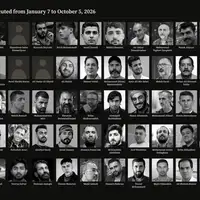
The pressure campaign follows the resignations of two players from Iran’s women’s national football team — Zahra Alizadeh and Kosar Kamali — in protest at the crackdown on nationwide protests in early January which left at least 36,500 dead.
Alizadeh, a national team player who competes for top-flight club Gol Gohar Sirjan, was the first athlete to step down from the squad. Kamali, a player for Ista, later announced her withdrawal from the national team in a social media post.
Niloufar Mirkarimi, a futsal referee operating under Iran’s football federation, also resigned from officiating, widening the protest beyond players to officials within the sport.
Posts announcing the resignations of Alizadeh and Kamali were removed from their Instagram pages hours after publication, according to people familiar with the matter.
Any protest-related posts or social media stories published by players have faced immediate security repercussions, the sources added.
Iran is entering a phase of persistent unrest, driven by decentralized “minor triggers” and deepening economic and legitimacy pressures that repression alone may no longer contain, senior analysts said at Iran International's townhall in Washington DC.
Iran experienced in January its most widespread and sustained unrest since the founding of the Islamic Republic, as protests spread across cities and provinces and authorities responded with an escalating crackdown that analysts say reflects a deepening crisis of legitimacy at the core of the state.
Speaking during a special Iran International Insight town hall on Wednesday, experts said the scale, persistence and decentralization of the unrest signal a structural rupture between state and society - one repression alone may no longer be able to contain.
In what participants described as one of the harshest security responses in recent years, tens of thousands have been killed, detained or interrogated. Rather than restoring order, panelists argued, the severity of the crackdown underscores mounting anxiety within the leadership about the durability of its authority.
A widening legitimacy gap
Political scientist Mohammad Ghaedi said each protest cycle deepens what he described as a structural legitimacy deficit.
“In democracies, when we ask why leaders should rule, the answer is because they are elected by the nation,” he said. “But if you ask that question of Iranians, there is no clear answer — because 47 years ago, Ayatollah Khomeini deceived the nation.”
According to Ghaedi, the leadership is fully aware of this vulnerability.
“They have to respond in a way that makes the nation unwilling to protest again. That explains the brutality of the repression,” he said.
From mega-triggers to permanent volatility
Bozorgmehr Sharafedin, a senior Iran analyst and Head of Digital at Iran International, said the protest landscape has fundamentally shifted.
“Iranian society has wisely moved from demonstrations triggered by mega-triggers to minor triggers,” he told the panel moderated by Gelareh Hon. “Minor triggers are very difficult for the government to contain because they're not centralized, they're unpredictable and they're emotionally charged.”
Instead of singular catalytic events driving nationwide mobilization, grievances now simmer across economic, social and political spheres — producing recurring, localized flare-ups that strain security forces and steadily erode the state’s ability to project control.
Sharafedin framed the crisis around three central actors: Ali Khamenei, Donald Trump and the Iranian public.
“The social contract between Khamenei and the people has expired,” he said. “Either the Supreme Leader reaches a deal with Trump at the expense of the people, or Trump sides with the people against the Islamic Republic. In both scenarios, Khamenei loses,”
Economic hardship and ideological erosion
Mohammad Machine-Chian, a senior journalist at Iran International and a former researcher at the University of Pittsburgh, argued that the unrest reflects both deep economic distress and mounting ideological rejection.
“Demanding a normal material life is in and of itself a rejection of Khomeinism — the whole ideology of the Islamic Republic, which prescribes abandonment of material life and demands sacrifice for the state” he said.
He cited soaring prices as a daily pressure reshaping public sentiment.
“Inflation is nearly 60%. Food inflation is about 72%. If we go deeper, it gets uglier — cooking oil around 200%, and red meat over 100%. This is the reality people are dealing with.”
Beyond inflation, he said, the regime’s traditional pillars are weakening. The Islamic Republic was historically sustained by an alliance between the bazaar and the mosques — institutions that once anchored its social legitimacy.
“The bazaar is finally breaking completely with the Islamic Republic,” he said. “Mosques now have detention centers. They no longer serve a social or civil purpose in Iranian society.”
Panelists also highlighted what they described as a significant psychological shift within society: foreign assistance, once politically taboo, is now openly debated.
Audience questions addressed policy trade-offs in the United States, concerns in Turkey over possible regional escalation, and the apparent weakening of Tehran’s regional proxy network.
The town hall concluded that the Islamic Republic faces converging pressures — eroded legitimacy, weakened institutions, economic deterioration and a society increasingly detached from the ideological foundations of the state. While repression may buy the leadership time, panelists said it no longer restores authority or rebuilds public consent.