US renews nuclear and missile demands on Iran as ‘armada’ arrives
The Trump administration wants Tehran to halt its nuclear “escalations,” ballistic missile program and support for regional proxy groups, a spokesperson for the Department of State told Iran International on Monday.
"Iran, the world’s leading state sponsor of terror, must stop its nuclear escalations, its ballistic missile program, and its support for its terrorist proxies," the spokesperson said.
"For decades, the Iranian regime has willfully neglected the nation’s economy, agriculture, water, and electricity to instead squander Iranian people’s vast wealth and future on terrorist proxies and nuclear weapons research."
The spokesperson made the remarks when asked about an Iranian state media report claiming that “recognition of Israel” has been added to the Trump administration’s preconditions for peace with Tehran.
Tehran has long rejected heeding a US diplomatic push for it to rein in its nuclear program and military activities as a violation of its sovereignty by an enemy power.
US President Donald Trump told Axios earlier in the day the situation with Iran is “in flux” after he sent a “big armada” to the region but believes Tehran is eager to cut a deal. “They want to make a deal. I know so. They called on numerous occasions. They want to talk."
Separately, Axios quoted US officials as saying any potential agreement with Tehran would require the removal of all highly enriched uranium from Iran, strict limits on the country’s long-range missile stockpile, a change in Iran’s policy of supporting regional proxy groups, and a ban on independent uranium enrichment inside the country.
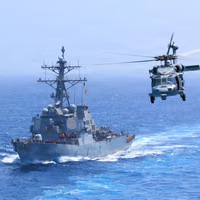
US Central Command on Monday confirmed the deployment of the USS Abraham Lincoln Carrier Strike Group to the Middle East. "The Abraham Lincoln Carrier Strike Group is currently deployed to the Middle East to promote regional security and stability."
The deployment came weeks after Trump promised help for Iranian protesters amid a brutal crackdown where at least 36,500 people were killed. He said he had cancelled all meetings with Iranian officials, and that "help is on its way" for Iranian people.
The State Department spokesperson said on Monday "the Iranian people want and deserve a better life."
"The regime’s brutal suppression of the Iranian people is on full display," the spokesperson said.
US renews nuclear and missile demands on Iran as ‘armada’ arrives | Iran International
Ali Ansari, an Iranian businessman under UK sanctions for allegedly financing Iran’s Islamic Revolutionary Guards, built a European property portfolio worth about €400 million, according to a Financial Times investigation based on corporate filings.
The outlet reported that the assets include luxury properties across several European countries, ranging from a golf resort in Mallorca to a ski hotel in Austria.
The holdings were structured through a complex network of offshore companies registered in jurisdictions including Luxembourg, St Kitts and Nevis, as well as Austria, Germany and Spain.
Ansari is not under European Union sanctions.
The findings show how wealthy Iranians with close ties to the ruling system have continued to acquire high-value assets in the West despite sanctions.
The report comes as Iran has been shaken by widespread protests fueled by a collapsing currency, high inflation, and public anger over corruption. Protesters have accused elites of enriching themselves while living standards for much of the population have sharply deteriorated.
Iran said about 40 Iranian citizens will be returned from the United States to Iran on Sunday, after being held for months in US immigration detention centers.
The acting head of Iran’s Interests Section in Washington told state news agency IRNA that the group will depart from Mesa Airport in Arizona, make a brief stop in Egypt and return to Iran via Kuwait.
Abolfazl Mehrabadi added the office coordinated with US immigration authorities to issue return travel documents for the detainees.
The flight is the third to repatriate Iranian asylum seekers and others whose immigration cases were halted and who were detained by US immigration authorities for various reasons.
The planned deportation has drawn criticism in the United States, with Democratic Representatives Yassamin Ansari and Dave Min, citing human rights concerns in Iran.
Iran’s foreign ministry confirmed on December 7 that 55 Iranian nationals had been detained to be deported from the United States amid President Donald Trump’s tightened immigration policies.
On September 29, a plane carrying 120 Iranians including three women landed in Iran, an Iranian expelled from the United States told Iran International, adding that detainees had faced mistreatment in US facilities and that force was used during their transfer.
More than 36,500 Iranians were killed by security forces during the January 8-9 crackdown on nationwide protests, making it the deadliest two-day protest massacre in history, according to documents reviewed by Iran International's Editorial Board.
Iran International's Editorial Board can confirm the death toll after reviewing newly obtained classified documents, field reports, and accounts from medical staff, witnesses, and victims’ families.
The new information provides a clearer picture of the killing pattern and the scale of a crime that can now be described as the largest and bloodiest massacre of civilians during street protests, over a two-day period, in history.
Iran International has received reports and evidence indicating the extrajudicial execution of a number of detainees in Tehran and other cities. Images released from morgues leave little doubt that some wounded citizens were shot in the head while hospitalized and undergoing medical treatment. It is evident that, had these individuals sustained fatal head wounds on the streets, there would have been no reason to admit them to hospital or begin treatment in the first place.
The images also show that in some cases, medical tubes and patient-monitoring equipment remained attached to the bodies. In other cases, cardiac monitoring electrodes are visible on the chest, suggesting these individuals were under medical care before being shot in the head. A number of doctors and nurses have also told Iran International that so-called “finishing shots” were fired at wounded patients.
That figure was explicitly cited in a report by the IRGC Intelligence Organization submitted to the Supreme National Security Council and the Presidential Office on January 11, two days after the two-day massacre, reviewed by Iran International.
36,500 killed in 400 cities
Our Editorial Board has now obtained more detailed information provided by the IRGC Intelligence Organization to the Supreme National Security Council.
Other state institutions have also received differing figures from other security bodies. However, given the scale of the killings, deliberate concealment, and what appears to be intentional disorder in the registration and transfer of bodies – along with pressure on families and, in some cases, the quiet burial of victims – it appears that even the security agencies themselves do not yet know the precise final death toll.
In a report presented on Wednesday, January 21, to the Iranian parliament’s National Security and Foreign Policy Committee seen by Iran International, the number of those killed was listed as at least 27,500.
According to sources within Iran’s Interior Ministry who spoke to Iran International on condition of anonymity, a consolidation of figures received from provincial security councils by Tuesday, January 20, showed the death toll had exceeded 30,000.
Two informed sources from the Supreme National Security Council also told Iran International that in two recent reports by the IRGC Intelligence Organization, dated January 22 and January 24, the number of those killed was listed as more than 33,000 and more than 36,500 respectively.
Interior Ministry reports say security forces confronted demonstrators in more than 400 cities and towns, with more than 4,000 clash locations reported nationwide.
Despite the confusion and concealment, the rapid increase in death toll figures in classified government reports has heightened concerns that the actual number of those killed may be even higher.
Due to communication restrictions and security pressure, independent verification remains impossible. However, based on credible information from hospital sources and eyewitnesses, the number of deaths in several major cities is described as shocking.
Conservative assessments by medical sources, based on the number of bodies delivered to hospitals and medical centers, estimate more than 2,500 killed in Rasht, at least 1,800 in Mashhad, more than 2,000 in Isfahan, Najafabad, and Khorasgan, at least 3,000 in Karaj, Shahriar, and Andisheh, 700 in Kermanshah, and 400 in Gorgan.
No clear aggregate figure has yet been obtained for Tehran. However, images released from Kahrizak morgue and hospitals across the capital indicate that thousands were killed in Tehran, with a significant proportion of the deaths occurring in southern Tehran.
Horrifying details of a historic crime
1 - Three doctors and four nurses in Tehran who spoke to Iran International said security forces entered hospitals and took away some wounded patients who were undergoing treatment. Images received by Iran International, along with videos circulating on social media, also show that some bodies with gunshot wounds to the head bear clear signs of hospitalization.
Two other nurses told Iran International that after a wounded young man was transferred to an ambulance in a clash area in western Tehran, a security agent suddenly entered the vehicle and, in front of them, killed him by firing two consecutive shots. The nurses said the man had been severely beaten before being moved and was semi-conscious. A trusted specialist physician at a Tehran hospital confirmed their account.
There are also reports that individuals were detained at home and that their families were later told to go to Kahrizak to collect their bodies. Other reports say security forces went to homes and drew people to the door – including under the pretext of delivering a package – before shooting and killing them.
These deeply alarming reports have in recent days been published by families or provided to Iran International by credible eyewitnesses.
If confirmed through independent investigation, the accounts would amount to clear cases of extrajudicial killing and, if found to be widespread, could be examined under the rubric of crimes against humanity.
The withholding of detainee numbers, the unknown locations of detention sites, and the lack of clarity over prisoners’ access to medical care and legal representation have heightened concerns among human rights activists.
A prominent lawyer inside Iran, who requested anonymity, described the situation as an “international human rights crisis.” He said, “Unofficial reports indicate that tens of thousands have been arrested, and the IRGC or whichever security body has custody of them can kill as many as it wants, send their bodies to Kahrizak or other morgues, and claim they were killed on the streets.”
2 - The organized killings across Iran indicate the brutal crackdown was carried out with the agreement and cooperation of state institutions and on the orders of the highest authorities of the Islamic Republic.
According to information received by Iran International, following a speech by Supreme Leader Ali Khamenei on January 9, phrases such as “al-nasr bil-ru‘b” (victory through terror) and “fight them until there is no sedition” were used in briefings and discussions among senior IRGC commanders. The same phrases also appeared on January 9 in Telegram channels affiliated to hardliners.
3 - Numerous reports and other evidence indicate that in many cities, bereaved families were forced to pay large sums described as “bullet fees” in exchange for receiving the bodies of their loved ones. In some cases, despite families’ objections, those killed were presented as members of the Basij militia.
4 - While most of the killings were carried out by IRGC and Basij forces, reports received by Iran International indicate that proxy forces from Iraq and Syria were also used in the crackdown. The deployment of non-local forces suggests a decision to expand repression capacity as quickly as possible.
Should Iran International obtain further information, it will inform its audience in subsequent statements.
Call for submission of evidence
Iran International once again calls on all compatriots inside and outside the country to send any documents, videos, photographs, audio testimonies, information about those killed or wounded, medical centers, locations of clashes, timing and geography of events, and any verifiable details related to the events of the past weeks.
The security of sources and confidentiality of information are our highest priorities. If you are concerned about your safety, do not send identifying information and provide only general, verifiable details.
Following verification and careful assessment, Iran International will publish its findings and share them with all relevant international bodies and institutions.
The truth will be recorded and documented. The names of the victims will be preserved. This crime will not be buried in silence.
Emory University has dismissed Fatemeh Ardeshir Larijani, the daughter of the US-sanctioned security chief of the Islamic Republic, the university confirmed to Iran International on Saturday, following growing calls for her removal.
"A physician who is the daughter of a senior Iranian government official is no longer an employee of Emory," the university’s Winship Cancer Institute, where Larijani worked, said in response to Iran International’s inquiry.
"Because this is a personnel matter, we are unable to provide additional information," the university said.
The US Treasury last week sanctioned Ali Larijani, the secretary of Iran's Supreme National Security Council, for “coordinating” the Islamic Republic's response to nationwide protests on behalf of Supreme Leader Ali Khamenei and for publicly calling on security forces to use force to repress peaceful demonstrators.
It sanctioned him alongside other alleged "architects" of the deadliest crackdown on protests in Iran's history earlier this month.
Emory University did not specify whether her dismissal was related to the US sanctions, but said its "employees are hired in full compliance with state and federal laws and other applicable requirements."
Ardeshir-Larijani was an assistant professor in the department of hematology and medical oncology at Emory medical school, whose official website described her research as focusing on "new target discovery and defining an immune resistance mechanism in lung cancer."
Her biography page at the university's website is no longer available following the Saturday dismissal.
US Representative Buddy Carter of Georgia earlier this week called for her removal from Emory and the revocation of her Georgia medical license.
Carter wrote in a letter to the university and the Georgia Composite Medical Board that Larijani had “recently and publicly advocated violence against Americans and US allies” while holding a senior national security position, and argued that his daughter’s continued role treating patients in the United States was unacceptable.
“Physicians are entrusted with intimate access to patients, sensitive personal information, and critical medical decision-making,” Carter wrote, adding that allowing someone with close family ties to a senior Iranian security official to hold such a position posed risks to patient trust, institutional integrity and national security.
The dismissal comes a few days after a protest gathering by a group of Iranians outside the Winship Cancer Institute, where protestors demanded her removal over her father's role in the brutal crackdown on Iranian protesters.
After unprecedented mass killings of protestors whose full scope lies concealed behind Iran's internet iron curtain, the Washington-based pro-Israel think tank JINSA urges Donald Trump to seize the moment to destroy the mutual foe of Israel and the United States.
The non-profit Jewish Institute for National Security of America, founded in 1976, advocates for a strong US military relationship with Israel and researches conflict in the Middle East.
JINSA president and CEO Michael Makovsky and the group’s vice president for policy Blaise Misztal told Iran International’s English-language podcast Eye for Iran that decades of containment, deterrence and nuclear diplomacy have failed because the Islamic Republic itself should be destroyed.
“It should be US policy to seek the collapse of this regime,” Makovsky said.
They said hesitation now — after mass killings of protesters across Iran — risks emboldening Tehran at the theocracy's weakest moment.
“We don’t say regime change,” Makovsky said. “The regime will fall … only when the Iranian people bring it down. But it should be US policy … to seek the collapse of this regime.”
The last months, Misztal said, have created a rare strategic opening: Iran’s nuclear clock has been set back, its regional proxies weakened and Iranians themselves have returned to the streets demanding freedom.
“This is a moment like no other,” he said. “I don’t know when the stars will align like this again… why not make it now? When is a better time than now?”
The duo urged the Trump administration to abandon negotiations, intensify pressure on the Revolutionary Guards and build the infrastructure needed to help Iranians defeat the Islamic Republic.
Misztal said previous administrations focused on Iran’s nuclear program, terrorism sponsorship and ballistic missile development as separate threats without tying them back to what he called the ideological nature of the theocracy.
“Yes, it’s a problem that Iran is the world’s greatest state sponsor of terrorism. Yes, it is a problem that it’s pursuing nuclear weapons,” he said. “But all of that stems from it being the Islamic Republic of Iran.”
Trump’s Promises and a Moment of Decision
Their warnings come as President Donald Trump faces rising scrutiny over his own rhetoric. Earlier this month, Trump vowed support for protesters and issued a direct warning to Tehran.
“I tell the Iranian leaders: You better not start shooting, because we’ll start shooting, too,” he said.
But Makovsky warned that after mass killings and widespread arrests, the absence of immediate consequences risks damaging US credibility.
“The Iranians have called his bluff for now,” he said. “If he doesn’t do it, it will go down as a tragic mistake.”
In recent days, Trump has said a US "armada" is heading toward the Middle East, with the aircraft carrier USS Abraham Lincoln and several guided-missile destroyers expected to arrive in the region soon as Washington signals it is positioning military assets amid escalating uncertainty.
The growing tensions are now rippling far beyond Iran itself.
Major European airlines have begun suspending flights across parts of the Middle East, citing security concerns. Air France has canceled flights to Tel Aviv and Dubai, British Airways has halted evening service to Dubai and KLM has suspended routes to Israel, Saudi Arabia and the UAE.
Industry officials say cancellations are expected to increase gradually as carriers reassess airspace restrictions and passenger safety in a rapidly deteriorating regional environment.
A Cold War–Style Pressure Campaign
Misztal framed the strategy as a modern version of what the United States pursued against Soviet communism: strengthening civil resistance while weakening the ruling system from within.
“The strategy of regime collapse has been precisely what the United States pursued throughout the Cold War,” he said.
He argued that Washington should encourage defections, isolate elites in authority, cut off funding streams and expand opposition communications.
“One of the things we recommended is a quarantine of Iran’s oil exports,” Misztal said, “so that it doesn’t keep getting the money to rebuild its forces to pay the Basij or the IRGC.”
Both analysts warned that Iran’s leadership is entering what they described as its most dangerous phase, amid mass violence at home and the potential for war abraod.
“A showdown of some kind” is coming, Misztal said, and “the next showdown will be the last one."