F/A-18F aircrafts are seen on the deck of USS Abraham Lincoln in the Gulf of Oman near the Strait of Hormuz in this file photo taken July 15, 2019.
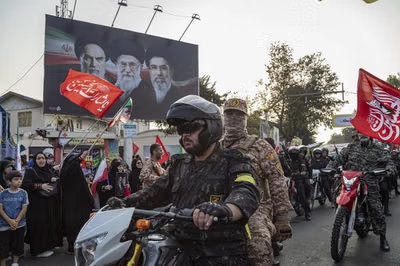
Senior Iranian clerics used Friday Prayers to attack the course of negotiations with Washington and issue warnings of retaliation, as a major US military buildup in the region fuels fears of renewed conflict.
Tehran’s interim Friday prayer leader said on Friday that Israel is “unwilling to attack Iran” after the “12-day war,” saying the episode showed Iran’s strength.
Mohammad Hassan Aboutorabi Fard said the experience of the 12-day conflict meant that “the Zionists are seriously preventing aggression against Iran,” because they fear war and “know they have no defense shield against Iran’s power.”
Aboutorabi argued that the confrontation last year, which included US strikes on Iranian nuclear sites during Israel’s 12-day campaign, altered the regional balance. He linked that assessment to the current round of talks with Washington, saying negotiations are unfolding within a broader strategy set by Supreme Leader Ali Khamenei.
Tehran’s interim Friday prayer leader Mohammad Hassan Aboutorabi Fard
“These negotiations are one of the important issues that have affected the political atmosphere of the world, the region and the country,” Aboutorabi said. “The strategy determined by the Supreme Leader has enabled the effective and commanding presence of the diplomatic teams on the international stage.”
Negotiations, he said, are advancing in close connection with active diplomacy, nuclear policy and military capability, arguing that continued threats from the United States would be costly and unproductive.
The rhetoric comes as Washington expands its military presence in the Middle East. US officials say 13 warships are now deployed in the region, including the aircraft carrier USS Abraham Lincoln, supported by destroyers and littoral combat ships. A second carrier, the USS Gerald R. Ford, is en route with additional escorts. Fighter jets and refueling aircraft have also been repositioned.
US media also reported that American forces could be ready to launch strikes within days, although President Donald Trump has not announced a final decision. Trump has repeatedly warned that military action remains an option if talks fail to produce a new agreement to replace the 2015 nuclear deal he withdrew from in 2018.
White House Press Secretary Karoline Leavitt said there had been “a little bit of progress” in Iran talks held in Geneva but acknowledged that significant gaps remain. She added that there are “many reasons and arguments” for a potential strike and said Iran would be “very wise” to reach a deal.
Hardline messaging from provinces
In Mashhad, Friday Prayer leader Ahmad Alamolhoda questioned the value of negotiations, saying if talks result in what he described as a “wrong and foolish” outcome, their course must be tightly defined.
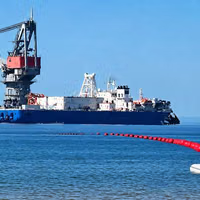
Alamolhoda threatened that Iran can close the Strait of Hormuz, pointing to what he described as a “heroic exercise” there and warning that Tehran has the ability to shut the strategic waterway and “entangle and exhaust the world.”
“That is the message,” he said. “This is who we are. Can you confront us? Can you match us?”
In Karaj, cleric Mohammad Mahdi Hosseini Hamedani referred to the unveiling of a hypersonic missile by the Islamic Revolutionary Guards Corps, saying its speed and multiple-warhead capability sent a message to Iran’s adversaries. The United States, not Iran, is in greater need of negotiations, he said.
Separately, Iranian lawmaker Amir Hayat Moghaddam said it is possible that a US warship could be sunk and American forces captured if war breaks out, warning that Iran would respond forcefully to any attack.
“If the Americans attack, we will immediately give a crushing response,” Moghaddam told Didban Iran.
Moghaddam, a member of parliament’s national security and foreign policy commission, said Iran could target all US bases in the region and that any response would not be “limited or symbolic.”
“In case of war, we can harm American forces, whether soldier or general,” he said, adding that Iran could also target the United States itself, including “the palace of Trump.”
At the same time, parliamentarian Salar Velayatmadar sought to temper alarm over US naval deployments, saying the proximity of American vessels does not automatically signal war. Such movements, he said, do not necessarily indicate imminent conflict, even as he warned that US bases in the region remain within Iran’s reach.
Araghchi pushes back on zero enrichment reports
Meanwhile, Iran’s Foreign Minister Abbas Araghchi said on Friday that the United States has not asked Tehran to permanently halt uranium enrichment, countering reports that Washington was demanding zero enrichment as a condition for a deal.
Speaking on MSNBC’s Morning Joe, Araghchi described recent talks in Geneva as “constructive” and said both sides had agreed on guiding principles for a possible agreement.
“The US side has not asked for zero enrichment,” Araghchi said, adding that Iran had not offered to suspend enrichment either.
“What we are now talking about is how to make sure that Iran’s nuclear program, including enrichment, is peaceful and would remain peaceful forever,” he said.
Araghchi said there was “no military solution” to Iran’s nuclear program and that diplomacy remained the only viable path forward, though he added that Iran was prepared for both negotiation and war.
According to Araghchi, the two sides have agreed to begin drafting a framework for a potential agreement at their next meeting, calling it “a normal way of any international negotiations.”
He also warned that if Iran were attacked again, it would defend itself, saying that after the previous 12-day conflict its “enemies had no way but to ask for an unconditional ceasefire.”