Iran’s currency plunge in late December 2025 sparked nationwide protests that quickly escalated from economic grievances into calls for an end to the Islamic Republic. The crackdown that followed was unusually violent, killing thousands under a sweeping internet blackout.
Trump’s response was neither a formal call for regime change nor an immediate move toward military conflict. Instead, it combined public threats, diplomatic suspension, and economic pressure with visible military signaling designed to raise the cost of repression while preserving strategic flexibility.
“A massive Armada is heading to Iran,” Trump wrote on Truth Social last week, describing the fleet—led by the aircraft carrier Abraham Lincoln—as “ready, willing, and able to rapidly fulfill its mission, with speed and violence, if necessary.”
The signalling grew more explicit on Wednesday, when the US president urged Iran to “quickly ‘Come to the Table’” and negotiate a deal. He warned that “the next attack will be far worse” than last June’s strikes on Iran’s nuclear sites if an agreement was not reached.
The military centerpiece of Trump’s strategy is the redeployment of the USS Abraham Lincoln carrier strike group, restoring credible strike capacity at a moment when Iran’s leadership is consumed by internal unrest.
Escorted by multiple destroyers and carrying nearly 90 aircraft, including F-35s, the Lincoln gives Washington a flexible range of options—from limited strikes on Revolutionary Guard assets to broader operations.
Additional US combat aircraft, armored units, and air-defense systems have been repositioned across regional bases, underscoring the signaling intent. The objective appears to be readiness without commitment.
Trump’s apparent aim is to exploit Iran’s weakened position to coerce strategic concessions—not only on the nuclear and missile programs, but also on Tehran’s regional proxy activity. That pressure has been reinforced by a proposed 25 percent tariff on countries trading with Iran, announced on January 12.
Washington’s approach appears calibrated to push for negotiations while Tehran is at its most vulnerable, stopping short of an explicit commitment to military action or regime change.
The ambiguity looks deliberate—and strategic. It may work, but it is not risk-free. US credibility could erode if threats are not followed through. External pressure may also strengthen hardliners in Tehran by reinforcing narratives of foreign orchestration, potentially unifying a fractured elite.
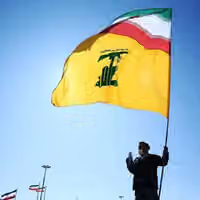
Iran’s armed allies in the region retain some capacity to retaliate against US interests or Israel. Whether they choose to do so is unclear, but the risk of escalation into a broader conflict cannot be dismissed.
Tehran, for its part, has hardened its rhetoric, warning of an “unrestrained” and “unprecedented” response to any US military operation, while simultaneously expressing openness to what it calls “fair” negotiations.
Pressure on Iran is also building beyond Washington. On Thursday, the European Union took what its foreign policy chief, Kaja Kallas, described as a “decisive step” toward designating the Islamic Revolutionary Guard Corps as a terrorist organisation—its strongest signal yet that patience with the Islamic Republic is wearing thin.
At the same time, Kallas cautioned that the region “doesn’t need another war,” underscoring Europe’s own balancing act between pressure and restraint.
Iran’s streets are quiet after a bloody crackdown. But the economy is in free fall, and another round of widespread protests appears increasingly likely.
The key question now is whether Trump’s gunboat diplomacy can extract strategic gains without igniting the very conflict it seeks to avoid—or whether it merely postpones a more dangerous reckoning.