Cryptocurrency is a rare tool embraced by both Iran’s rulers and its citizens—used at the top to enrich elites to dodge sanctions and at the bottom to survive the economic devastation wrought by their policies.
Blockchain forensics firm Chainalysis estimates that Iran’s crypto ecosystem exceeded $7.78 billion in 2025.
Any figure attached to Iran’s crypto economy is of course partial: both the state and private users have powerful incentives to conceal activity, whether to limit sanctions exposure or avoid domestic scrutiny.
What is increasingly clear, however, is that the state now dominates a large share of that volume.
Chainalysis estimates that the Islamic Revolutionary Guard Corps processed more than $3 billion in crypto transactions last year. Israel’s counter-terror financing authority has published a seizure order listing 187 crypto addresses worth roughly $1.5 billion in Tether, a crypto denomination pegged to the dollar.
New findings by the blockchain analytics and crypto-compliance firm Elliptic link Iran’s central bank to at least $507 million in purchases of dollar-pegged Tether (USDT).
That stockpile could supplement constrained foreign-exchange reserves and help authorities lean against sudden spikes in the rial’s parallel market.
In effect, USDT can function as an off-balance-sheet foreign-exchange buffer: accumulated outside correspondent banking channels, mobilized through intermediaries, and sold into rial markets via local exchanges and over-the-counter desks when pressure builds.
•
•
Access, however, is not evenly distributed. Reports indicate state blessing for—or "whitelisting"—internet connectivity for certain traders, even as much of the country has endured a pervasive internet blackout since a deadly crackdown on protestors ramped up on Jan. 8.
When the rial comes under pressure, connectivity itself becomes an instrument of intervention: stablecoin-based market operations still require traders who can connect, quote prices, and settle transactions.
Alternate reality for households
Iran’s central bank has imposed limits on currency trading and transaction flows, while rolling out an anti-speculation tax regime covering gold, jewelry, foreign currency and cryptocurrencies.
The effect has been to raise the cost of traditional inflation hedges while signaling that policymakers now view household portfolio shifts as a macroeconomic risk.
The central bank has moved to cap individual crypto holdings at $10,000, despite warnings from Iranian traders and economists that such restrictions would choke savings and push activity further underground.
On the mining side, the divide is even starker. State-linked and religious institutions are among the largest players, in part because electricity tariffs in Iran are not uniform.
Iran International has reported repeated allegations of crypto mining at state-sponsored sites, including mosques, which benefit from reduced energy rates—an obvious advantage in an industry where profitability hinges on power costs.
The result is effectively two mining economies: small operators running rigs at home or in workshops, attempting to stay invisible, and state-linked actors with access to cheaper electricity, larger facilities, and more predictable protection.
Authorities have periodically blamed illegal neighborhood miners, but some experts see that focus as a way to deflect attention from deeper problems of grid management and governance.
Where the cheapest power is concentrated in privileged institutions and enforcement is uneven, the largest rents accrue not to households plugging in a single machine, but to organized actors with access.
Iran has become a cutting-edge battlefield of monetary adaptation. The central bank experiments with stablecoins to stabilize the rial, while households use the same rails to escape it.
A tightly capped, KYC-only micro-saver lane could offer households limited protection for modest savings while increasing transparency and helping isolate state-connected networks operating at scale.
The unresolved question is whether regulated crypto channels can be structured to distinguish household self-preservation from state-linked finance—or whether policy choices will continue to push both into the same shadows.
Whether the state and its beleaguered citizenry can defy mounting economic pressure may hang in the balance.
Iranian authorities are still carrying out a chain of crimes linked to the protest crackdown, including extrajudicial killings, deaths under torture and the systematic mistreatment of detainees and their families, according to the executive editor of Iran International TV.
Asghar Ramezanpour said the violence has not ended with the suppression of mass demonstrations, warning that detainees face ongoing threats to their lives, denial of medical treatment and collective detention in unconventional holding facilities.
He also cited systematic harassment of families of those killed or detained, as well as continued efforts by authorities to block information from reaching the public.
Ramezanpour’s comments followed the release of a new report estimating that at least 36,500 people were killed in the crackdown on protests, with the deadliest violence concentrated on January 8 and 9, according to classified government documents seen by Iran International.
Iran’s state broadcaster has reached a point where control no longer translates into attention, exposing how years of manipulation, omission and distrust have hollowed out its authority and left a system that still fills airtime but is no longer watched.
Islamic Republic of Iran Broadcasting has lost the few audience it once assumed it possessed. According to a 2024 survey by the state-run ISPA, only 12.5 percent of Iranians follow the news through the state broadcaster, and 11.5 percent watch films and TV series on state TV.
Viewers have migrated elsewhere, disengaged, or stopped watching altogether. The result is a broadcaster that retains infrastructure and reach on paper but has been stripped of public relevance in practice.
This erosion matters because the system was never designed to retain an audience. Its function was to define reality by default, assuming passive consumption rather than active belief. Once viewers disengaged, repetition lost its force. Control of distribution no longer compensates for the absence of viewers.
During moments of nationwide crisis, when internet shutdowns leave citizens with few information sources, state television no longer functions as a reference point. Instead, it serves as a tool of narrative management: selecting what can be shown, omitting what cannot be explained, and substituting political reality with staged images of normalcy.
Broadcasting without an audience
For decades, Iran’s media model assumed a captive audience. State television and aligned agencies – particularly Guards-affiliated outlets such as Tasnim and Fars – operate not as independent newsrooms but as synchronized instruments of governance. Their role has been to speak in a single vocabulary, regardless of whether anyone is listening.
This model depends on two conditions: uninterrupted control of distribution and a public compelled to accept official framing as the baseline. Periods of unrest strain both. Authorities respond by narrowing the information space – blocking platforms, jamming opposition satellite networks, sidelining independent outlets and cutting internet access – to prevent images and testimony from circulating outside official filters.
Yet this strategy also exposes weakness. When viewers are forced back to a channel they no longer trust, omissions and contradictions become more visible, not less. Absence of alternatives does not restore authority; it highlights how little credibility remains.
Managing perception through omission
One of the clearest techniques used by Iranian state media during crises is substitution: replacing destabilizing political reality with curated depictions of normalcy. While protests across the country have been driven by explicit rejection of the political system – including chants calling for the overthrow of Supreme Leader Ali Khamenei – state television has persistently reframed unrest as a response to economic pressure.
Instead of addressing violence, casualties or political slogans, IRIB dispatched reporters to city streets to highlight the availability of basic goods such as chicken meat. These segments emphasized supply while omitting that prices had surged several times over in recent weeks.
By focusing on availability rather than affordability – and by recasting a political uprising as economic grievance – the broadcasts constructed an image of stability. The effect was to depoliticize a movement defined not by price demands, but by calls for the end of the ruling order.
Alongside omission sits coercive performance: televised confessions aired by Fars and Tasnim from detained protesters presented as “leaders” of unrest. These segments are not designed to persuade skeptics. They function as demonstrations of power, signaling the state’s ability to script guilt and enforce compliance.
From staged crowds to synthetic reality
What distinguishes the current phase is not the presence of propaganda, but its tools. Traditional methods – recycled crowd shots, selective framing and inflated attendance claims – have long been used. What is new is reliance on digitally manipulated or AI-assisted content that blurs the line between documentation and fabrication.
A recent example illustrates such shift. State media circulated a video presented as aerial helicopter footage of pro-government rallies, promoting it as evidence of mass popular support. Viewers quickly questioned its authenticity, pointing to visual inconsistencies in lighting, movement and composition, as well as the absence of basic helicopter safety features.
The state’s instinctive response – denial, external blame and further restriction – reinforced the cycle. Each tightening of control signaled anxiety. Each refusal to address substantive questions accelerated the erosion of credibility.
Whether every technical critique was correct was secondary. The significance lay in the reaction. Official visuals were no longer treated as authentic; they were examined as artifacts to be tested for manipulation.
This marked a shift from propaganda as persuasion to propaganda as evidence production. The aim was no longer only to frame events, but to manufacture visual proof. Paradoxically, the more sophisticated the techniques, the faster trust eroded.
Rasht Bazaar: A disaster told through one voice
The fire at Rasht’s central bazaar showed how narrative control operates under blackout conditions.
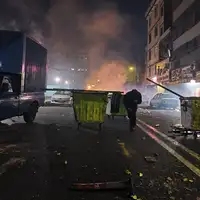
During protests in the northern city on January 8 and 9, a large section of the historic market caught fire as internet and phone services were cut, limiting residents’ ability to document events. State television retained full operational capacity and sent reporters to the scene while the fire was still burning.
Official coverage attributed the blaze to protesters and focused on material damage, repeatedly citing the number of shops destroyed. Casualty figures were absent. Later segments emphasized economic losses through interviews with selected shopkeepers and officials, while avoiding scrutiny of security forces.
Eyewitness testimony carried by Iran International described a sharply different sequence: crowds pushed toward the bazaar, people trapped by smoke in narrow corridors, and security forces firing on those emerging with raised hands to surrender.
In this environment, state broadcasting operated with technical access but without an audience willing to accept its account. The absence of open networks and real-time citizen reporting produced a one-sided evidentiary landscape shaped by coercion and selective disclosure.
Rasht Bazaar
Beyond access: a crisis of credibility
Iran’s media crisis is often framed as a problem of access – blocked platforms, censored outlets and restricted bandwidth. It is more fundamentally a crisis of credibility.
A broadcaster that has lost its viewers may still produce content, but it no longer produces belief. Control without an audience is not influence. And in politics, messages that are not believed might as well not be seen.
US officials told Iraqi leaders Washington would starve Baghdad of oil revenue if it kept up economic links with Iran and would suspend ties if politicians deemed close to Iran became ministers, Reuters reported on Friday citing sources.
The warnings would mark a sharp uptick in rhetoric on Iraq by the administration of US President Donald Trump as it pursues its maximum pressure campaign of sanctions against its Mideast arch-nemesis Iran.
Citing three Iraqi officials and a source familiar with the matter, the news agency reported that US Charge d'Affaires in Baghdad Joshua Harris conveyed the warnings in conversations over the past two months with Iraqi officials from across its fractured political spectrum.
Iran relies closely on the banking sector its Western neighbor, where recent parliamentary polls kept Shi'ite Muslim parties in the ascendant and delivered gains for politicians from the kaleidoscope of militias and parties backed by Tehran.
The Islamic Republic's own economic lifeline of oil exports is under heavy pressure from US sanctions, even if export levels remain buoyant one year into Trump's second term, and Iraqi financial instruments help it skirt US curbs.
Following a 2003 US invasion, the United States has maintained de facto control over Iraqi oil revenues and its preponderant banking and financial puts the funds within its reach.
"The United States supports Iraqi sovereignty, and the sovereignty of every country in the region," Reuters quoted a US State Department spokesperson as saying in response to a request for comment. "That leaves absolutely no role for Iran-backed militias that pursue malign interests, cause sectarian division, and spread terrorism across the region."
US warnings also broached cutting off engagement with Baghdad if 58 members of parliament Washington views as linked to Iran are elevated by Prime Minister Shia al-Sudani to cabinet positions.
"The American line was basically that they would suspend engagement with the new government should any of those 58 MPs be represented in cabinet," Reuters quoted an Iraqi officials as saying.
"They said it meant they wouldn't deal with that government and would suspend dollar transfers," the source added.
Forming the new cabinet is due to take months and the US moves did not appear to be linked to a recent deadly crackdown on protestors in Iran, which resulted in new US sanctions on Iranian officials and oil shipping networks.
The US Treasury on Friday slapped new sanctions on ships and their owners it accuses of enriching the Iranian state and fueling its repression following mass killings of protestors earlier this month.
The measures targeting nine vessels from what the United States dubs Iran's "shadow fleet", their owners and management firms, saying their activities have together exported hundreds of millions of dollars’ worth of Iranian oil and petroleum products.
“The Iranian regime is engaged in a ritual of economic self-immolation—a process that has been accelerated by President Trump’s maximum pressure campaign. Tehran’s decision to support terrorists over its own people has caused Iran's currency and living conditions to be in free fall,” US Treasury Secretary Scott Bessent was quoted as saying in a statement.
“Today’s sanctions target a critical component of how Iran generates the funds used to repress its own people. As previously outlined, Treasury will continue to track the tens of millions of dollars that the regime has stolen and is desperately attempting to wire to banks outside of Iran."
The new US sanctions come after the treasury last week announced sanctions on several top Iranian commanders and the country's powerful security chief Ali Larijani, whom it accused of being "architects" of the violence.
Iranian security forces opened fired on protestors nationwide in violence that culminated on Jan. 8-9 this month which medics and government sources told Iran International claimed the lives of at least 12,000 people.
The number may be more than 20,000, the UN special rapporteur on human rights in Iran said Thursday, citing reports from doctors inside the country.
One year after US President Donald Trump returned to the White House and revived the "maximum pressure" sanctions on Iran from his first term, available data show the country’s energy exports remain largely intact.
Data from the commodity intelligence firm Kpler, seen by Iran International, show that in 2025 Iran delivered an average of 1.38 million barrels per day (bpd) of crude oil and gas condensate to China—a decline of just 7 percent compared with 2024.
After Iranian oil exports to Syria halted in December 2024, China effectively remained Tehran’s sole buyer of crude oil over the past year.
Unlike crude oil, Iran’s petroleum product exports—fuel oil (mazut), naphtha and liquefied petroleum gas (LPG)—are relatively diversified, with shipments mainly destined for China, the United Arab Emirates, Malaysia and Singapore.
According to Kpler, Iran exported an average of 190,000 bpd of naphtha and 256,000 bpd of fuel oil last year, a combined decline of about 13 percent compared with 2024.
The drop, however, was driven not by tighter US sanctions but by Iran’s worsening domestic gas shortages, which forced power plants and industrial facilities to burn more fuel oil, reducing volumes available for export.
Data from tanker-tracking firms Kpler and Vortexa show that the modest decline in crude oil exports was offset by increased shipments of natural gas and LPG.
Iran has also continued exporting natural gas to Turkey and Iraq.
Tehran and Baghdad don’t publish official figures, but data from Turkey’s energy ministry indicate that natural gas imports from Iran increased about 9 percent during the first 11 months of last year compared with the same period in 2024.
One reason US sanctions have struggled to significantly curb Iran’s energy exports has been the continued operation of the so-called shadow fleet—a network of oil tankers that transport sanctioned crude through flag changes, disabled tracking systems, ship-to-ship transfers, and opaque ownership structures.
According to estimates by TankerTrackers, roughly 1,500 oil tankers worldwide were involved in shadow fleet activity last year, with nearly 40 percent linked to Iranian oil shipments.
Although the United States stepped up sanctions on such tankers in 2025, existing data suggests that hundreds of non-sanctioned vessels remain active in transporting Iranian oil through opaque trading routes and intermediary networks, undermining the enforcement capacity of US measures.
Further data from Kpler indicate that widespread domestic protests in Iran in recent weeks have had no noticeable impact on the country’s oil and petroleum product export volumes.
While China has remained the sole buyer of Iranian crude oil and condensate, the United Arab Emirates—one of Washington’s closest regional allies—has emerged as the largest importer of Iranian fuel oil, accounting for nearly 70 percent of those exports.
Estimates by Iran International put the total value of Iran’s exports of crude oil, petroleum products, and natural gas last year—excluding discounts and the costs of sanctions evasion—at roughly $60 billion.
The figure highlights the gap between early US projections that Iran’s oil exports would collapse by as much as 90 percent and the far more limited impact visible in the data so far.