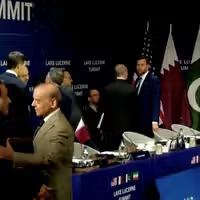
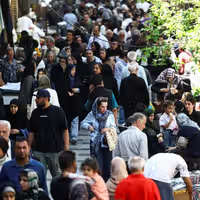
An Iranian lawmaker said on Tuesday that recent public discontent was driven by economic instability caused by what he described as poor policy decisions.
Hossein Samsami, a member of parliament from Tehran, said authorities should not adopt what he called harmful policies that worsen living conditions and create dissatisfaction.
"We should not, through poor and livelihood-destroying policies, create discontent among this nation," he said during a parliamentary session.
Samsami said the main cause of the recent discontent was instability in the currency and prices.
"The main reason for the recent dissatisfaction was currency instability and price volatility," he said, adding that these problems stemmed from what he described as misguided policies adopted over the past month.
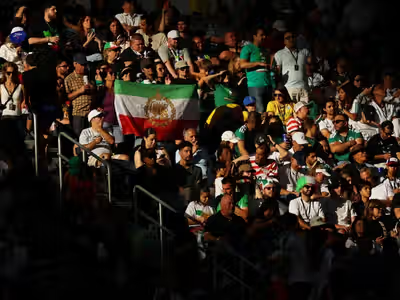

Exiled Prince Reza Pahlavi said thousands of military and police personnel had not shown up for work to avoid taking part in the crackdown on protesters, in a message posted on X.
"Because of your steadfastness and resistance, thousands of military and police personnel have not shown up for work so they would not have to take part in the repression," Pahlavi said.
He accused the authorities of trying to spread fear through killings, repression and internet shutdowns in an effort to make people abandon the movement.
"The regime is trying to create fear and terror among you," he said.
Pahlavi also called on internet and communications specialists to disrupt state systems to help restore access for the public.
"Target the regime's information infrastructure so that our compatriots' connection with the world can be restored again," he said.

Information received from the Supreme National Security Council and the presidential office shoes that the nationwide killings during Iran’s latest protests were carried out on the direct order of Supreme Leader Ali Khamenei, with the explicit knowledge and approval of the heads of all three branches of government.
The information further indicates that the Supreme National Security Council issued an order for live fire, and that forces of the Islamic Revolutionary Guard Corps and the Basij were mainly responsible for shooting those killed.
The operation is assessed as fully organized, not the result of “sporadic” and “unplanned” clashes, and unprecedented in Iran’s history in geographic scope, intensity and the number of deaths over a short period.
The assessment was reached after evidence converged from Sunday, following a multi-stage review of information from a source close to the Supreme National Security Council; two sources in the presidential office; accounts from IRGC sources in Mashhad, Kermanshah and Isfahan; as well as eyewitness and family testimony, field reporting, medical-center data and information provided by doctors and nurses across several cities.
Tehran’s top judicial official said some cases linked to ongoing protests have been sent to court on charges including what he described as moharebeh, a term under Iranian law that can carry death penalty.
Ali Alghasimehr said the province’s judicial system was fully prepared to handle cases involving what he called terrorists and those detained in the protests.
"The Tehran provincial judiciary has full readiness to deal with these cases," he said, adding that special branches had been assigned to hear them.
He did not give details on the number of cases or those involved.

At least 12,000 people were killed in the largest killing in Iran’s contemporary history, carried out largely over two consecutive nights on January 8 and 9, Iran International’s editorial board concluded, based on a review of sources and medical data.
Iran is under a coordinated blackout aimed not only at security control but at concealing the truth, reflected in internet cuts, crippled communications, media shutdowns, and the intimidation of journalists and witnesses.
Publication was delayed until the evidence converged.
The assessment is based on a multi-stage review of information from a source close to the Supreme National Security Council; two sources in the presidential office; accounts from several sources within the Islamic Revolutionary Guard Corps in Mashhad, Kermanshah and Isfahan; testimonies from eyewitnesses and families of those killed; field reports; data linked to medical centers; and information provided by doctors and nurses in multiple cities.
Many of those killed were under the age of 30.

Iran's exiled Queen Farah Pahlavi said Iranians will soon celebrate freedom together as protests continue, praising their bravery and offering condolences to families of the victims.
"Soon you will celebrate freedom together in Iran and light will overcome darkness," she wrote on X.
Pahlavi said authorities had cut communications out of fear of public voices being heard, but added that the message of protesters could not be silenced. She also referred to videos emerging of protesters being killed, saying it has caused her deep pain as a mother and offered condolences to families while wishing recovery for the wounded.
“Every child of this nation whose blood is shed revives for me the unbearable grief of losing my own children,” she said.
Addressing Iran’s armed forces, Pahlavi urged them not to tie their fate to those responsible for bloodshed and to join the people, saying no interest or political survival could justify killing compatriots.