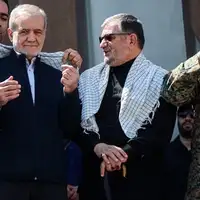
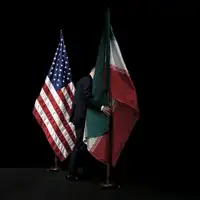
White House Press Secretary Karoline Leavitt told reporters that what Iran is saying publicly is different to the message they are sending privately to the United States.
An official from the Islamic Republic reached out to US Special Envoy Steve Witkoff "expressing a far different tone than what you're seeing publicly," Leavitt said.
Axios had earlier reported a phone call between Iran's foreign minister Abbas Araghchi and Witkoff, during which the two sides discussed the protests and Iran's disputed nuclear program.
“I think one thing President Trump is very good at is always keeping all of his options on the table,” Leavitt said.
“Airstrikes would be of the many, many options that are on the table for the commander-in-chief. Diplomacy is always the first option for the president. He told all of you last night that what you’re hearing from the Iranian regime is quite differently from the messages the administration has received privately.”
“I think the president has an interest in exploring those messages. However, with that said, the president has shown he’s unafraid to use military options if and when deemed necessary,” she added. “Nobody knows that better than Iran.”

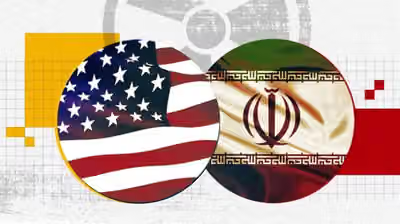
Iran's Supreme Leader Ali Khamenei described protestors demanding the end of clerical rule US-backed mercenaries in a message on Monday and said state-sponsored rallies had thwarted their aims.
"Today you carried out a great act and created a historic day. These massive gatherings, filled with firm resolve, thwarted the plans of foreign enemies that were meant to be carried out by their domestic mercenaries," Khamenei said.
"The great nation of Iran put itself—along with its resolve and identity—on display before its enemies. This was a warning to US politicians to end their deception and stop relying on treacherous mercenaries," the message reads.
He called the Iranian nation "strong and powerful, aware and able to identify its enemies, and present on the scene at all times."

Tehran on Monday escalated its public warnings to Washington, mooting retaliation for any attack while dismissing US president Donald Trump's pledges to protect protestors even as reports emerged of quiet diplomatic outreach intended to avert war.
Senior Iranian officials used coordinated statements to signal resolve against any US attack amid Tehran's deadly crackdown on nationwide protests, portraying Trump’s warnings as both dangerous and unserious.
Parliament speaker Mohammad Bagher Ghalibaf said that any American attack would prompt a sweeping response across the region.
“We have heard that you have threatened Iran,” Ghalibaf told a state-sponsored rally in Tehran on Monday, addressing Trump directly. “The defenders of Iran will teach you an unforgettable lesson.”
“All American centers and forces throughout the region will be our legitimate targets in response to any potential adventurism,” he added. “Come and see how all your capabilities in the region will be wiped out.”
The warnings were echoed by security chief Ali Larijani, who downplayed Trump’s recent remarks linking possible US action to Tehran’s handling of the protests.
“Trump says things like this a lot. Do not take him seriously,” Larijani was quoted as saying by state-affiliated media. “The Iranian nation has shown that it intends to settle accounts with the United States and Israel.”
'Under control'
Iran’s foreign minister, Abbas Araghchi told a group of foreign ambassadors in Tehran on Monday that the situation in the country is “completely under control” but that Iran was ready for war if the United States did not engage in what it called fair talks.
Referring to Trump's warning about a possible attack on Iran if the killing of protesters continues, Araghchi said: “The Islamic Republic is not seeking war, but it is fully prepared for war.”
“The Islamic Republic is also ready for negotiations, but these talks must be fair, based on equal rights, and founded on mutual respect,” he added.
But the remarks came as Axios reported that Araghchi had reached out over the weekend to US Middle East envoy Steve Witkoff, citing two sources with knowledge of the matter.
According to the report, the outreach appeared aimed at de-escalating tensions or buying time amid growing concern in Tehran over potential US moves. One source said Araghchi and Witkoff discussed the possibility of holding a meeting in the coming days.
The contrasting signals reflect the bind facing Tehran as protests continue across the country, and Washington as it gauges various courses of action and their possible consequences.
An array of witness reports and videos reviewed by Iran International points to widespread use of lethal weapons to control dissenting crowds, killing at least 2,000 people across Iran since the protests began.

Exiled Prince Reza Pahlavi on Monday urged the Trump administration not to engage in negotiations with the Islamic Republic, saying the theocracy is “on its back legs” and would fall if Iranian protesters receive support from the United States.
Pahlavi said in a post on X that "negotiating with this criminal regime who is still threatening America and the President will not bring peace."
"But immediate action to support these brave protesters will save thousands of lives and bring lasting peace to the region. That will be President Trump’s legacy," he added.
US President Donald Trump said on Sunday a meeting was being set up with Iranian officials after they called him asking for talks on a nuclear deal. However, he said the meeting may take place after a possible US attack on Iran.
In his message on Monday, the exiled prince said Trump can "bring about the greatest peace the world has ever seen by helping Iranians finally end this criminal regime."
"President Trump is not Obama. His words of support for the protesters in Iran show that. Now is the time to act," he said.

Iran’s nationwide internet shutdown has completely cut off public access to online platforms since January 8, while many state-linked and security-affiliated media outlets have continued operating on Telegram.
Telegram channels linked to the Revolutionary Guards including Fars and Tasnim, as well as several state-funded outlets such as Mehr, SNN and the Farhikhtegan newspaper, have continued to update their Telegram channels regularly despite the shutdown, according to observations by Iran International.
The state broadcaster's news channel, IRIB News, has also continued posting updates. However, its news agency YJC updated its Telegram channel only during the first few days of the shutdown, until Saturday, and has remained inactive since then.
Meanwhile reformist newspapers Shargh, Etemad, and Hammihan, along with moderate platforms such as Khabar Online, have remained silent on Telegram during the blackout. Another moderate outlet, Asr-e Iran, however, has kept its channel active despite the shutdown.
While Iranian officials including the office of Supreme Leader Ali Khamenei and Foreign Minister Abbas Araghchi have made frequent posts on their Telegram channels, the Iranian government’s official news agency, IRNA, has remained silent since Thursday, when the nationwide digital blackout began in Iran.
In the early hours of the shutdown, many users in the Iranian diaspora expressed outrage after the office of Iran’s Supreme Leader continued to update its X account while much of the country was cut off from the outside world.
Rights groups warn Iran’s nationwide internet blackout is being used to shield lethal crackdowns on protesters, cutting off evidence of state violence as unrest continues across the country.
Cybersecurity expert Amin Sabeti told Iran International that the blackout has severed access to the global internet across much of the country and disrupted domestic online services that remained partially available during previous crackdowns.
“This is the most extreme internet shutdown we’ve ever had,” Sabeti said, adding that its scope signals a significant escalation in Tehran’s use of digital repression amid nationwide unrest.
While some users in Iran have been able to send videos and reports to Iran International through Starlink terminals, director of Washington operations for anti-censorship tool Psiphon says even Starlink uploads have been affected.
US President Donald Trump said on Sunday he will discuss with Starlink chief Elon Musk to provide internet access for Iranian protesters.

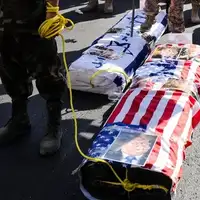
Tehran on Monday conducted large pro-government rallies in several cities intended to counter the nationwide protests challenging its rule, in a strategy it has deployed against previous bouts of mass unrest ultimately crushed by deadly force.
The aim is not necessarily to convince skeptics, but to project an image of control and popular backing at a moment of visible strain.
After days of sustained demonstrations calling for the overthrow of the system, authorities organized counter-rallies in several cities on Monday, presenting them as popular condemnations of the protests themselves.
State television depicted the gatherings as mass denunciations of unrest, echoing official claims that the uprising was driven by “armed terrorists” and foreign adversaries.

A familiar mobilization
The mechanics of the rallies followed a script many Iranians recognize. State bodies drew participants to central locations in Tehran and other major cities, relying on administrative pressure and access to public resources.
Coverage was then amplified by state television and media outlets affiliated with the Islamic Revolutionary Guards Corps.
In recent broadcasts, state outlets released a mix of ground-level footage and aerial images intended to convey scale. Some of the images show visible crowds, underscoring that the authorities retain a base of support.
It is difficult to determine precise numbers, the duration of the gatherings, or whether all images reflect live events from the same day. Similar visual techniques — including the reuse of footage or the circulation of undated aerial shots — have been employed during previous protest cycles.
Even taken at face value, the rallies appeared limited in duration and geographic spread.
By contrast, demonstrations opposing the government have persisted for weeks, erupting across hundreds of locations according to tallies compiled by activists and researchers, despite the risks involved.
The contrast is sharpened by the conditions under which each takes place: pro-government gatherings proceed under heavy security, while protesters have faced gunfire, mass arrests and lethal force.

Information control as context
This round of rallies unfolded amid unusually severe restrictions on communication. For several consecutive days, internet connectivity across much of Iran has been sharply curtailed, according to digital rights groups and user reports, leaving millions unable to communicate freely or share information.
State and Guards-linked outlets, by contrast, have continued to publish without interruption. Agencies such as Tasnim, Fars and Mehr have maintained full access, flooding television and online platforms with official narratives.
The result is a highly asymmetric information environment. While ordinary citizens struggle to document events or verify developments, state-aligned media dominate the public space with curated imagery.
Under such conditions, rallies are presented largely on the authorities’ terms, with limited independent means to corroborate scale, timing or participation.
A recurring sequence
Similar state-organized rallies followed major protest movements in 2009, 2019 and 2022, each time presented as demonstrations of enduring legitimacy. In each case, they coincided with intensified security measures and tighter controls on dissent.
Evidence of the human toll has continued to surface despite efforts to restrict documentation.
Videos circulating online in recent days, which could not be independently verified, appeared to show bodies in a morgue in Kahrizak, with grieving relatives gathered nearby—imagery that contrasted sharply with official broadcasts of unity and resolve.
In a message released Sunday night, Reza Pahlavi described the moment as a new phase in what he called a national uprising, urging supporters to challenge the state’s control over information and public space.
What the competing images ultimately underscore is a question that spectacle alone cannot answer: how Iranian cities would look if opposing sides were able to assemble under comparable conditions.
The return to this familiar choreography comes as protests continue despite severe limits on communication, widespread arrests and the high personal cost of participation.
The repeated staging of loyalty rallies suggests not confidence, but the absence of other tools for demonstrating consent. Carefully framed images may circulate for a time, but they cannot indefinitely substitute for credibility rooted in broad public trust.
In the end, theater may delay recognition of a crisis, but it does not resolve one.