Some analysts now warn that Iran may be entering the early stages of regime collapse — not through a single dramatic event, but through a slow erosion of state capacity.
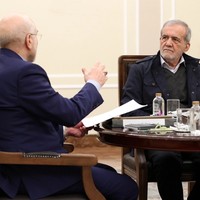
What makes this round different is not only the fury in the streets. It is the growing uncertainty within the clerical establishment, which is leaning more heavily on coercion while projecting less confidence than before.
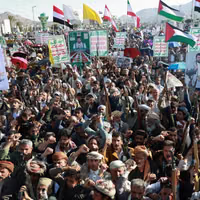
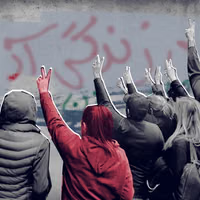
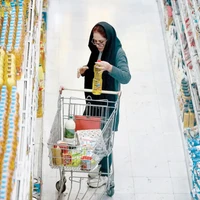
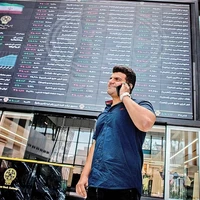
The protests began with the plunging rial. They have since widened into a broader test of whether the government can still manage a country living in constant crisis. Demonstrations that started in Tehran’s electronics markets have spread across provinces, bazaars and campuses, with chants increasingly aimed at the ruling system itself.
Live fire and deaths have fueled anger, while rare scenes in a religious city like Qom and other cities show crowds refusing to retreat.
A system running out of answers
Shayan Samii, a former US government appointee said the anger goes beyond economic hardship — it reflects a belief that the future has narrowed.
“They are upset because the value of their currency has gone down the drain,” he said. “There is nothing to look forward to.”
That sense of closure, he argued, is what pushes ordinary Iranians to take risks despite repression — a difficult dynamic for a state that relies heavily on deterrence and coercion.
Journalist and author Arash Azizi described protests appearing not only in major cities but in towns once seen as politically quiet.
“There is discontent everywhere,” he said — but protesters “lack leadership” and “lack organization.”
Without that, he warned, unrest can erupt and fade without producing structural change, even as each round leaves the system more brittle.
From an intelligence perspective, Danny Citrinowicz, former head of the Iran branch in Israeli military intelligence, said the deeper issue is not simply mismanagement but the absence of any workable path forward.
“The main problem the regime has is that it has no silver-bullet solution to the economic problems in Iran,” he said. Even if authorities find temporary fixes, “the problem will stay.”
Economic calm, in other words, may only pause — not resolve the crisis.
Cracks inside the ruling class
It is not only public anger that is shifting, said Alex Vatanka of the Middle East Institute but the mood among elites themselves.
“I have certainly not ever seen this level of hopelessness inside the Iranian regime,” he said.
That kind of discouragement, he added, can be more consequential than unrest alone, opening space for miscalculations and internal rivalries that become harder to contain.
Former US State Department official Alan Eyre cautioned against assuming outside forces can engineer rapid political change.
“Regime change is wildly improbable in Iran right now,” he said — warning that intense external pressure could strengthen hard-liners or push Iran toward greater militarization.
His remarks followed comments by Donald Trump that the United States was “locked and loaded” if Iranian authorities kill protesters — language that energized some activists while raising fears of escalation among others.
Why this wave feels different
Bozorgmehr Sharafeddin, head of Iran International Digital, argued that this round cuts deeper because it points to a crisis of state survival rather than policy error.
“This protest is not about inflation,” he said. “This is about the collapse of the Iranian economy.”
He also noted that international reaction came immediately — a contrast with earlier cycles when global attention arrived more cautiously and later.
Across the conversation, one theme recurred: the state still has the means to suppress dissent — but it is doing so with increasing uncertainty about what comes next.
Protesters are directing anger at the foundations of clerical power, not merely the officials administering policy. Reform promises carry less credibility. And senior figures themselves acknowledge problems they cannot easily fix.
That does not guarantee revolution and it does not mean collapse will come overnight. But analysts say a government that relies primarily on coercion while showing visible doubt from within no longer projects stability.
What emerges, they warn, is a system still capable of force yet less certain of itself with every passing crisis.
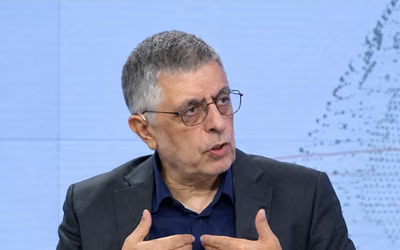
You can watch Episode 84 of Eye for Iran on YouTube or listen on any podcast platform of your choosing.