Iran arms export agency offers missiles for crypto – FT
The long-range air defense system called Arman is displayed during an unveiling ceremony in Tehran, Iran, in this picture obtained on February 17, 2024
Iran’s official defense export agency is offering to sell ballistic missiles, drones and other advanced weapons systems to foreign governments in exchange for cryptocurrency and barter, Financial Times reported on Thursday.
The Ministry of Defence Export Center, known as Mindex, presents itself as the export arm of Iran’s defense ministry. It advertises more than 3,000 products across categories including armaments, rockets and missiles, aviation, marine platforms, and radar and optical systems.
The portal’s payment terms say contracts can be settled using “digital currencies,” local currencies in the buyer’s country and barter arrangements, alongside more traditional bank transfers.
Mindex’s online platform, hosted on an Iranian cloud provider already blacklisted by Washington, says decades of experience in overseas sales and says it works with a number of foreign clients.
A frequently asked questions section reassures potential buyers that “given the general policies of the Islamic Republic of Iran regarding circumvention of sanctions, there is no problem in implementing the contract,” and promises that purchased products will reach their destination “as soon as possible,” FT reported.
According to the center’s own “About us” page, Mindex began its marketing activity in 1989 and is “affiliated to the Ministry of Defence and Armed Forces Logistics,” (MODAFL) a ministry that has been under US sanctions since 2007 for supporting Iran’s missile and conventional arms programs.
Washington has repeatedly targeted MODAFL‑linked front companies and procurement networks, warning that foreign entities supplying or buying military hardware through such channels risk secondary sanctions and potential exclusion from the US financial system.
Recent US designations have also singled out Iran‑linked “shadow banking” and crypto networks accused of helping Tehran move money for oil and weapons sales outside formal banking channels, underscoring the risks for buyers using digital assets to pay Mindex.
US Treasury in recent months has sanctioned multiple Iran‑linked networks accused of using front companies and alternative payment channels to facilitate weapons such as Russia and Venezuela, warning that digital currencies do not shield transactions from enforcement.
The fifth day of protests in Iran became the deadliest so far, with at least seven protesters killed by security forces, as rallies spread to new cities including the clerical stronghold of Qom, where protesters called for the downfall of the theocracy.
Demonstrations were reported across dozens of locations, from Tehran and Isfahan to Lorestan, Mazandaran, Khuzestan, Hamadan, and Fars, with protesters chanting slogans directly targeting the ruling system and the Supreme Leader Ali Khamenei.
For the first time in the past five decades, pro-monarchy slogans have come to dominate the chants.
Security forces used live fire in several cities, including Nurabad in Lorestan and Hamadan in western Iran, where videos showed officers shooting at demonstrators who remained in the streets despite the crackdown.
Protesters killed by security forces
The US-based Human Rights Activists News Agency (HRANA) has so far documented the deaths of at least seven protesters, mostly killed on Thursday.
Iran International has managed to speak with the families of three victims.
In Lorestan, 28‑year‑old barber Shayan Asadollahi was killed after security forces in pickup trucks opened fire on protesters in the city of Azna on Thursday, a relative told Iran International.
Iran International also spoke with the relatives of Dariush Ansari Bakhtiarvand in Fooladshahr and Amir‑Hessam Khodayarifard in Kuhdasht, who were killed on Wednesday night.
The unrest has taken on a distinctly anti‑government tone, with protesters in Bandar Abbas chanting “Death to the entire system” and "Long live the Shah (King)”, while pro-monarchy graffiti and slogans appeared in Esfahan and Sistan and Baluchestan.
Recent reports said evening and nighttime demonstrations in multiple cities including Bandar Abbas, Azna, Hamedan, Qom, Qazvin and Babol.
In the restive southeast, a group of Baluch prisoners urged residents of Sistan and Baluchestan to join the “wave of freedom” and support demonstrations across the country, recalling that the province was one of the main hotspots of the 2022 Woman, Life, Freedom protests and repeatedly faced deadly crackdowns.
Iranian protesters chanted pro-monarchy slogans in Qom, a core stronghold of Shiite clerics and the Islamic Republic, signaling a major symbolic breach in a city long seen as politically untouchable.
Spectators at a football match in Esfahan were also filmed chanting “Reza Shah, may your soul rest in peace,” underscoring the prominence of pro‑monarchy slogans in this wave of protests.
They called on people to reclaim streets they said “belong to the people, not dictators,” and to make chants such as “Death to the dictator” and “Freedom, justice, Iranian republic” echo “like thunder across Iran.”
Caution and support
The Paris‑based Narges Foundation, run by the family of jailed Nobel laureate Narges Mohammadi, issued a statement on her official X account declaring that “silence is not an option” as streets once again see live fire, tear gas, beatings and mass arrests, and urging solidarity with families of those killed, detainees held incommunicado and the wounded denied safe treatment.
Former senior lawmaker Heshmatollah Falahatpisheh, who once headed parliament’s National Security and Foreign Policy Committee, warned in his own X post that “all the ideologies of the world are not worth the tears of one mother” and urged Iranians to ensure their hands “do not get stained with the blood of even one Iranian.”
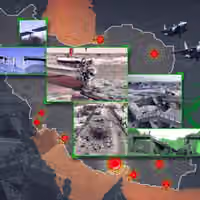
Iran erected banners across Tehran on Thursday threatening further attacks against Israel and a US base in Qatar, with state media publishing images of the banners showing maps and locations of strikes carried out during a 12‑day war in June.
The phrase “It Will Happen Again” appears above images of sites targeted during the June war, including Israel’s Nevatim airbase and the Haifa refinery and power plant, as well as Qatar’s Al‑Udeid airbase, which hosts American troops and was targeted in June.
Iranian officials framed those strikes as only a fraction of the country’s missile capabilities and warned that future retaliation could be more extensive.
The new banners come after recent remarks by US President Donald Trump on his support for possible Israeli attacks on missile or nuclear sites in Iran, prompting senior state and military officials in Tehran to issue a series of defiant and threatening messages.
Trump said on Monday he would support possible Israeli strikes on Iran if the Islamic Republic further develops its ballistic missile or nuclear programs, warning Tehran against rebuilding military capabilities destroyed in Israeli and American airstrikes in June.
“Israel should remember the blows it received in the recent war and take a lesson from the previous attack before thinking of entering a new one,” IRGC spokesman Brigadier General Mohammad Ali Naeini said on Wednesday.
“Iran’s power is increasing by the day, and Israelis only talk about a weak Iran in the media while they themselves know very well how strong our missile capabilities are,” Naeini added.
The United States held five rounds of negotiations with Iran over its nuclear program earlier this year, for which Trump set a 60‑day deadline. When no agreement was reached by the 61st day on June 13, Israel launched a surprise military offensive, followed by US strikes on June 22 targeting key nuclear facilities in Isfahan, Natanz and Fordow.
The attacks killed several nuclear scientists along with hundreds of military personnel and civilians, while Iranian counterattacks killed 32 Israeli civilians and an off‑duty soldier, according to official tallies from both sides.
On June 23, Iran launched around 14 short‑ and medium‑range ballistic missiles at Al‑Udeid base as part of its retaliation for US strikes on Iranian nuclear facilities the previous day.
US officials said air defenses in Qatar intercepted 13 of the missiles and that one fell short of the base, but satellite imagery later indicated a missile had struck and damaged a large US radar dome used for secure communications, while Washington reported no American casualties.
Iran denies seeking nuclear weapons and says its nuclear program is for peaceful purposes, while Supreme Leader Ali Khamenei has said dealing with Trump is beneath the dignity of the Islamic Republic and officials have rejected US demands to end uranium enrichment and curb missile capabilities.
The United States has long insisted that Iran must completely halt its uranium enrichment program, stop supporting its armed allies in the Middle East and accept restrictions on its ballistic missile program. Tehran has rejected the demands.
Nationwide protests were held in Iran for the fourth day in a row on Wednesday, with fresh rallies reported in multiple cities, a harsh response from security forces and growing calls for a regime change by both protesters and politicians across the world.
Demonstrators took to the streets in cities including Esfahan, Hamadan, Babol, Dehloran, Baghmalek and Pian, chanting slogans against Supreme Leader Ali Khamenei, backing exiled prince Reza Pahlavi, and commemorating slain protesters from previous uprisings such as teenager Artin Rahmani from Izeh.
In Esfahan, nighttime protesters were filmed chanting “Don’t be afraid, we are all together” and “Death to the dictator,” while in Dehloran and Baghmalek demonstrators shouted pro‑monarchy slogans including “This is the national slogan: Reza Pahlavi,” “Javid Shah” (“Long live the Shah”) and calls for Khamenei to be overthrown.
Acts of defiance
Security forces responded with force in several locations, with reports and footage of gunfire and tear gas in cities such as Nahavand, Asadabad and Hamadan, where residents were seen standing their ground, including one protester who faced down a water cannon.
In Babol, crowds intervened to stop security forces from arresting a demonstrator, while in Tehran a student leader at the University of Tehran, Sarira Karimi, was detained after a raid on her home, with her whereabouts unknown.
Voices of support
Prominent cultural and religious figures also weighed in, with top Sunni cleric Molavi Abdolhamid saying crushing living conditions and a political dead-end are driving the revolt, and acclaimed filmmaker Jafar Panahi describing the unrest as an uprising to “push history forward” now that “shared pain has turned into a cry in the streets.”
Western politicians continued to line up behind the protesters. US Senator Rick Scott said he was encouraged to see Iranians “calling for an end to the abusive Iranian dictatorship” and urged them to keep standing up to the “evil regime," while fellow Republican Senator Pete Ricketts called for more pressure on Tehran as people risk their lives in the streets.
Swedish MEP Charlie Weimers urged the EU to “stand on the right side of history” by cutting diplomatic ties with Tehran’s rulers, backing internet access for Iranians and engaging with opposition leaders about a “post‑Islamist Iran."
A landmark criminal lawsuit filed in Argentina by victims of the 2022 Woman, Life, Freedom movement signals a new push to hold Islamic Republic officials accountable beyond Iran’s borders.
Shahin Milani, the executive director of the Iran Human Rights Documentation Center (IHRDC), told Iran International's English podcast Eye for Iran, the case marks a turning point – warning that even mid-level officials can no longer assume impunity.
“Iranian officials – even mid-level ones – should understand they are not safe anymore. If they leave Iran, justice may follow them.”
Why Argentina and why this matters now
The complaint was filed by a group of survivors together with the Iran Human Rights Documentation Center and supported by the Strategic Litigation Project at the Atlantic Council.
It asks Argentine judges to investigate crimes against humanity committed during the Islamic Republic's violent response to the 2022 protests, including murder, torture, gender-based persecution and targeted blinding.
Argentina was chosen because its courts recognize universal jurisdiction, allowing them to investigate atrocity crimes even when they were not committed on Argentine soil.
Crucially, Iranian officials – the alleged perpetrators – do not need to set foot in Argentina for a criminal investigation to begin.
Milani says that distinction changes the calculus inside Iran’s power structure.
“If Argentina issues arrest warrants, that alone is a success. Travel becomes risky. Borders become unpredictable.”
Argentina has already heard cases linked to abuses in Venezuela, Myanmar, and Spain’s Franco era, and has dealt with Iran-related cases before, including proceedings tied to the 1994 AMIA bombing – an attack on a Jewish community center in Buenos Aires that killed 85 people.
The list of 40 accused officials remains confidential for now. Much of the case, however, draws on years of documentation, including findings by the UN Fact-Finding Mission, which concluded that Iran’s crackdown amounted to crimes against humanity.
Three of the complainants have chosen to be publicly identified.
Kosar Eftekhari was 23 when she was shot in the eye during the protests. Mersedeh Shahinkar was also blinded at close range, but later returned to the streets wearing an eye patch as an act of defiance. Mahsa Piraei joined the case after her mother, Minou Majidi, was killed by security forces while demonstrating against the clerical establishment.
Majidi’s case drew international attention after an image of her daughter, Roya Piraei, standing without the mandatory hijab beside her mother’s photograph at her gravesite went viral. Majidi’s other daughter, Mahsa, is now seeking justice through the landmark lawsuit.
Roya Piraei at her mother's grave.
“In our own country, Iran, we were unable to find justice for my mother’s killing because there is no fair or independent judiciary,” Piraei told the Atlantic Council. “Our insistence on preserving human dignity is a global cause that knows no borders.”
Their stories form both the moral heart and legal backbone of the complaint.
Not compensation, only accountability
Unlike civil lawsuits in courts, this case does not seek financial damages.
“This is a criminal complaint,” Milani said. “It’s about responsibility, something painfully rare when it comes to the Islamic Republic.”
Even without immediate arrests, he said, the case lays the legal groundwork for accountability when conditions change.
Milani avoids predicting political collapse or transition. But he is clear about the role of human rights lawyers: they build cases now so they are ready when circumstances change.
“We don’t know what’s going to happen in the future. It’s possible that some of these officials’ circumstances change and they have to leave Iran – and they should know they’re not going to be immune from prosecution.”
In other words, even if justice does not arrive immediately, the legal architecture is being laid brick by brick – quietly, deliberately, and beyond Iran’s borders.
No one expects Argentina’s courts to deliver overnight justice. Similar cases against authoritarian officials elsewhere have taken years, and many defendants remain free.
For the families and survivors behind the complaint, however, this marks the clearest indication yet that the struggle that began in the streets in 2022 is now moving into courtrooms – and that justice, however delayed, may no longer be out of reach.
Iran’s Supreme Leader has appointed Ahmad Vahidi as deputy commander-in-chief of the Islamic Revolutionary Guard Corps (IRGC), replacing Ali Fadavi, who was moved to head an advisory group under the IRGC commander.
The decree, issued in Vahidi’s former name Vahid Shahcheraghi and read out at a handover ceremony, said the appointment was made following a proposal by the IRGC commander. Senior Guards commanders and military officials attended the event.
Vahidi has been implicated by Argentine prosecutors in the 1994 bombing of the AMIA Jewish community center in Buenos Aires, which killed 85 people.
At the time, Vahidi was the head of the Quds Force, the external operations branch of Iran's sprawling paramilitary organization the Islamic Revolutionary Guard Corps.
Interpol said in a 2009 statement that a red notice for Vahidi was issued in November 2007 at Argentina’s request, adding that a red notice is not an international arrest warrant and that any decision to detain an individual rests with national authorities.
Argentina’s foreign ministry said in April 2024 that it wanted Vahidi arrested in connection with the AMIA case when he traveled abroad as part of an Iranian delegation. Iran has repeatedly rejected allegations of involvement in the attack.
The United States has sanctioned Vahidi for his role in Iran’s suppression of protests, including the use of lethal force by security services during demonstrations sparked by the 2022 death of Mahsa Amini.
The Treasury Department said Vahidi oversaw law enforcement agencies involved in serious human rights abuses and had earlier been sanctioned over alleged links to Iran’s nuclear and weapons programs.
Iranian media have described Vahidi as a veteran Guards commander who held senior posts spanning the IRGC’s intelligence and overseas operations and later served in cabinet roles, including as defense minister and interior minister.