Iran's budget for this fiscal year had given the sprawling paramilitary body new economic power by tasking it with selling nearly 600,000 barrels of oil per day to fund military expenditures.
The dramatic raid by Washington, which is the latest move in an escalating pressure campaign against Venezuelan President Nicolas Maduro, now puts the shadowy trade buoying targeted economies in Caracas and Tehran in the crosshairs.
“The seizure underscores Washington’s escalating efforts to crack down on dark-fleet activity tied to Iranian and Venezuelan crude trades,” analytics firm Kpler said in a research note.
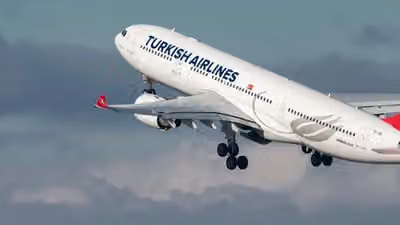
The Guyana-flagged ship, called Skipper, had loaded crude earlier this year at Iran’s Kharg Island terminal and has frequently shuttled between Venezuela, Iran and China—a top customer for the sanctioned powers.
Kpler notes that Skipper has been repeatedly linked to sanction-evasion tactics, including spoofing its location and mislabeled Iranian cargoes routed through Asia.
The tanker, formerly known as Adisa, was sanctioned on November 3, 2022 for transporting oil on behalf of the IRGC-Quds Force to Iran-backed Hezbollah in Lebanon—both of which are deemed terrorist organizations by US authorities—as well as to Syria.
The US campaign targeting the dark fleet has intensified for months. In an October report, Kpler said that over 60% of the vessels that have loaded Iranian crude in the last 12 months are now sanctioned by OFAC, up from 38% one year ago.
Still, according to shipping analytics firm Vortexa, Iran's shadow trade to China appears to be operating at full tilt. Export volumes stood at around 1.5-1.7 million bpd so far in 2025, it said, up slightly from last year but a full 25% from 2023.
"This consistency underscores the maturity of Iran’s sanctions-evasion logistics," it wrote in an analyst note, adding that Iran's capacity to get its crude to Chinese markets was limited by the number of eligible vessels and muted buyer interest.
Impact on Iran's revenues
Venezuela is offering its sanctioned crude at a $14–15 per barrel discount, according to reporting by Reuters. Kpler previously estimated that Iran, too, has increased its discounts to around $8 per barrel.
Along with Russia, the sanctioned exporters are effectively in direct competition with one another to lure Chinese buyers by offering deeper discounts.
Complicating matters further, with the global market oversupplied, the baseline price of oil has fallen to around $62 per barrel.
Discounts of $11-15 dollars therefore wipe out a substantial portion of export revenues for the sanctioned trio — all of which remain under pressure to lower prices even more to retain Chinese clients.
Chartering a Very Large Crude Carrier the size of the Skipper typically costs around $100,000 per day, and much higher for sanctioned cargoes.
For Iran — now holding 200 million barrels on the water according to Vortexa, the pressure to sell quickly is immense.
To the costs of chartering and discounting must also be added the expensive sanctions-evasion operations: ship-to-ship transfers, falsified documentation to rebrand cargoes, intermediaries and non-standard insurance.
Kpler data indicates that Iranian crude discharge in Chinese ports has fallen to 1.2 million bpd in the last two months after hitting near 2 million bpd in September and October as Chinese buying pauses late into the trading cycle.
Along with global low oil prices, the combined pressures may hit at Iran’s oil revenues when its economy can tolerate it least. The Iranian rial has depreciated at an accelerating rate in recent weeks and inflation has surged.
The currency lost nearly 15% of its value in just the past month and hit a new low on Monday of 1.31 million to the dollar.