Iran confirms envoy accreditation pending in Lebanon, plays down rift
A man gestures the victory sign as he holds a Hezbollah flag, on the second day of the ceasefire between Israel and Iran-backed group Hezbollah, in Tyre, southern Lebanon November 28, 2024
Iran said accreditation for its newly appointed ambassador to Lebanon remains pending and expects the process to proceed naturally, playing down talk of a diplomatic rift after reports about the Lebanese foreign minister delaying the file.
“We have accepted Lebanon’s new ambassador, and I hope the process of accepting our new ambassador in Lebanon will follow its natural course,” foreign ministry spokesperson Esmail Baghaei said during his weekly briefing on Sunday when asked about the reported suspension.
Baghaei rejected suggestions that diplomatic ties had been disrupted, saying relations between Iran and Lebanon were long-standing and ongoing.
Iran already has an ambassador in Beirut and that Lebanon’s new ambassador has recently taken up his post in Tehran, he added.
“The relevant process regarding Iran’s new ambassador in Lebanon has been underway for some time,” Baghaei said. “We hope this process will proceed in a normal manner in Lebanon as well, and that our new ambassador will be stationed there.”
Lebanon’s foreign minister, Youssef Raji, has declined to advance the administrative steps required to approve Iran’s proposed ambassador, including submitting the credentials to the cabinet and presidency, the Lebanese pro-Hezbollah daily Al-Akhbar reported on Saturday.
Iran’s role in Lebanon and the wider region had fueled instability, Raji told Al Jazeera on Friday, saying Beirut remained open to dialogue if Tehran stopped supporting Hezbollah and ended what he described as interference in Lebanon’s internal affairs.
Iranians are increasingly discontented with how their country is run but the Islamic Republic persists because of its ability and willingness to crush dissent by force, ex-CIA analyst and National Security Council director Ken Pollack told Eye for Iran.
Pollack’s assessment comes as Iran faces overlapping crises at home and abroad.
The country is under intense economic strain, social dissent has become more visible and the Islamic Republic is recalibrating after military setbacks suffered by the June war with Israel.
Yet despite the pressure, Pollack said the system remains intact for a simple reason.
“Revolutions only succeed when regimes lose either the capacity or the willingness to use force,” he said. “The Islamic Republic learned from 1979. It is determined not to repeat the Shah’s mistake.”
“There is no question this country is in a pre-revolutionary state,” Pollack added. “They’re trying to have a revolution.”
Pollack pointed to Iran’s long cycle of unrest, tracing repeated efforts to challenge the Islamic Republic back to the 1999 student uprising.
Since then, protest waves have erupted every few years, including nationwide demonstrations and the women-led revolt that followed the death of Mahsa Amini in morality police custody.
Each time, he said, the population pushed harder, experimented with new tactics and widened the social base of dissent.
What stopped those efforts, Pollack said, was not a lack of public anger but the clerical establishment's consistent readiness to deploy force.
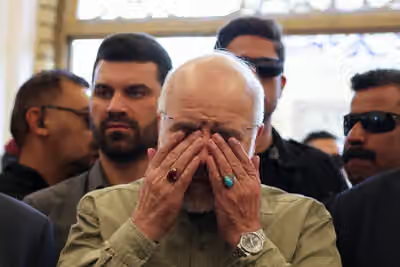
Pollack said episodes of unrest, such as at a public memorial service on Friday for a lawyer who died under mysterious circumstances, highlight the paradox defining Iran today: visible cracks in social control paired with an unflinching security response.
Looking ahead, Pollack identified the eventual death of Supreme Leader Ali Khamenei as the most serious potential inflection point.
At 86, the health of the veteran theocrat has become a subject of quiet speculation even inside Iran. Succession, Pollack warned, can destabilize authoritarian systems by exposing elite rivalries or paralyzing decision-making.
“Succession can just as easily lead to chaos, fragmentation or something worse,” he warned. “These systems often survive by becoming more repressive, not less.”
Pollack also criticized US policy for focusing too narrowly on Iran’s nuclear program while sidelining Iran's regional behavior and domestic repression. He warned that treating nuclear negotiations as the central problem risks missing broader forces shaping Iran’s future.
“The nuclear program is an irritant,” he said. “The real issue is the regime’s drive to dominate the region and its willingness to repress its own population to survive.”
For now, Pollack said, Iran remains suspended in a dangerous middle ground: a society actively trying to change its political fate and a state still capable of stopping it.
“These regimes can endure for a long time,” he said. “But when they finally break, it usually happens faster than anyone expects.”
Lebanon’s foreign minister has delayed processing the credentials of Iran’s newly appointed ambassador, the Lebanese pro-Hezbollah daily Al-Akhbar reported, marking the latest escalation in diplomatic tensions between the two countries.
The newspaper said Lebanon appointed Ahmad Suwaydan as its new ambassador to Iran in October, after which Tehran put forward its corresponding envoy.
However, Lebanese Foreign Minister Youssef Raji has so far refused to submit the Iranian ambassador's credentials to the cabinet, forward them to the presidency or notify Iran of Lebanon’s approval, the report said.
On Friday, Raji told Al Jazeera that Iran’s role in Lebanon and the wider region has fueled instability, while stressing that Beirut remains open to talks with Tehran if it stops supporting Hezbollah and end what he called its interference in Beirut's affairs.
“Iran’s role in Lebanon and the region has been very negative,” he said. “We have a problem with Iran, but we are open to dialogue, provided it stops interfering in our internal affairs and halts funding an illegal organization in Lebanon.”
Iran has long backed Hezbollah and has resisted international and domestic calls for the group to disarm, arguing that continued Israeli actions justify its armed presence.
Raji’s refusal to process the Iranian ambassador's credentials followed a diplomatic exchange with Iranian Foreign Minister Abbas Araghchi, who earlier this month invited his Lebanese counterpart to visit Tehran. Raji declined the invitation, citing unfavorable conditions, and proposed meeting in a neutral third country.
In response, Araghchi said he understood Lebanon’s position given ongoing Israeli actions and said he would accept an invitation to visit Beirut. He said Iran also seeks “a new chapter” in relations based on mutual respect and sovereignty.
Foreign exchange prices in Iran surged to new records, sending the rial to fresh lows and pushing gold higher as demand for hard assets intensified on Saturday.
The US dollar traded above 1,280,000 rials, the euro crossed 1,500,000 rials and the British pound climbed past 1,700,000 rials in Iran’s open market, extending a sustained upward trend.
Gold prices followed the currency rally, with the new-design coin rising beyond 1,380,000,000 rials, reflecting the weaker rial and continued investor demand for inflation hedges.
Inflation and foreign-exchange volatility have intensified since the return of UN sanctions in September and Tehran’s insistence on maintaining its nuclear enrichment program in defiance of the international community's demands.
Britain, France and Germany triggered the so-called snapback mechanism to restore UN sanction under Security Council Resolution 2231, citing Iran's failure to comply with its nuclear obligations.
The move restored UN penalties previously suspended under the resolution, tightening external constraints on Iran’s economy. Tehran denies seeking a nuclear weapon and accuses the United States and European countries of economic warfare.
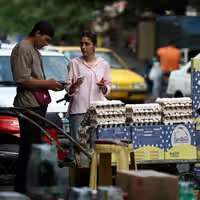
Over the past year, food prices have risen more than 66 percent on average, squeezing households and straining purchasing power.
Market participants linked the renewed spike to persistent uncertainty over economic management, limited foreign currency supply and expectations of further depreciation.
The repeated record-setting levels have sharpened concerns over purchasing power, as higher exchange rates feed directly into import costs and domestic prices across the economy.
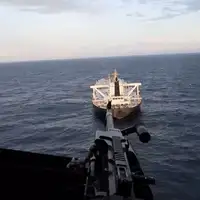
Iranian authorities have detained 18 crew members of a foreign tanker seized in the Gulf of Oman, state media reported on Saturday, saying the vessel was carrying 6 million liters of smuggled fuel.
The detainees include the ship’s captain, Iranian media said, citing the judiciary in Hormozgan province. Authorities did not identify the tanker and said an investigation was underway. The semi-official Fars news agency later reported that the crew included nationals of India, Sri Lanka and Bangladesh.
Iranian officials said the tanker was seized on Friday after committing multiple violations, including ignoring stop orders, attempting to flee, and lacking navigation and cargo documentation.
The detention follows a series of vessel seizures announced by Iranian authorities in recent weeks. In mid-November, the Islamic Revolutionary Guard Corps Navy confirmed the seizure of a Marshall Islands-flagged tanker off Iran’s Makran coast. Later in November, the Guards said they seized an Eswatini-flagged vessel in the Persian Gulf carrying about 350,000 liters of smuggled gasoil.
Iran, which maintains low domestic fuel prices through subsidies and has seen its currency weaken sharply, regularly reports interceptions of vessels accused of moving fuel illegally by sea to its Persian Gulf neighbours and by land to neighboring countries.
The Gulf of Oman and the nearby Strait of Hormuz sit along a major route for global energy shipments, where Iranian forces and international shipping have faced repeated disruptions in recent years.
The Sunni militant group Jaish al-Adl hailing from Iran's Baluch ethnic minority announced it would change its strategy toward civil disobedience under a new umbrella group gathering like-minded factions, even as it continued deadly attacks on government forces.
In a video message posted on Telegram, masked spokesman Mahmoud Baluch announced the formation of the new “Popular Fighters Front” on Wednesday which he described as a merger of several Baluch political groups and movements in the restive southeastern region of Iran.
“I am honored to tell the suffering people who long for liberation from the oppression of the rule of the Supreme Leader that the fighters of Sistan and Baluchistan, understanding the country’s critical situation and with the aim of increasing the effectiveness of the struggle” had formed the body, he said.
The announcement came after the new group claimed responsibility for an armed attack which Iranian state media said killed several members of the security forces on Wednesday.
Iran, the United States and several other countries have designated Jaish al-Adl as a terrorist organization, citing its record of bombings, ambushes, kidnappings and suicide attacks targeting the army, border guards and police.
In a written manifesto, the new group said it aims to fight poverty, injustice and discrimination by prioritizing civil action.
“We consider civil activity the natural and legal right of every citizen,” it said. “In this regard, the Popular Fighters Front is pursuing civic, media and political efforts aimed at conveying the people’s voice, raising public awareness and strengthening national cohesion in the face of discrimination and inequality.”
“Civil action must be carried out responsibly, within the law, and with full observance of personal and public security principles,” he added. It did not renounce violence.
Haalvsh, a rights group that documents abuses and unrest in Sistan-Baluchestan, said the merger includes the PADA Baloch Movement, the Nasr-e Baluchestan Movement, Jaish al-Adl, the Mohammad Rasulullah group led by Haji Vahed Bakhsh, as well as groups operating under the label of spontaneous Baloch fighters.
Jaish al-Adl (Army of Justice) emerged around 2012 as a successor to Jundullah, after Tehran's capture and execution of Jundullah’s leader Abdelmalek Rigi.
The group operates mainly in Iran’s Sistan-Baluchistan province along the border with Pakistan and says it fights for political and religious rights for Iran’s Sunni Baloch minority in the Shi'ite theocracy.
“Iran’s role in Lebanon and the region has been very negative,” Raji said. “We have a problem with Iran, but we are open to dialogue, provided it stops interfering in our internal affairs and halts funding an illegal organization in Lebanon.”
Iran has long backed Hezbollah and has rejected international and domestic calls for the group to disarm, arguing that continued Israeli actions justify its armed presence.
The diplomatic dispute followed an exchange earlier this month in which Iranian Foreign Minister Abbas Araghchi invited Raji to visit Tehran. Raji declined, citing unfavorable conditions, and suggested meeting in a third country.
Baghaei dismisses Venezuela meddling
In the same briefing, Baghaei brushed off comments attributed to Venezuelan opposition figure María Corina Machado accusing Iran of interference in Venezuela’s internal affairs. He said the claims were politically motivated and unrelated to facts on the ground.
“It is not appropriate to respond to the remarks of someone who has shown no value or attachment to her own country,” Baghaei said.
On reports of Iranian interference in Caracas, he said: “These remarks are irrelevant. Venezuela, as a sovereign country, sets its foreign relations according to its national interests, engages with partners on the basis of mutual respect, and shapes its foreign policy accordingly.”
US Secretary of State Marco Rubio this month cast Venezuela as a regional launchpad for Iranian influence, describing Maduro’s government as a narcotics transit hub that hosts Iran’s Revolutionary Guards and its Lebanese ally Hezbollah
Little public evidence exists about the security relationship Venezuela has with Iran or its armed allies. Tehran and Caracas boosted ties under Maduro's predecessor Hugo Chavez, who cast himself as a bulwark against what he called American imperialism.
Machado said on Wednesday that their influence in Venezuela amounted to an invasion while not directly addressing whether she supported stepped up US military attacks on the country to bring about Maduro's downfall.
“Venezuela has already been invaded,” she said at a news conference alongside the Norwegian Prime Minister Jonas Gahr Store on Thursday.
“We have the Russian agents, we have the Iranian agents, we have terrorist groups such as Hezbollah, Hamas, operating freely in accordance with the regime. We have the Colombian guerrillas, the drug cartels.”