Beirut delays processing credentials of new Iran envoy - Lebanese daily
Lebanon’s foreign minister Youssef Raji
Lebanon’s foreign minister has delayed processing the credentials of Iran’s newly appointed ambassador, the Lebanese pro-Hezbollah daily Al-Akhbar reported, marking the latest escalation in diplomatic tensions between the two countries.
The newspaper said Lebanon appointed Ahmad Suwaydan as its new ambassador to Iran in October, after which Tehran put forward its corresponding envoy.
However, Lebanese Foreign Minister Youssef Raji has so far refused to submit the Iranian ambassador's credentials to the cabinet, forward them to the presidency or notify Iran of Lebanon’s approval, the report said.
On Friday, Raji told Al Jazeera that Iran’s role in Lebanon and the wider region has fueled instability, while stressing that Beirut remains open to talks with Tehran if it stops supporting Hezbollah and end what he called its interference in Beirut's affairs.
“Iran’s role in Lebanon and the region has been very negative,” he said. “We have a problem with Iran, but we are open to dialogue, provided it stops interfering in our internal affairs and halts funding an illegal organization in Lebanon.”
Iran has long backed Hezbollah and has resisted international and domestic calls for the group to disarm, arguing that continued Israeli actions justify its armed presence.
Raji’s refusal to process the Iranian ambassador's credentials followed a diplomatic exchange with Iranian Foreign Minister Abbas Araghchi, who earlier this month invited his Lebanese counterpart to visit Tehran. Raji declined the invitation, citing unfavorable conditions, and proposed meeting in a neutral third country.
In response, Araghchi said he understood Lebanon’s position given ongoing Israeli actions and said he would accept an invitation to visit Beirut. He said Iran also seeks “a new chapter” in relations based on mutual respect and sovereignty.
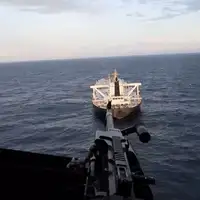
Iranian authorities have detained 18 crew members of a foreign tanker seized in the Gulf of Oman, state media reported on Saturday, saying the vessel was carrying 6 million liters of smuggled fuel.
The detainees include the ship’s captain, Iranian media said, citing the judiciary in Hormozgan province. Authorities did not identify the tanker and said an investigation was underway. The semi-official Fars news agency later reported that the crew included nationals of India, Sri Lanka and Bangladesh.
Iranian officials said the tanker was seized on Friday after committing multiple violations, including ignoring stop orders, attempting to flee, and lacking navigation and cargo documentation.
The detention follows a series of vessel seizures announced by Iranian authorities in recent weeks. In mid-November, the Islamic Revolutionary Guard Corps Navy confirmed the seizure of a Marshall Islands-flagged tanker off Iran’s Makran coast. Later in November, the Guards said they seized an Eswatini-flagged vessel in the Persian Gulf carrying about 350,000 liters of smuggled gasoil.
Iran, which maintains low domestic fuel prices through subsidies and has seen its currency weaken sharply, regularly reports interceptions of vessels accused of moving fuel illegally by sea to its Persian Gulf neighbours and by land to neighboring countries.
The Gulf of Oman and the nearby Strait of Hormuz sit along a major route for global energy shipments, where Iranian forces and international shipping have faced repeated disruptions in recent years.
The Sunni militant group Jaish al-Adl hailing from Iran's Baluch ethnic minority announced it would change its strategy toward civil disobedience under a new umbrella group gathering like-minded factions, even as it continued deadly attacks on government forces.
In a video message posted on Telegram, masked spokesman Mahmoud Baluch announced the formation of the new “Popular Fighters Front” on Wednesday which he described as a merger of several Baluch political groups and movements in the restive southeastern region of Iran.
“I am honored to tell the suffering people who long for liberation from the oppression of the rule of the Supreme Leader that the fighters of Sistan and Baluchistan, understanding the country’s critical situation and with the aim of increasing the effectiveness of the struggle” had formed the body, he said.
The announcement came after the new group claimed responsibility for an armed attack which Iranian state media said killed several members of the security forces on Wednesday.
Iran, the United States and several other countries have designated Jaish al-Adl as a terrorist organization, citing its record of bombings, ambushes, kidnappings and suicide attacks targeting the army, border guards and police.
In a written manifesto, the new group said it aims to fight poverty, injustice and discrimination by prioritizing civil action.
“We consider civil activity the natural and legal right of every citizen,” it said. “In this regard, the Popular Fighters Front is pursuing civic, media and political efforts aimed at conveying the people’s voice, raising public awareness and strengthening national cohesion in the face of discrimination and inequality.”
“Civil action must be carried out responsibly, within the law, and with full observance of personal and public security principles,” he added. It did not renounce violence.
Haalvsh, a rights group that documents abuses and unrest in Sistan-Baluchestan, said the merger includes the PADA Baloch Movement, the Nasr-e Baluchestan Movement, Jaish al-Adl, the Mohammad Rasulullah group led by Haji Vahed Bakhsh, as well as groups operating under the label of spontaneous Baloch fighters.
Jaish al-Adl (Army of Justice) emerged around 2012 as a successor to Jundullah, after Tehran's capture and execution of Jundullah’s leader Abdelmalek Rigi.
The group operates mainly in Iran’s Sistan-Baluchistan province along the border with Pakistan and says it fights for political and religious rights for Iran’s Sunni Baloch minority in the Shi'ite theocracy.
Israel will not allow Iran to restore its air defense systems, missile infrastructure or nuclear facilities after a 12-day war in June and is prepared to strike again if Tehran moves to rebuild, a former senior Israeli general told Iran International.
“Any substantial effort to restore those capabilities will be a trigger for action,” Brigadier General Amir Avivi, a former officer in the Israeli military who now serves in the reserves, told Iran International in an interview.
The United States held five rounds of negotiations with Tehran over its disputed nuclear program earlier this year, for which President Donald Trump set a 60-day ultimatum.
When no agreement was reached by the 61st day Israel launched a surprise military offensive on June 13, followed by US strikes on June 22 targeting key nuclear facilities in Isfahan, Natanz and Fordow.
Avivi said Israel's destruction of Iran's air defense capabilities which ultimately paved the way for the US bombing run was swift.
“Within two days we had opened an air corridor to Tehran and could operate almost freely over large parts of Iran,” Avivi said. “They had more than 130 air-defense systems in the west and around Tehran, and we took out roughly 84 of them very quickly.”
Three red lines
Avivi said Israel in coordination with the United States is closely tracking Iran’s efforts to repair war damage as Tehran tries to project strength while quietly restoring parts of its military infrastructure.
“We are watching them by the minute, and there are three red lines that will bring Israel to act again: rebuilding advanced air defenses that close the corridor to Tehran, resuming mass production of ballistic missiles, and any move to renew nuclear weapons work,” Avivi said.
Tehran denies seeking a nuclear weapon and says it aims only for peaceful technology. Israel and Western countries doubt its intentions.
Israeli intelligence has warned that Iran hopes to build a missile arsenal capable of overwhelming Israel's defenses, even as Tehran insists its program is defensive and conventional.
“Before the war they were aiming for around 10,000 ballistic missiles, and we are not going to sit and wait for them to return to that level or get close to a weapons‑grade nuclear capability,” Avivi said.
Scientists, sites and industry
The attacks on June 21 also struck the Islamic Revolutionary Guard Corp’s (IRGC) external arm, killing Mohammad Saeed Izadi, who oversaw Palestinian operations, and Mohammadreza Nasirbaghban, the Quds Force’s deputy for intelligence.
The strikes killed senior nuclear scientists along with hundreds of military personnel and civilians. Iranian counterattacks killed 32 Israeli civilians and an off-duty soldier.
“We didn’t only hit the nuclear sites, we hit the scientists, the weaponization experts and the industries that make explosives, fuel and components, so they cannot easily rebuild,” Avivi said.
Iranian authorities have quietly moved surviving nuclear scientists to safe houses and dispersed some sensitive work, while publicly insisting that missile and cyber units remain fully operational.
“The regime was hit very, very hard, much harder than people think, and recovering that military‑industrial base will take them a very long time,” Avivi said. “The image of Iran as a regional powerhouse was exposed as a paper tiger, and that has encouraged Europe to move toward harsher measures.”
Psychological pressure
During the June attacks, Israel also struck Tehran’s Evin prison and state television main building. Iranian officials condemned Israel's onslaught as "terrorism" and "psychological warfare".
The UN Special Rapporteur on human rights in Iran said in October that Israel likely violated international law in its military campaign in June while Tehran expanded repression after the conflict with hundreds of executions and new curbs on dissent.
When asked what was the objective of the attack on the prison which according to official tallies killed about 80 people, Avivi said it was a message to leaders in Tehran.
“We hit symbols of repression and propaganda to show that if we decide to destabilize the regime itself, not just its military capabilities, we can reach those places,” Avivi said.
“The idea was to throw the leadership off balance and make them feel existentially threatened, not just militarily exposed.”
‘Campaign between wars’
Avivi described the current period with Iran and its allies as a “campaign between wars,” in which covert operations and limited strikes are used to contain threats between major flare‑ups.
“We are moving from a short war to ongoing operations between wars, some of them kinetic and some not, including cyber and intelligence work,” he said.
Since June, Israel has continued to hit carry out air strikes on targets it says aim at Hezbollah in Lebanon and Hamas in Gaza. The strikes have killed hundreds of people according local health authorities, many of them civilians.
“We will keep degrading these groups systematically until the day comes when local governments can deal with them themselves,” Avivi said.
Next objective
Iran’s Revolutionary Guards claimed victory in the 12‑day war and threatened a tougher response if Israel strikes again in rhetoric rejected by Israel and the United States.
“In the last round we did not set regime change as a formal goal, but if this regime continues to threaten Israel’s existence, next time bringing it down could be on the table for Israel and the US,” Avivi said.
Lebanon’s foreign minister said Arab and international parties have warned Beirut that Israel is preparing a wide military operation, while accusing Iran of playing a destabilizing role in Lebanon and the wider region.
“We have received warnings from Arab and international parties that Israel is preparing for a wide military operation against Lebanon,” Foreign Minister Youssef Raji told Al Jazeera on Friday. He said Beirut was “intensifying diplomatic contacts to keep Lebanon and its facilities out of any Israeli strike.”
Raji said Hezbollah’s arsenal has failed to protect Lebanon or support Gaza, as the Lebanese state pushes to bring all weapons under national control.
“Hezbollah’s weapons have proven ineffective in supporting Gaza and defending Lebanon,” he said, adding that the government is in dialogue with the group to persuade it to hand over its arms. “But Hezbollah refuses,” he said.
Lebanon has tasked its army with extending state authority nationwide following a ceasefire with Israel that took effect in late 2024 after more than a year of cross-border fighting.
Iran ties and conditions for dialogue
Raji said Iran’s role in Lebanon and the wider region has fueled instability, while stressing that Beirut remains open to talks with Tehran under clear conditions.
“Iran’s role in Lebanon and the region has been very negative,” he said. “We have a problem with Iran, but we are open to dialogue, provided it stops interfering in our internal affairs and halts funding an illegal organization in Lebanon.”
Iran has long backed Hezbollah and has resisted international and domestic calls for the group to disarm, arguing that continued Israeli actions justify its armed presence.
Diplomatic exchange with Tehran
Raji’s remarks follow a diplomatic exchange with Iranian Foreign Minister Abbas Araghchi, who earlier this month invited his Lebanese counterpart to visit Tehran. Raji declined the invitation, citing unfavorable conditions, and proposed meeting in a neutral third country.
In response, Araghchi said he understood Lebanon’s position given ongoing Israeli actions and said he would accept an invitation to visit Beirut. He said Iran also seeks “a new chapter” in relations based on mutual respect and sovereignty.
US President Donald Trump on Thursday said Iran's nuclear program is "gonzo" after air attacks he ordered in June and that it faced "obliteration" if restarted, telling Tehran they could avoid more destruction with a nuclear deal.
His speech on Iran was his most extensive in months and indicated efforts had stalled on resuming talks after a 12-day military campaign started by Israel and joined by US forces.
"The Atomic Energy Commission said it's like 'gonzo,' one person actually used the term obliterated, but Iran actually said that they probably can never go there again," he told reporters. "They can probably never start there again. If they ever started, they'd probably choose a new site."
"They can try, but it's going to take them a long time to come back. But if they do want to come back, and they want to come back without a deal, then we're going to obliterate that one, too," Trump said.
Trump’s remarks came hours after Iran’s Supreme Leader Ali Khamenei dismissed speculations about a possible fresh round of war on Iran, calling it part of “enemy propaganda”.
“Today, beyond these military confrontations — which have existed, as you have seen, and whose likelihood is constantly being talked up, with some even deliberately fanning the flames to create anxiety, though they will not succeed, God willing — we are facing a propaganda and media confrontation,” Khamenei said.
“We are confronted with a broad front in a propaganda war; we are in a spiritual war. The enemy has realized that seizing this land, this soil, this divine and spiritual territory, is not possible through pressure or military tools.”
Trump has long said the June 22 missile and bunker-buster bomb attacks on three Iranian nuclear sites took out Iran's nuclear capabilities. Still, Tehran and Washington do not appear set on resuming two months of talks they had before the war.
Iran denies seeking a nuclear weapon but the United States and Western countries want Iran to end uranium enrichment, curb its missile power and rein it aid for armed groups in the region like Hamas and Hezbollah. Tehran has rejected the conditions.
"Their nuclear capability would have been there in about two months," he said of Iran's timeline to build a nuclear weapon before the war. "I think it looked like it was—some people say two weeks. I don't know if it's two weeks, but a very short period of time."
Iran's Supreme Leader has said dealing with Trump is beneath the dignity of the Islamic Republic and that the US approach to talks amounted to dictation.
Trump insisted on Thursday that Iran could have been spared the attacks if it came to a deal through talks, and that it must.
"Forget about the nuclear. The nuclear is gone. But look at the damage they've suffered, the death that they've suffered. They could have had a deal where nobody would have died."
"They missed that opportunity. But they would like to make a deal right now," Trump said. "Yes, please."