Cook Islands linked to tankers moving Iranian and Russian oil - AFP
Finnish tugboat Ukko sails near the Cook Islands-flagged tanker Eagle S off Porkkalanniemi, Kirkkonummi, in the Gulf of Finland, December 28, 2024, as authorities move the impounded vessel carrying Russian oil toward the inner anchorage of Svartbäck near the port of Kilpilahti.
Dozens of foreign tankers suspected of transporting sanctioned crude for Iran and Russia sailed under the Cook Islands flag in 2024-2025, according to an AFP analysis of US and UK sanctions data.
AFP reported that at least 34 ships linked to suspected sanctions evasion were Cook Islands–flagged over the period, including 20 cited on US sanctions lists and a further 14 on a British blacklist.
The flag is administered by Maritime Cook Islands, a private operator that runs the registry for the self-governing Pacific territory.
The analysis said shipowners could obtain Cook Islands papers without visiting the country, using a small beachside office – located next to a pizza shop – as their point of contact. The office serves as the headquarters for what AFP described as one of the world’s fastest-growing shipping registries.
New Zealand, which has a free-association relationship with the Cook Islands and retains responsibilities that include foreign affairs, said the findings show a policy divergence with the microstate and that Wellington has repeatedly raised concerns with its government.
“New Zealand continues to hold serious concerns about how the Cook Islands has been managing its shipping registry, which it has repeatedly expressed to the Cook Islands government over many years... This is a completely unacceptable and untenable foreign policy divergence,” said a spokesman for Foreign Minister Winston Peters.
Maritime Cook Islands said it does not harbor sanctioned vessels and that any ships accused of sanctions-busting are promptly deleted from the registry, adding that it conducts due diligence checks before registration.
Western sanctions aim to limit oil revenue for Tehran and Moscow.
Analysts say a “shadow fleet” uses reflagging, opaque ownership and ship-to-ship transfers to move cargoes outside mainstream maritime services – a practice that places added scrutiny on flag registries as enforcement widens to entities connected to suspect voyages.
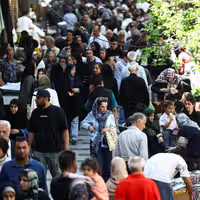
A currency exchange in Tehran, Iran, October 5, 2025.
Iran’s rial continued to weaken on Monday afternoon in a sign of flagging confidence in the country's troubled economy, with the US dollar trading at an all-time high above 1.19 million rials according to local exchange-rate websites.
The rise outstrips a previous record of 1.17 million hit on September 30 after European states moved to reimpose UN sanctions on Iran over its disputed nuclear program, further constraining its trade opportunities.
By Monday afternoon, the dollar was trading at just over 1.19 million rials, the Euro about 1.38 million and the UK Pound near 1.57 million.
Local exchange-rate websites also showed the Emami gold coin — Iran’s most traded benchmark coin used by households and investors as a store of value — hitting a fresh record above 1.26 billion rials, extending a sharp rise that began over the weekend.
The latest slide in the rial comes amid soaring inflation, renewed volatility in Iran’s unofficial markets and continued uncertainty over stalled nuclear talks with the United States.
The US dollar, which traded at about 140,000 rials in 2018, has risen roughly eight-fold since Donald Trump restored US sanctions on Iran seven years ago.
Britain, France and Germany triggered the so-called snapback mechanism to restore UN sanction under Security Council Resolution 2231, citing Iran's failure to comply with its nuclear obligations.
The move restored UN penalties previously suspended under the resolution, tightening external constraints on Iran’s economy. Tehran denies seeking a nuclear weapon and accuses the United States and European countries of economic warfare.
On Monday, local media reported that alongside fading hopes for reviving nuclear talks, rising gasoline prices have also contributed to turbulence in Iran’s currency and gold markets.
After months of debate, the government formally introduced a three-tier gasoline pricing system, with the third rate set to take effect at 50,000 rials on December 6.
South Korea’s foreign ministry said on Monday that South Korean nationals have been arrested in Iran on suspicion of smuggling, adding its embassy is in contact with Iranian authorities and providing consular assistance.
The ministry declined to confirm how many were detained or give details of their occupations or the alleged offenses.
South Korean media outlet Yonhap, citing diplomatic sources, reported that two South Koreans and an Iranian national were taken into custody around November 20 in Iran’s southwest on smuggling charges.
One of the South Koreans was described as an employee of a Korean public institution and the other a Korean resident in Iran, Yonhap said.
It added that Seoul officials have been liaising with Iran since the incident and are offering consular support.
The South Korean ministry said it could not disclose further information while the case remains under investigation by Iranian authorities.
A patient lies on a bed at Masih Daneshvari Hospital in Tehran on December 1, 2025, as unhealthy air pollution strains vulnerable groups
Iran is facing a fresh shortage of the brand-name anti-rejection drug Myfortic with pharmacies halting distribution in several cities and clinicians warning that forced switches to substitutes could endanger a minority of kidney-transplant patients.
Patients in Mashhad said rations shrank from two months to one week before stocks of the drug (mycophenolic acid 360 mg) “fell to zero,” with pharmacists advising a move to domestically made equivalents, the ILNA news agency reported.
Fatemeh Pour-Rezagholi, secretary of Iran’s Kidney Transplant Scientific Association, said originator-brand supplies have not been distributed recently, citing foreign-exchange constraints, sanctions-related frictions and customs delays.
She added that Iranian versions are available and effective for most patients, but unplanned brand changes can be stressful or risky for those early post-transplant or with prior rejection. Importers have indicated the original brand may return later in winter, according to ILNA.
Doctors and pharmacists told ILNA that 70-80% of recipients tolerate domestic formulations, but roughly 10-20% may require a specific brand or closer therapeutic-drug monitoring.
Patient groups and clinicians are urging clearer import timetables, steadier FX allocation for critical transplant drugs and contingency guidance to minimize unplanned switches.
Clinicians say the fiscal and human costs are far higher if grafts fail and patients return to dialysis, and have asked regulators to protect a baseline of imports for high-risk cases while stabilizing domestic supply for the majority.
US sanctions policy formally exempts most medicines and many medical devices, with humanitarian channels – such as Switzerland’s state-backed payment mechanism – designed to process vetted transactions.
In practice, suppliers and aid groups say persistent “over-compliance” by global banks, shippers and insurers fearful of sanctions risk, which can delay or block payments, shipments and insurance even for lawful medical goods.
Economists also point to the rial’s volatility and domestic pricing and procurement rules as recurring hurdles that raise import costs and complicate supply planning.
According to Mehr News on Monday, Iran has raised medicine prices several times in recent months under a “realistic pricing” policy meant to support the domestic pharmaceutical industry, but insurance coverage has not kept pace – leaving patients to shoulder a growing share of drug costs as reimbursements lag behind the hikes.
A man walks past a mural with the colors of the Venezuelan flag, after US President Donald Trump said that the airspace above and around Venezuela would be completely closed, amid rising tensions between the Trump administration and the government of Venezuelan President Nicolas Maduro, in Caracas, Venezuela, November 29, 2025.
Iran’s foreign ministry accused the United States of endangering international peace at its weekly briefing on Monday, responding to Washington’s latest warnings against Venezuela.
“The United States has turned into the biggest threat to international peace and security with the conduct it has displayed in recent years,” Foreign ministry spokesman Esmail Baghaei said.
He said Washington had used coercive pressure across the Western Hemisphere – citing Venezuela, Cuba, Nicaragua, Brazil and Mexico – and called the proposed airspace closure “an unprecedented act that violates international law, especially aviation safety norms.”
Baghaei said such measures should be scrutinized by the UN Security Council as “clear violations of the UN Charter’s prohibition on the use or threat of force.”
His comments followed confirmation by Trump on Sunday that he had spoken by phone with Venezuelan President Nicolás Maduro.
Washington’s confrontation with Caracas has escalated as US officials accuse figures around Maduro of involvement in narcotics trafficking through the so-called Cartel de los Soles.
The US has increased maritime and air patrols in the Caribbean and carried out interdictions of suspected smuggling vessels. Caracas has denounced the operations as unlawful aggression.
Over the weekend, Trump said Venezuela’s surrounding airspace should be considered “closed in its entirety,” a declaration that heightened uncertainty in Caracas as pressure on Maduro intensifies.
Asked whether the comment implied imminent military action, Trump said, “Don’t read anything into it.”
Saudi deputy foreign minister visits Tehran
Baghaei also addressed the visit of Saudi Arabia’s deputy foreign minister, saying the trip extended a two-year process of rebuilding bilateral relations.
He said discussions covered both Iran-Saudi ties and shared regional concerns, including the situations in Lebanon and Syria.
Iran's Foreign Ministry Spokesman Esmail Baghaei
“This is a process both countries are determined to continue in order to strengthen trust and understanding among regional states,” Baghaei said.
Contacts with Europe
Foreign Minister Abbas Araghchi’s recent visit to France, Baghaei said, was held at the invitation of his French counterpart to discuss bilateral and international matters.
The nuclear file, he said, was among the topics raised but not the sole focus.
A separate call between Araghchi and EU foreign policy chief Kaja Kallas had been arranged earlier, he added, though the Paris trip was also discussed during their conversation.
Iran’s nuclear case remains at an impasse as tensions persist between Iran and Western powers led by the United States over uranium enrichment and international inspections. The International Atomic Energy Agency continues to warn about reduced monitoring access.
Iran’s engagement with European officials, he said, remained “ongoing and structured,” with diplomacy aimed at clarifying positions rather than opening new channels.
Turkey's Foreign Minister Hakan Fidan (L) and Iran's Foreign Minister Abbas Araghchi hold a joint press conference in Tehran on November 30, 2025.
Iran and Turkey have agreed to start building a new joint rail line that will serve as a strategic trade corridor between Asia and Europe, Iranian foreign minister Abbas Araghchi said Sunday.
The Marand–Cheshmeh Soraya transit line, which will run toward Turkey’s Aralik border region, will span about 200 kilometres and cost roughly $1.6 billion.
Iranian authorities say construction is expected to take three to four years to complete.
Speaking in Tehran alongside his Turkish counterpart Hakan Fidan, Araghchi said the two sides had agreed in their meeting “to begin work, on a priority basis, to connect the two countries’ railway lines at the border.”
Earlier this month, Iran’s transport minister Farzaneh Sadegh said the project would transform the southern section of the historic Silk Road into an “all-rail corridor ensuring the continuity of the network between China and Europe”.
She said it would enable “fast and cheap transport of all types of cargo with minimal stops”.
The ancient Silk Road linked East Asia to the Middle East and Europe for centuries before declining with the rise of maritime trade routes.
China launched its Belt and Road Initiative in 2013, seeking to revive those connections through major maritime, road and rail projects. Despite close political relations with China, Iran has been largely left out of the initiative’s major investments.
Iran has sought to expand infrastructure and trade ties with neighbouring states as it works to revive its strained economy.