Iranian President Masoud Pezeshkian said on Tuesday that Tehran would not yield to foreign pressure despite sanctions and economic difficulties, pledging to “stand for Iran until the last breath.”
“Now the world is pressuring us to surrender, but surrender is not in our nature,” Pezeshkian told a ceremony honoring Iran’s freestyle and Greco-Roman wrestling champions. “Although we are in difficult conditions, we are taking steps such as improving relations with our neighbors.”
He said Iranian athletes’ victories at the world championships in Croatia had lifted national morale and should inspire broader determination. “With the determination and passion you showed, we must move forward toward success in all areas,” he added.
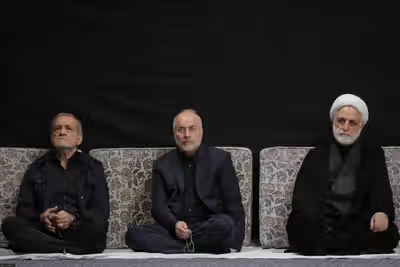
Mohsen Rezai, a former commander of Iran’s Revolutionary Guards, said on Tuesday that speculation about whether war will break out is misplaced because “the war is already ongoing,” describing Iran as engaged in an “unjust economic, propaganda and media war.”
Rezai, now a senior member of the Expediency Council, told state media that for two decades regional neighbors had been led to believe an Iranian attack was imminent, fueling “Iranophobia.”
He said the true goal of Iran’s adversaries was to obstruct the country’s political, scientific, economic and military progress.
“Our country today is under attack by the most ruthless enemies in history … who respect no international rules and even shed the blood of children,” Rezai said.
He added that US and Israeli actions in past conflicts had failed against Iranian resistance, and that Iranians would continue to defend themselves “until the last breath.”

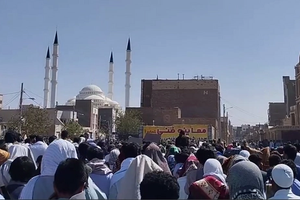
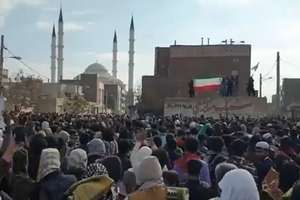
Armored and military vehicles were deployed across Zahedan and other cities in Iran’s Sistan-Baluchistan province on Tuesday as authorities tightened security for the third anniversary of the September 30, 2022 Bloody Friday killings, local outlet Haalvsh and residents said.
Haalvsh reported a heavy security presence from early morning, with forces stationed at key intersections to deter gatherings marking the 2022 crackdown, when security units opened fire around Zahedan’s Grand Mosalla and the Makki Mosque after Friday prayers.
Rights groups say at least 66 people were killed that day, with later tallies from Baluch activists and Iran Human Rights putting the toll at about 96–107 and more than 300 wounded.
Human Rights Watch documented unlawful lethal force in a December 22, 2022 report, and Amnesty International and other monitors have cited shots to the head, neck and torso.
A year later in 2023, protesters clashed with security forces in Zahedan on the anniversary, with rights groups reporting injuries and internet disruptions while authorities said the city was calm, Reuters reported then.


In September 2024, Iran's top Sunni cleric Mowlavi Abdolhamid publicly criticized Supreme Leader Ali Khamenei over the lack of accountability.
According to a report by the Center for Human Rights in Iran to mark the third anniversary, a trial of state perpetrators ended with light sentences for a handful of low-level officers and no punishment for senior commanders, calling it evidence of impunity and alleging families were pressured into silence.
Authorities have previously blamed “terrorists” and rioters for the 2022 bloodshed and said force was used to restore order, with provincial officials denying excessive force.
Iran’s judiciary spokesman said the reactivation of UN sanctions would have limited effect, while authorities pursue legal claims tied to a recent 12-day conflict.
“The effect of the snapback mechanism is neither such that we can say it has no effect, nor such that we can say the world will end because of its implementation, no,” Asghar Jahangir told reporters, calling the move by three European states illegal and largely psychological.
He said Iran is documenting damage and filing cases domestically and internationally over the 12-day war.

A senior Iranian lawmaker dismissed the reimposition of United Nations sanctions under the snapback mechanism as illegal and largely symbolic, saying it would not bring new pressure on Tehran.
Alireza Salimi, a member of parliament’s presiding board, told local media the move was aimed at creating “psychological pressure” on Iran but would have only a short-term impact.
“In practice, nothing new has happened, since the same sanctions already existed,” he said, adding that Western powers had violated the 2015 nuclear deal from the outset and sought to limit Iran’s missile and nuclear capabilities.
A senior Iranian lawmaker said the activation of the UN sanctions snapback mechanism by the United States and Europe was intended to foment unrest inside Iran.
Ahmad Rastineh, spokesman for parliament’s cultural committee, said on Tuesday that European powers were acting as “obedient servants” of Washington.
He urged the government to formally end nuclear talks, halt cooperation with the UN nuclear watchdog and repeated that the Islamic Republic seeks the “elimination” of Israel.